












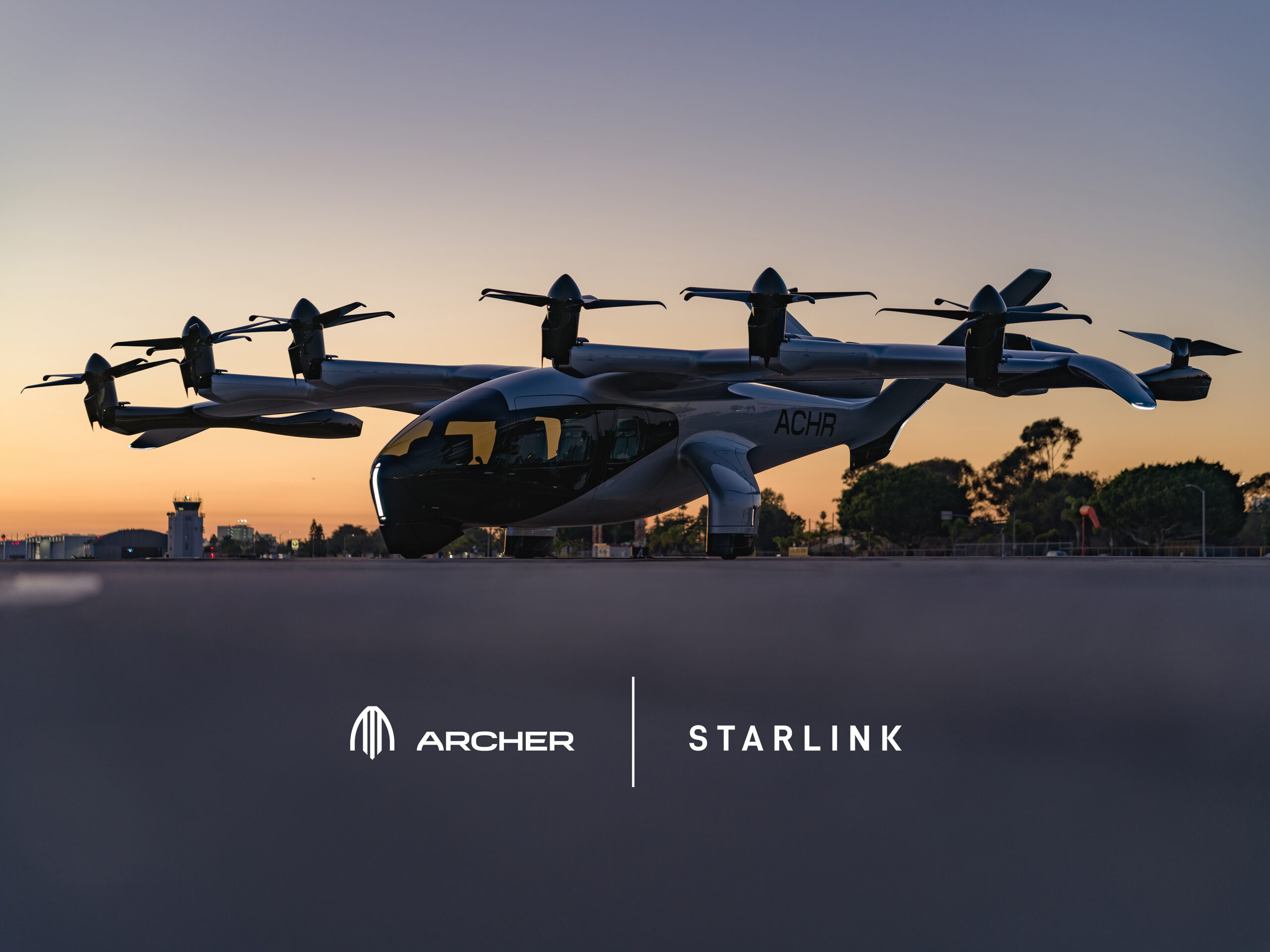


Powered-lift aircraft, such as electric vertical takeoff and landing (eVTOL) air taxis, are the FAA’s first new category of aircraft since helicopters were introduced in the 1940s. At least some of those state-of-the-art aircraft could have state-of-the-art internet.
Archer Aviation on Friday revealed plans to integrate and test SpaceX’s Starlink internet service on its flagship Midnight. The company envisions providing high-speed connectivity for the air taxi’s four passengers as they make short hops between airports, downtown areas, and event venues in cities such as New York, Miami, and Los Angeles.

Archer said Starlink, which is built to provide internet even in dense urban areas and locations with minimal cell service, is “uniquely suited” to air taxi operations over cities at about 1,500 feet agl. The integration would mark Starlink’s first on an eVTOL air taxi.
Passengers won’t be the only ones using the service. Archer said Starlink will be part of its “air taxi connectivity architecture,” handling communications between Midnight, its pilots, and engineers on the ground.
“Connectivity is a must-have feature for Midnight. Starlink is uniquely built to deliver it,” said Adam Goldstein, founder and CEO of Archer. “This industry-first collaboration will enable seamless, high-speed connectivity and essential amenities for our passengers and pilots.”
Starlink’s Spread
Starlink comprises a constellation of nearly 10,000 satellites—and growing—that orbit the Earth at about 550 kilometers. That’s far lower than geostationary internet satellites, which shortens the distance the data needs to travel and enables speeds comparable to ground-based broadband services.
Passengers on Starlink-equipped aircraft can stream video, make phone calls, play online games, and more, even during taxi, takeoff, and landing. A flat, electronically steered antenna on the aircraft automatically tracks multiple satellites at once, handing off between them as the plane moves. A supplemental type certificate (STC) is required for installation on each airframe.
Regional charter provider JSX was the first carrier to equip its aircraft with Starlink back in 2023. Business Insider in January reported that 30 others have announced deals to outfit their fleets. That includes United Airlines, which plans to add the service to its entire fleet and in October completed its first Starlink-equipped mainland flight using a Boeing 737-800.
Southwest in February became the latest Starlink airline customer, announcing plans to install the service on more than 300 aircraft by year’s end, with the first to enter commercial service this summer. Others include Lufthansa, Alaska Airlines, British Airways, and Emirates, as well as the flag carriers of France, Spain, Italy, Japan, Korea, and many more.
The system can be installed on a wide variety of aircraft with STCs, including airframes from Boeing, Airbus, Embraer, Textron Aviation, Gulfstream, and Bombardier. Starlink is working on additional STCs for the Boeing 767, Airbus A380, Dassault Falcon 10X, Pilatus PC-12, and more in 2026.
Archer’s Midnight could be the next added to that list.
Not Just Wi-Fi
Archer sees other applications for Starlink beyond improving the experience of Midnight passengers and pilots.
The company said it will work with Starlink to develop a “connectivity solution” that could help it build future autonomous variants. Though Midnight will be piloted at launch, Archer plans to transition to uncrewed operations later, with Boeing air taxi unit Wisk Aero serving as its exclusive autonomy provider. Boeing in 2023 made an investment to fund the integration of Wisk’s technology on Midnight.
The firm is also working with autonomous systems developer Anduril on a hybrid-electric defense variant and will supply its electric powertrain for Anduril’s autonomous Omen concept.
In January, Archer revealed that it will integrate Nvidia’s IGX Thor AI computing module into “future iterations of its aircraft programs.” Thor is designed for quick and accurate onboard computing for autonomous decision-making, advanced perception, and predictive operations. The companies also plan to develop new AI systems for autonomous operations, airspace integration, and pilot safety.
Archer intends to use Hawthorne Municipal Airport (KHHR)—which it acquired for $126 million in November—as a testbed for its AI technologies. Hawthorne is the planned operational hub of the firm’s Los Angeles network, which could ferry athletes and spectators between venues at the 2028 Summer Olympic Games.
Archer has additional partnerships with the organizers of the 2026 FIFA World Cup and Super Bowl LXI in 2027, which will also take place in Los Angeles, though Midnight is not expected to fly passengers at those events.

