














Flying Car to Begin Testing at California Airports

Alef Aeronautics says two airports have agreed to host testing of its prototype Model Zero.

Alef flying car airport flight testing
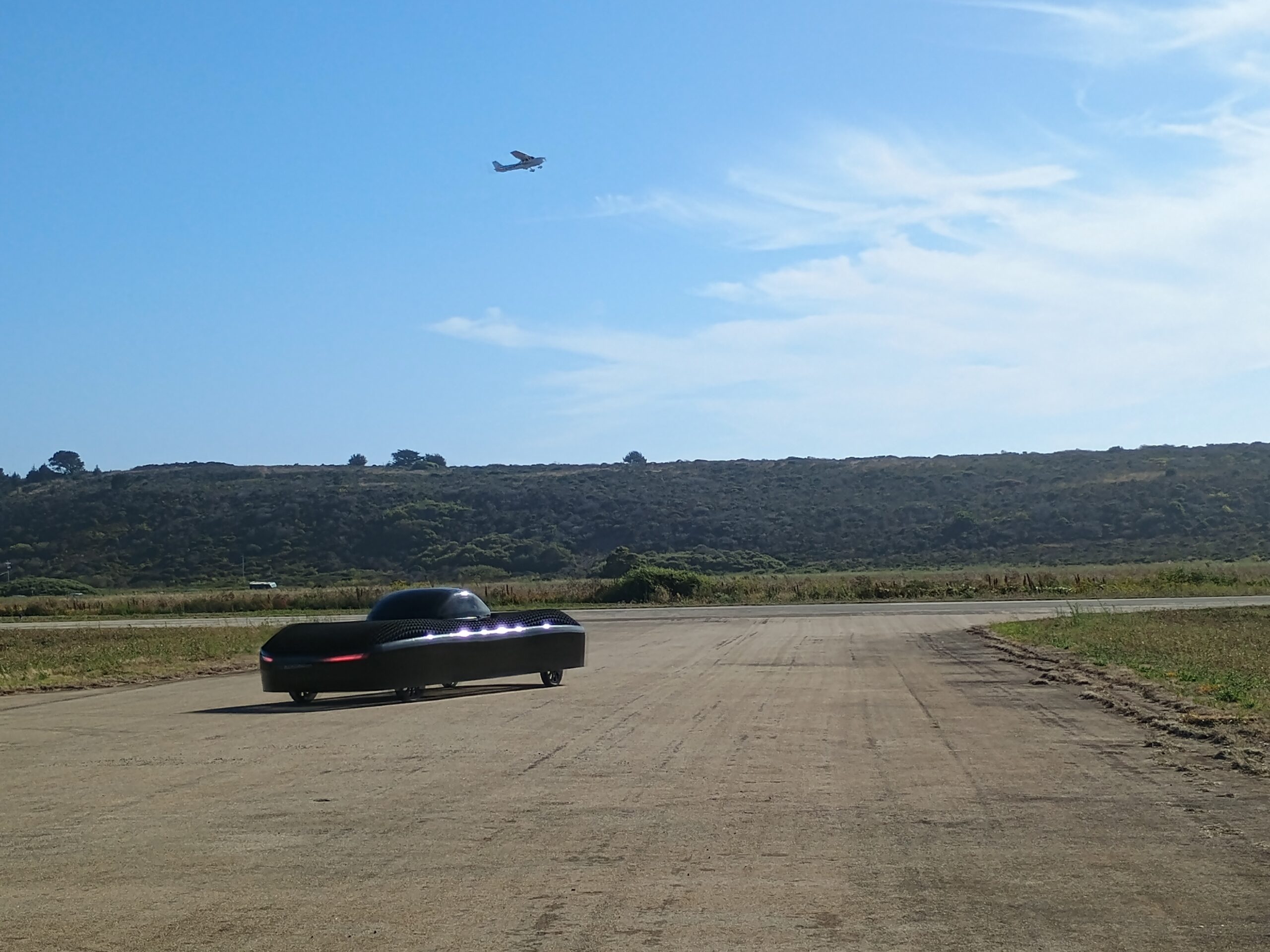
Alef’s Model Zero flying car arrives at Half Moon Bay Airport (KHAF) for flight testing. [Courtesy: Alef Aeronautics]
Gemini Sparkle

Key Takeaways:

  • Alef Aeronautics is commencing flight testing for its Model A "flying car" (roadable eVTOL) at Half Moon Bay and Hollister Municipal airports in California.
  • The Model A features unique vertical takeoff and landing (VTOL) capabilities and a design that rotates 90 degrees for flight, aiming to integrate automotive and aviation infrastructure.
  • Initial tests will demonstrate driving, flying, and VTOL maneuvers, with the company anticipating new FAA regulations (MOSAIC) will streamline certification for the $300,000 vehicle.
See a mistake? Contact us.

A true flying car in the Jetsonian sense of the term—one capable of driving alongside other cars or lifting off directly from the road to fly over traffic jams—is set to begin testing at two California airports.

Alef Aeronautics, developer of the roadable, electric vertical takeoff and landing (eVTOL) Model A, on Tuesday said it signed flight testing agreements with Half Moon Bay (KHAF) and Hollister Municipal (KCVH) airports. The company in 2023 received an experimental category special airworthiness certification that allowed it to take its prototype Model Zero out for drive-and-fly testing on the streets of California.


Alef said the testing will begin with an ultralight variant of the Model Zero, later moving to the original prototype and commercial Model A. It plans to sell the latter for $300,000 and says it has received more than 3,300 preorders through its website. The company is backed by angel investor Tim Draper, an early investor in Tesla and SpaceX.

“Alef first and foremost is a car, using the automotive infrastructure, automotive business model, and automotive market,” Jim Dukhovny, CEO of Alef, said in a statement. “The novelty is integrating a car into the aviation infrastructure and air traffic. Working in safe, controlled, nontowered airport environments will help Alef, FAA, airport operators, and pilots see how this will work in the future at scale.”

Alef’s Flying Car

The California-based startup is developing a vehicle unlike anything else on the market. A few other developers, such as Samson Sky and Aska, are building winged designs that are also billed as flying cars. But they lack the vertical takeoff and landing (VTOL) capability that enables Alef’s architecture to lift off directly from the street.

The Model A will accommodate a driver-pilot plus one passenger, with a driving range of about 200 statute miles (sm), per Dukhovny. The airframe is similar to a car’s, but its opaque top and bottom are replaced with meshing. This allows the aircraft’s eight propellers—arranged within the vehicle around the driver’s seat—to generate airflow for vertical lift.

Once in the air, the vehicle is designed to rotate 90 degrees so that its sides become upper and lower wings. The driver’s seat—now a cockpit—gyrates forward to face what used to be the roof in car configuration. In this biplane mode, it is expected to have a range of about 110 sm.

The Model Zero ultralight weighs about 250 pounds, measuring about 17 feet long by 7 feet wide. Its distributed electric propulsion system comprises eight redundant sets of motors and propellers, with four additional engines located inside the wheels.

The model can be flown with or without an onboard pilot—a remote pilot in command (PIC) monitors all flights and can step in as needed. A kill switch, for example, immediately cuts all propulsion. The remote ground station, located inside a van, receives real-time telemetry such as battery level, temperature, and vibration.

Safety features include a backup glider system—which could soon be complemented by a full-aircraft parachute—and an automated system that tells the aircraft to fly home if communications are lost.

Flight Plan

Prototype flight tests at the two airports—which Alef said could serve as future bases for Model A fleets—will attempt to mirror common air traffic patterns.

The Model Zero will demonstrate driving, flying, maneuvering, and VTOL. Alef will give crewed aircraft right of way and alert them to test operations. Artificial intelligence-based obstacle recognition will be deployed to help it detect traffic, which visual observers will also monitor directly.

The company shared little about the planned campaign, but details of its proposal are available in the agenda for an August 13 meeting of the Hollister Airport Advisory Commission.

Per the meeting notes, Alef contacted the airport in May and met with representatives to tour the facility later that month. It developed a concept of operations (ConOps) for the testing and gave a presentation to the commission, public, pilots, and airport tenants.

Alef proposed two initial test areas—the West end of the airport’s Taxiway C, near a set of hangars, and a vacant tie-down area at the north end of the aircraft parking ramp. The former would be used mainly for media and investor demonstrations and only when there are no aircraft present. The latter would be the main test site, hosting operations about once every two weeks. The aircraft would not enter taxiways or runways.

Initial flight testing will consist of a vertical takeoff to 50 feet, forward flight less than 200 feet, and vertical landing. Later, though, Alef proposed to drive on the tarmac, take off, and transition to biplane mode for a half loop around the airport. These tests would require a 15-minute preflight inspection and five-minute warmup and reinspection. The aircraft would fly no faster than 75 knots.

For each flight, Alef said it will brief the crew, confirm there is no rain or wind faster than 15 knots, and conduct a preflight site visit to ensure the runway is clear of obstacles. Crews would comprise at least one pilot or PIC and two visual observers responsible for monitoring the airport’s common traffic advisory frequency. Personnel would inform air traffic control when and where tests are taking place.

Alef said the airport agreements give it five test flight locations, which should provide a boost as the company works toward certification. The Model A will need to meet safety standards for both automobiles and aircraft, complicating the process. For example, Dukhovny’s plan to initially certify the model as a low-speed vehicle would cap its speed at 25 mph on public roads. Early VTOL certification efforts, meanwhile, have been arduous.

However, the final Modernization of Special Airworthiness Certification (MOSAIC) rule opens a path to certify the Model A as a light sport aircraft. The updated rule removes weight and powerplant restrictions for LSA models, opening the category to a variety of new designs.

Dukhovny in a LinkedIn post said the Model A qualifies under the provision, eliminating the need for type or production certification. It would also allow the vehicle to fly with passengers, at night, and—with special permissions—over San Francisco, he said.

“I think this is too good to be true (there are probably more sober restrictions in there, and this will not be fast), but this might be HUGE for Alef!” Dukhovny wrote.

The Alef CEO also expressed optimism about the eVTOL integration pilot program (eIPP) created by President Donald Trump’s June executive order. The eIPP is proposed as a three-year effort to study the safe integration of VTOL models.

Like this story? We think you’ll also like the Future of FLYING newsletter sent every Thursday afternoon. Sign up now.

Jack Daleo

Jack is a staff writer covering advanced air mobility, including everything from drones to unmanned aircraft systems to space travel—and a whole lot more. He spent close to two years reporting on drone delivery for FreightWaves, covering the biggest news and developments in the space and connecting with industry executives and experts. Jack is also a basketball aficionado, a frequent traveler and a lover of all things logistics.

Ready to Sell Your Aircraft?

List your airplane on AircraftForSale.com and reach qualified buyers.

List Your Aircraft
AircraftForSale Logo | FLYING Logo
Pilot in aircraft
Sign-up for newsletters & special offers!

Get the latest stories & special offers delivered directly to your inbox.

SUBSCRIBE
