













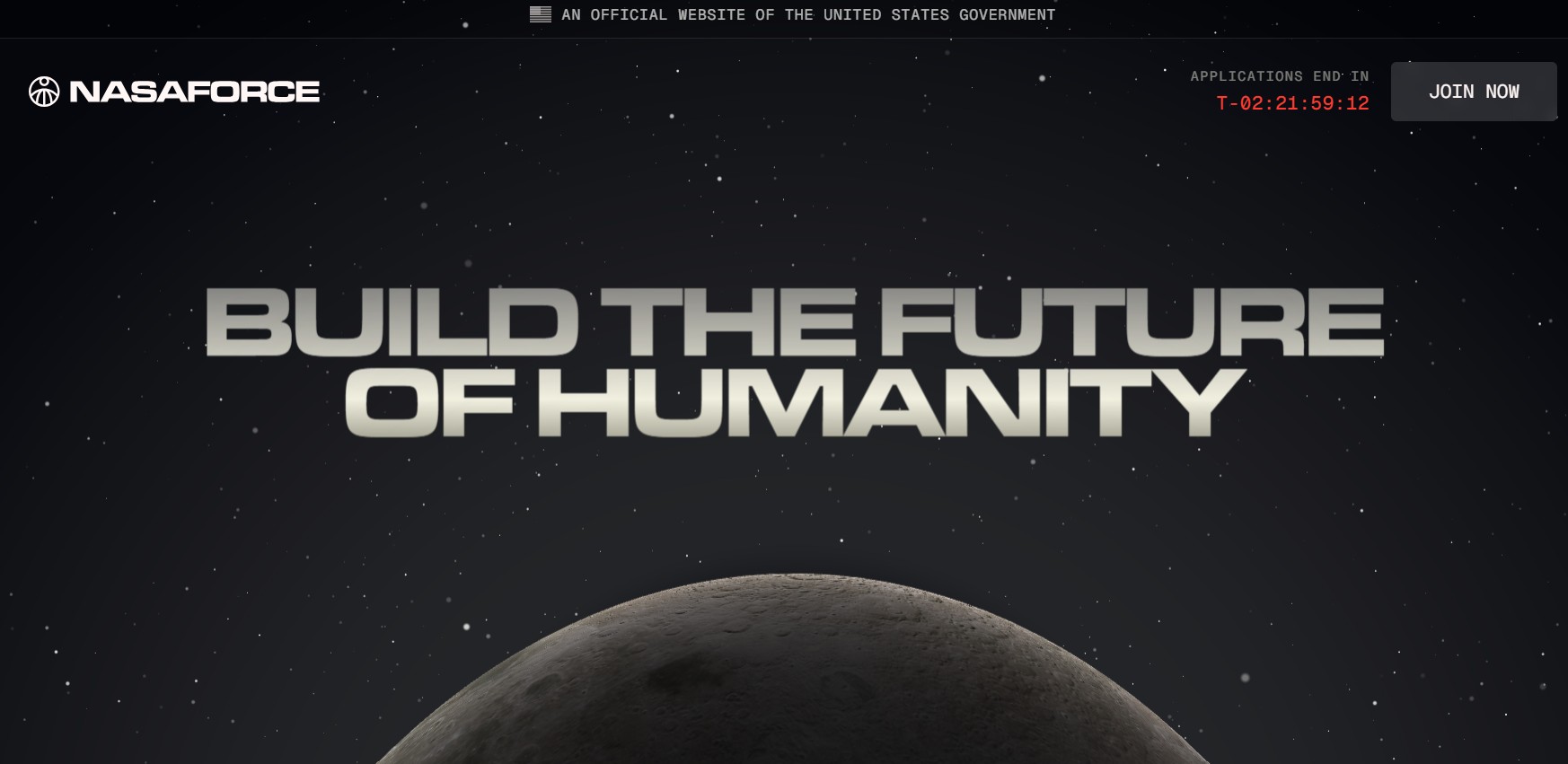


NASA Force Applications Open

The first applications launched Friday for two-year aerospace engineer positions.

NASA Force website
NASA Force gives private sector employees the chance to work on projects tied to the Artemis moon mission campaign. [Credit: NASA]
Gemini Sparkle

Key Takeaways:

  • NASA has launched "NASA Force," an initiative recruiting U.S. private sector aerospace employees for 1-2 year "mission-critical" roles on projects like the Artemis moon mission.
  • The program aims to inject private sector talent, provide mentorship, and rebuild core competencies within NASA's workforce following significant employee departures and budget cuts.
  • NASA Force is considered essential for the agency's ambitious goals, including achieving semiannual crewed lunar landings by 2028 and establishing a permanent moon base.
  • The initial application window for aerospace engineer positions is extremely limited, and the program also allows NASA personnel to work in the private sector, with safeguards against conflicts of interest.
See a mistake? Contact us.

U.S. private sector employees can now apply to work on some of NASA’s most complex projects.

NASA on Friday launched the official website and application portal for NASA Force—a workforce initiative that will recruit the best and brightest aerospace employees for one-to-two-year “mission-critical” roles at the space agency. Per the website, selected personnel “for a few days” will have access to projects under NASA’s Artemis moon mission campaign, including the Orion crew capsule, Space Launch System (SLS) rocket propulsion system, and lunar rovers and landers.


Orion and SLS earlier this month flew the successful Artemis II mission, sending four astronauts around the moon and farther from Earth than humans have ever ventured. By 2028, NASA hopes to achieve semiannual crewed lunar landings as it looks to build a permanent, $30 billion moon base. Officials have implied that NASA Force will be essential to the effort as a force multiplier.

The first applications under NASA Force are for two-year aerospace engineer positions, with the potential for extensions. The four-day application window closes on Monday. According to the website, spots are “extremely limited.”

Why We Need a NASA Force

NASA Administrator Jared Isaacman announced NASA Force in March, saying the injection of private sector talent will “provide mentorship and training and help season and rebuild the core competencies within the NASA workforce.”

More than 4,000 employees departed the space agency in 2025, most due to deferred resignation and early retirement programs implemented by the White House. More cuts could be on the horizon, with the White House requesting just $18.8 billion for NASA’s fiscal year 2027 budget—a 23 percent decline from 2026 funding levels.

However, NASA Force is a collaboration between the space agency and the Office of Personnel Management (OPM), signalling that the White House understands the need to bolster NASA’s ranks.

“NASA Force is about making sure the agency has access to the next generation of innovation and strong partnerships with private sector talent to drive its very ambitious agenda,” said OPM director Scott Kupor.

NASA will also be able to assign its own personnel to terms at private sector employers. No more than 2 percent of the space agency’s civil workforce would be allowed to participate at a time.

To prevent conflicts of interest, a contract between NASA, the private sector company, and the employee would prohibit temporary personnel from accessing information that could benefit their employer. They would be barred from “inherently governmental” work. Private employers would also remain on the hook for pay and benefits.

“We have international partners, we have commercial industry, like many of those in this room,” Isaacman said earlier this month. “But we also require the scientific, the software development, the engineering, technical, and operational talent to execute on the mission.”

With Artemis II in the books, NASA is preparing for the Artemis III mission in 2027. That will be a low-Earth orbit test flight comprising Orion, SLS, and one or both human landing system (HLS) vehicles being developed by Blue Origin and SpaceX.

Artemis IV in early 2028 is targeted as humanity’s first lunar landing since the Apollo era more than half a century ago.

Jack Daleo

Jack is a staff writer covering advanced air mobility, including everything from drones to unmanned aircraft systems to space travel—and a whole lot more. He spent close to two years reporting on drone delivery for FreightWaves, covering the biggest news and developments in the space and connecting with industry executives and experts. Jack is also a basketball aficionado, a frequent traveler and a lover of all things logistics.

Ready to Sell Your Aircraft?

List your airplane on AircraftForSale.com and reach qualified buyers.

List Your Aircraft
AircraftForSale Logo | FLYING Logo
Pilot in aircraft
Sign-up for newsletters & special offers!

Get the latest stories & special offers delivered directly to your inbox.

SUBSCRIBE
