












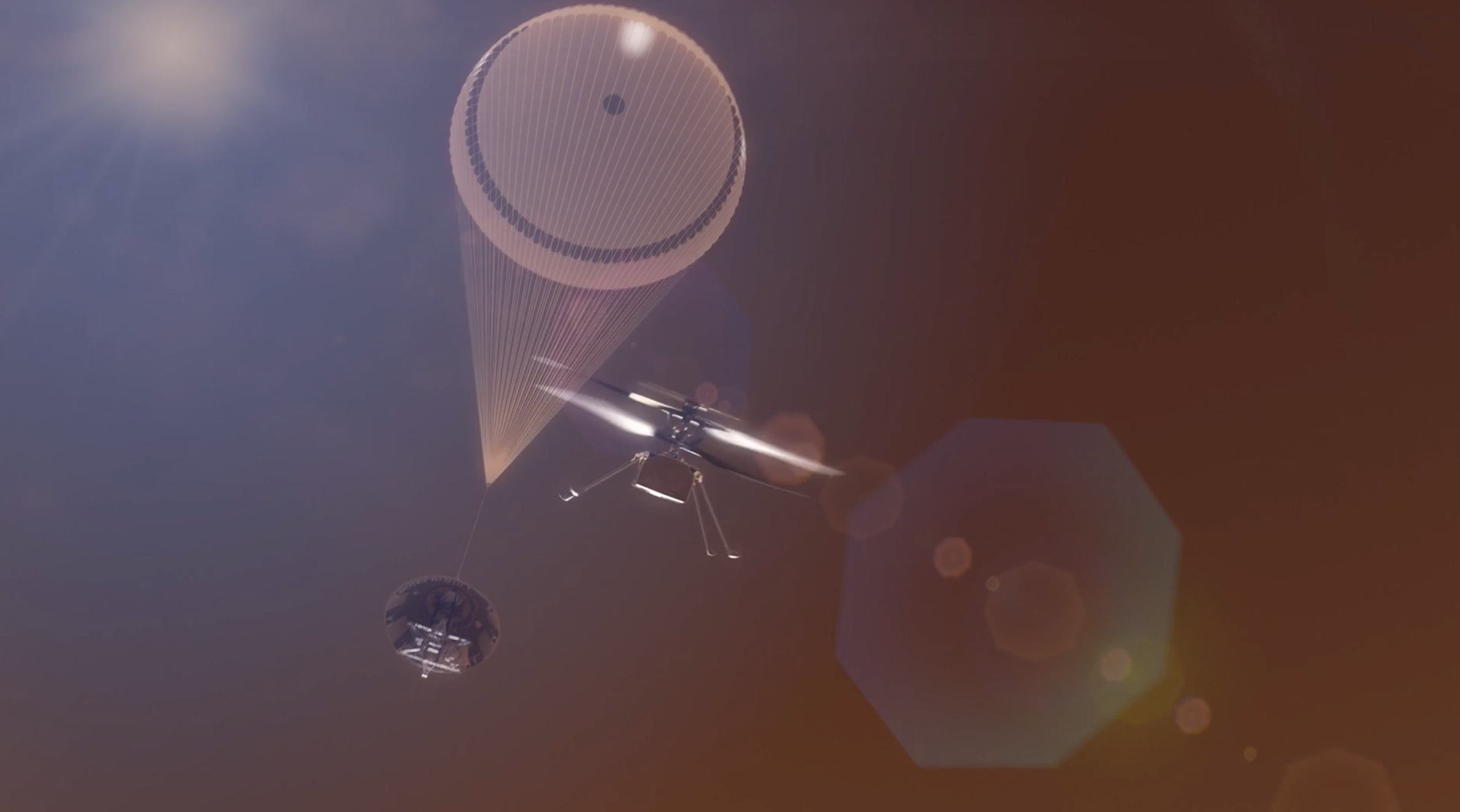


AeroVironment’s aptly named Skyfall is like something out of a James Bond movie.
The aerospace technology firm on Thursday unveiled the concept, which it described as a system for potential future helicopter missions on Mars. Codeveloped with engineers at NASA’s Jet Propulsion Laboratory (JPL), Skyfall could deploy a small fleet of self-flying rotorcraft to the Red Planet by 2028, AeroVironment said.

The company, which rebranded to AV in May, has already begun “internal investment” and coordination with JPL to hit that target, it said.
“Skyfall offers a revolutionary new approach to Mars exploration that is faster and more affordable than anything that’s come before it,” said William Pomerantz, head of space ventures at AeroVironment.
The next-generation Mars helicopters could be used to scour the Martian interior for areas containing water or other resources—or even select sites for future astronaut missions.
AeroVironment and JPL previously collaborated on NASA’s historic Ingenuity—the first aircraft to fly under its own power on another planet. The space agency’s Perseverance rover deposited Ingenuity on Mars in 2021 for what was intended to be a one-month series of demonstrations.
But the rotorcraft vastly exceeded expectations. Ingenuity had an intended range of 980 feet, altitude of 15 feet, and lifespan of just a few weeks. Over nearly three years, though, it covered almost 11 miles—about 30 times more ground than planned—across 72 missions. It flew 2,000 feet on one flight and reached about 79 feet in altitude on another.
The rotorcraft spanned about 4 feet from blade tip to blade tip and was lightweight, allowing it to fly in Mars’ thin atmosphere—the equivalent of flying about 22 miles above the Earth.
Ingenuity’s final flight in January grounded the helicopter for good. But it continues to beam data back to Earth, including avionics data that could help engineers develop its successor. JPL plans to transfer certain Ingenuity components, including avionics, flight software, and modeling techniques, for AeroVironment’s use.
Skyfall is intended to build on Ingenuity’s success. The concept comprises six scout helicopters that deploy from a mothership after entering the Martian atmosphere, descending under their own power. AeroVironment calls this the “Skyfall maneuver”—a first-of-its-kind approach that it contends will eliminate the need for a dedicated landing platform, which adds cost and complexity.
Each helicopter would operate independently, collecting subsurface radar data and beaming it back to Earth. The idea is to enable safe future landings in areas with high concentrations of water, ice, or other resources hidden below the surface. The data could help NASA determine where to send the first Mars astronauts, or even unearth evidence of past life on the planet, AeroVironment said.
“With six helicopters, Skyfall offers a low-cost solution that multiplies the range we would cover, the data we would collect, and the scientific research we would conduct—making humanity’s first footprints on Mars meaningfully closer,” said Pomerantz.
While NASA has not yet announced any funding for Skyfall, JPL in 2023 enlisted AeroVironment to design a pair of Mars sample recovery helicopters under a $10 million contract. The rotorcraft—also built off of Ingenuity’s design—are intended as a secondary retrieval method for NASA’s Mars Sample Return mission, which has faced cost and schedule difficulties.
If all goes to plan, the partners will fly Skyfall on Mars before those samples are finally returned, which NASA hopes will happen in the 2030s.
Like this story? We think you’ll also like the Future of FLYING newsletter sent every Thursday afternoon. Sign up now.

