











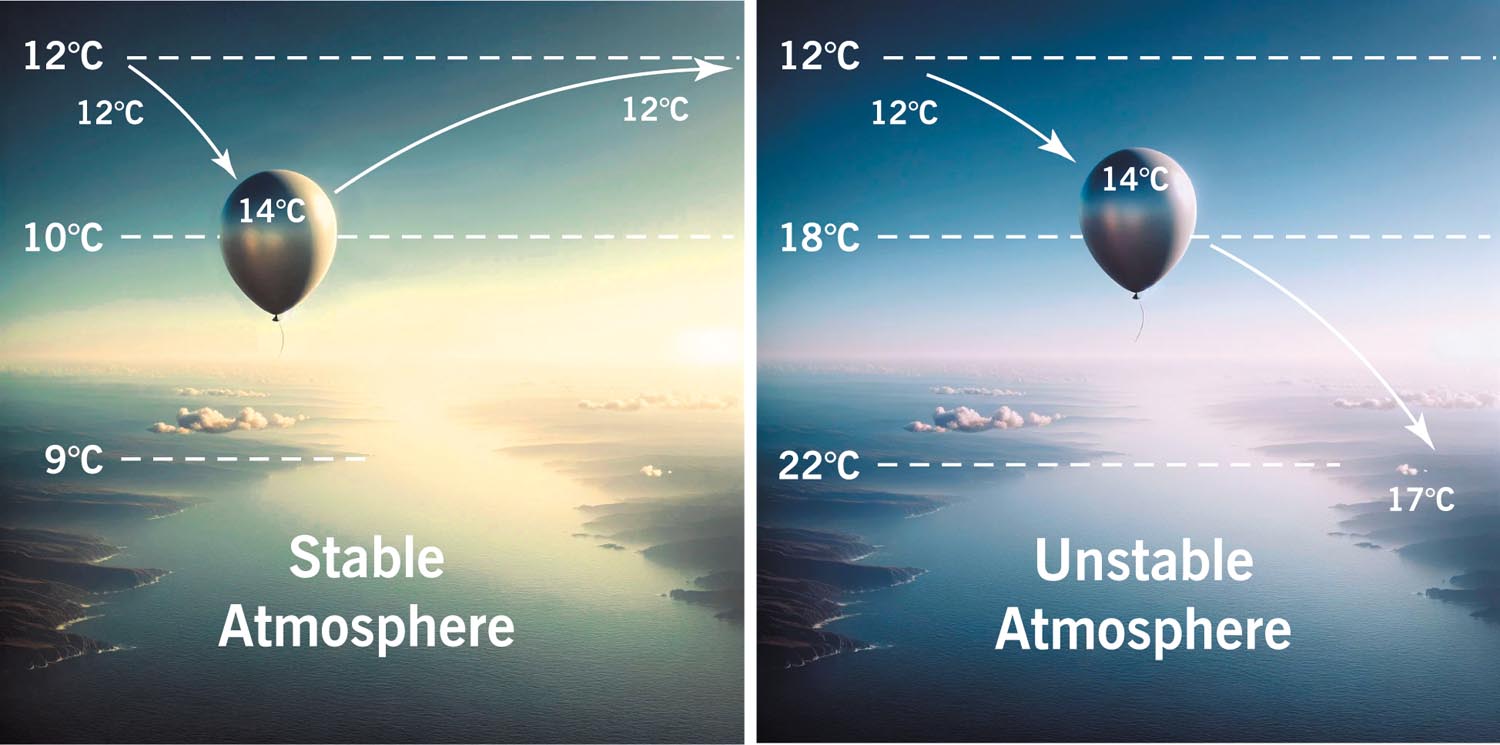


Stability and instability are topics that come up a lot in aviation meteorology. Perhaps it’s been a little too long since ground school and you need a refresher. You’ve come to the right place. Physics concepts like humidity, pressure, density, and stability can sometimes be difficult to remember, and the topics are about as dry as it gets. But these things do play into the safety of your flight, and understanding them will make you a sharper pilot. So let’s begin.
Some Basic Concepts
When we consider a column of air through the troposphere, the layer of air about 20,000 to 50,000 feet deep, we find that the temperature always decreases within this layer as a whole. Smaller layers embedded within this column, including those in contact with the surface, often show different characteristics. These layers may be isothermal, showing no temperature change with height, or may increase in temperature with height, creating an inversion. The layer above the troposphere, the stratosphere, always shows an isothermal layer or an inversion, and we use this to help find the top of the troposphere.

