











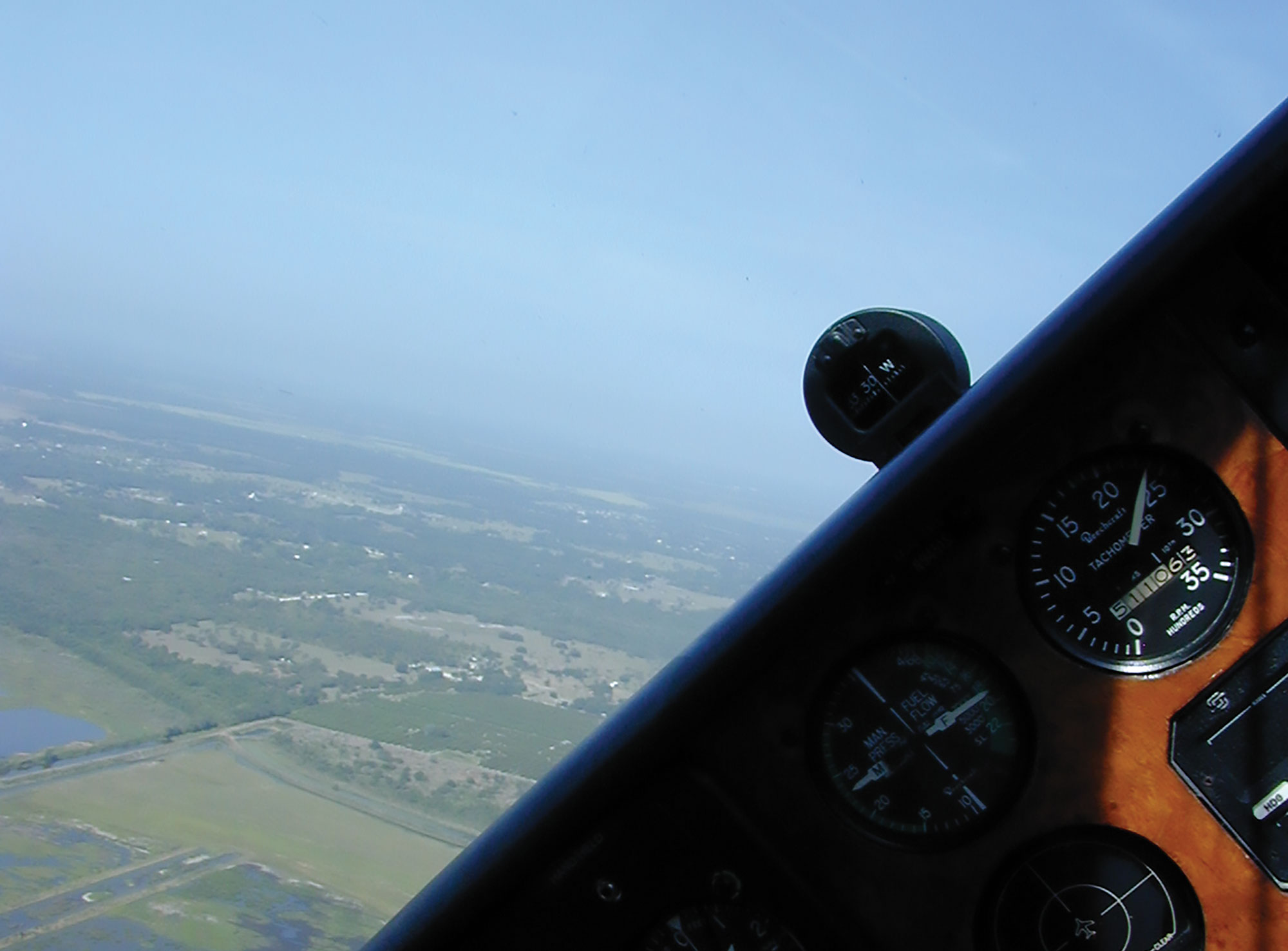


Anyone who has gone through primary training and progressed as far as doing airwork—slow-flight, stalls, ground-reference maneuvers, etc.—should be familiar with at least the concept of a clearing turn. In its most-common flavor, the airplane is turned 90 degrees in one direction and then another 90 degrees in the other direction. In between those turns, while flying more or less straight-and-level, we’re supposed to look for potential traffic before reversing the turn and initiating the planned maneuver.
Of course, as with almost all things in aviation, there’s a right way and a wrong way to perform a task, and looking for traffic while performing a clearing turn qualifies. Meanwhile, the “clearing turn” itself also could use some amplification, not least because it’s really two turns. And we should probably take a moment to pay attention to what we’re turning toward before even beginning the clearing turn. Just like rain on your wedding day, wouldn’t it be ironic to collide with another airplane during a clearing turn?

What The FAA Says
The Airplane Flying Handbook (AFH, FAA-H-8083-3B) admits there “are many types of clearing procedures” and that “most are centered around the use of clearing turns.” In other words, the FAA really doesn’t care how you clear the space around you, only that you do. I’ve often wondered about this, since turning “only” 90 degrees in one direction and then back seems to leave a huge blind spot, namely the 180 degrees of airspace we didn’t look directly at. Perhaps a 360-degree turn—slowly, perhaps at standard rate—would be better?
Perhaps. The downside is that we won’t be straight-and-level during such a maneuver, but concentrating not only on looking for conflicts and managing the turn. Instead, maybe we should be flying a series of four 90-degree turns in the same direction, rolling out after each one to scan for traffic? That would provide the opportunity for a full scan, but also could soak up a few more minutes of precious and expensive dual instruction.
Since the FAA isn’t particular about how you clear the area, only that you do, the private pilot airman certification standards (ACS) lists “[f]ailure to use proper and effective visual scanning techniques to clear the area before and while performing maneuvers” as an area of “unsatisfactory performance and grounds for disqualification.” Your examiner gets to decide what is “proper and effective.”
A Multi-Step Process
I look at a clearing turn prior to performing maneuvers as a series of actions, all of which are designed to ensure potential conflicts are minimized, instead of one more complicated procedure.
First, we need to select an area relatively free of traffic. Your flight instructor probably has a practice area in mind, and unless you’re enrolled in a large flight school or there’s a lot of training going on in your area, it’s probably benign. Obviously, right over an airport or a navaid probably isn’t a good location. If we’re doing ground-reference maneuvers, it also has to have objects we can use for reference, so open water probably isn’t a good choice, either. The need to be away from other flight training activity and over a remote area with ground-based objects can limit our choices.
Once over the area you want to use, orient the airplane as you need to begin the maneuver. You’ll probably want to reduce power and adjust the pitch trim to compensate, which can take a few moments. While you’re slowing is a good time to start scanning for potential conflicts, especially out the sides of the airplane or in the direction in which a wing will block your view (see the sidebar at left).
How steeply you turn is up to you. In my primary training, we rarely banked more than 30 degrees, and that was only to perform steep turns. At typical maneuvering speeds, a standard-rate turn is relatively shallow and slow, so a bank angle between 20 and 30 degrees often works nicely.
While in the turn, you already should be scanning the space. You may want to lean forward, getting a better angle to view the space the airplane’s about to fly into. Roll out 90 degrees from the previous heading and level the wings.
How you scan is another of those tasks the FAA doesn’t specify. As the sidebar on the opposite page discusses, there are several scanning methods, many of which have been subjected to sophisticated testing. The best scanning method is the one you use and are most comfortable with, but it also must allow you to focus far ahead of the airplane. Various FAA publications discuss the human eye’s limitations, and it’s important that whatever method you use recognizes them and compensates accordingly.
How long you should stay on the 90-degree heading is another undefined factor. The real answer is however long it takes to scan the area and verify it’s free of conflicts.
Once your scan 90 degrees off the desired heading is complete, reverse the process. Lean forward again as you bank in the opposite direction to observe the space you’re flying into. Roll out on your original heading and continue scanning to the sides. Congrats; you just performed a clearing turn.
Tools And Exceptions
Many pilots these days are flying with a traffic display, typically based on ADS-B In’s traffic information service. It’s a good tool, designed to enhance our situational awareness, but it’s only advisory in nature and subject to errors.
One of its most consequential failings is the inability to display non-participating traffic. There are still thousands of aircraft out there lacking electrical systems, for example, and those equipped with only a Mode A or C transponder might not show up on your ADS-B traffic display if they’re low and/or if you’re in a remote area.
Still, it’s a good idea to use your traffic display as one more tool you can use to ensure you’re clear of traffic. Start your clearing turn procedure with a glance at the display, preferably zoomed in to a short range. You’re looking for obvious conflicts, but especially in the direction you plan to turn. It’s useful, also, for spotting traffic conflicts behind you, or below, where even a clearing turn might not spot the problem. Keep an eye on the display as part of your normal, inside-the-cockpit scan, too, as things can change.
All that having been said, I still have a problem with this most basic of all maneuvers. First, perhaps, is the unreliability of many traffic-scanning techniques. In addition to the FAA/CAMI “Pilot Vision” brochure mentioned in the sidebar at right, the FAA also has an advisory circular, AC 90-48E, Pilots’ Role in Collision Avoidance, revised in October 2022. In addition to its own scanning technique, it provides a comprehensive review of the FAA’s various related guidance materials and also has a few suggestions we all might want to consider.
Three of the ideas it includes take us beyond clearing turns. One suggests slightly adjusting pitch and/or bank angle periodically to eliminate blind spots, especially in high-density traffic areas. Another encourages looking behind the aircraft, for obvious reasons, when in one of those shallow banks. A final suggestion involves moving our head to allow us to see around wing struts or windshield frames. These suggestions also apply to clearing turns, and should be part of such procedures.


