Thinking Inside The Box

Predicting landing performance can mean a deep dive into the airplane’s documentation, with no precise answers.

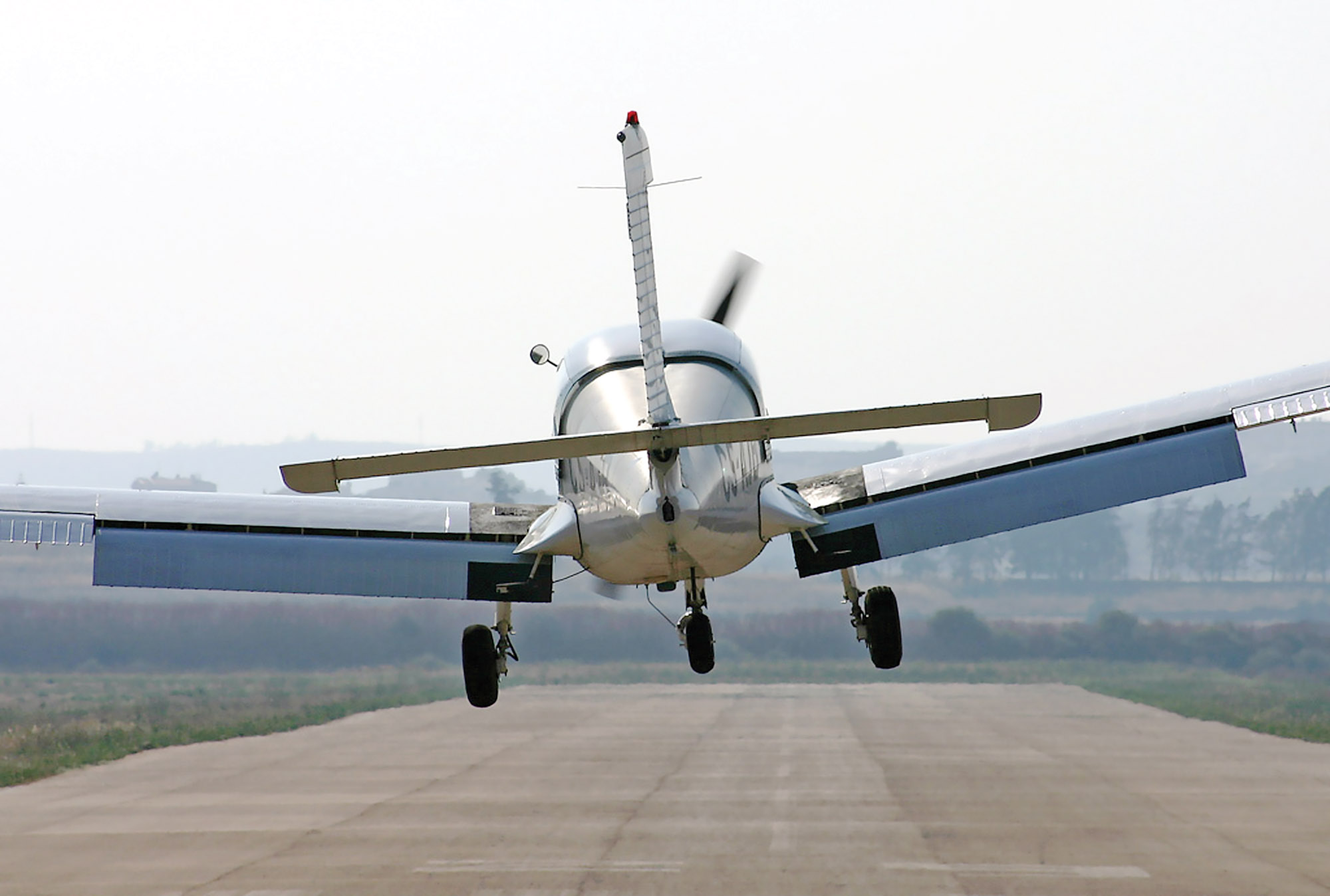
This image of a Morane Saulnier Rallye in the landing flare is by Jorge Santos.
Gemini Sparkle

Key Takeaways:

  • Landing performance planning is a critical pre-flight action, requiring pilots to carefully analyze Airplane Flight Manual (AFM) or Pilot's Operating Handbook (POH) data to ensure the aircraft can safely land within the available runway parameters.
  • Interpreting AFM/POH performance data involves understanding various chart types, weight adjustments, flap settings, and surface conditions, with regulatory requirements sometimes presenting challenges or requiring careful judgment.
  • Beyond runway length, factors such as runway width, slope, and braking action are crucial for safe landings, especially in challenging conditions like strong crosswinds, ice, or snow, and require additional pilot assessment.
  • Proper pilot technique, including stabilized approaches, adapting to situations like no-flap landings or airframe icing, and understanding specific aircraft behaviors (e.g., helicopter Vortex Ring State), is essential for safe operation.
See a mistake? Contact us.

You’ve found that airport that you’ve never been to before, and now it’s time to land. If it wasn’t an abnormal situation, like an unplanned diversion, you analyzed the landing performance before you took off, right?

Landing performance is like a box. You measure length, width and height. Your task is to fit a moving object into that box, without scraping the edges.

What The FARs Say

Most of the time, pilots focus on available runway length. That’s the most prominent requirement in FAR 91.103, Preflight Action. The regulation goes on to say that you have to use the data in the approved Airplane Flight Manual or “reliable information appropriate to the aircraft, relating to aircraft performance under expected values of airport elevation and runway slope, aircraft gross weight, and wind and temperature.”

The regulations don’t say much about width. And they don’t say much about technique, either. 

AFM Or POH?

The FARs refer to the Airplane Flight Manual (AFM), but most of us are flying airplanes with a comprehensive Pilot’s Operating Handbook, or POH. Is there a difference? No. According to the FAA’s Pilot’s Handbook of Aeronautical Knowledge (PHAK), “The POH for most light aircraft built after 1975 is also designated as the FAA-approved flight manual.”

The PHAK also notes, “Originally, flight manuals followed whatever formats and content the manufacturer felt was appropriate.” This changed around 1975, when, based on a recommendation by the General Aviation Manufacturers Association (GAMA), the industry settled on a standard format for the POH. The standard sections are 1, General; 2, Limitations; 3, Emergency Procedures, which also includes abnormal procedures; 4, Normal Procedures; 5, Performance; 6, Weight and Balance; 7, Systems Descriptions; 8, Handling, Service and Maintenance; and 8, Supplements. 

Older aircraft operating instructions were really hodge-podge. My 1970 Mooney POH had General Description, Systems Operations, Normal Procedures, Emergency Procedures, Limitations, Performance and Servicing. A 1958 Piper Apache manual has Design Features, Operating Instructions, Performance Charts and General Maintenance. Emergency Procedures are deep in the operating instructions. When I was flying Apaches, I dog-eared the emergency page of the manual to make it easier to find. It includes the dire warning, “If the right engine fails, the vacuum pump will no longer function.” Single-engine partial-panel is definitely an emergency!

Even with the standardization, procedures can be hard to find. In many POHs, the required configurations are not in the “normal procedures” section: They’re in the performance section.

There are two basic kinds of performance charts: graphs and tables. As a quick review, the Cessna 172N AFM/POH uses tables. The Cessna table only applies at maximum gross weight, which sounds weird because landing at MGW must have been preceded by an overweight takeoff. The real reason is that landing performance will always be better than what the table shows. Choose the row based on pressure altitude and the column based on temperature. Since there is only one weight, there is only one approach speed. 

There still might be a regulatory problem. During my most recent simulator training session, we were told that the FAA would not permit landings with partial flaps, because there was no performance data. The argument that the performance would be “better than no flaps” fell on deaf ears. Pilots were required to reconfigure the airplane by changing the flap setting when breaking out of a precision approach at minimums. That destabilizes the approach near the ground in minimum visibility conditions, which goes against every shred of common sense everyone had. Pilots have the authority to deviate from any rule (FAR 91.3), but that only applies in an emergency. Maybe the thing to do is to change the final call-out to, “Field in sight. Landing. I declare an emergency.”

The question of whether one can legally land a Cessna 172 at any weight below the maximum one is best ignored.

The King Air B200 AFM/POH uses graphs. Starting with the temperature, move up to the pressure altitude, move across to adjust for weight, then for headwind or tailwind and then for obstacle height. There’s a little gotcha with the obstacle height: Although the table shows a smooth curve going from the distance required over no obstacle to the distance required over a 50-foot obstacle, those are the only valid points on the graph. The performance landing over a 25-foot obstacle will be better. The performance page also lists the approach IAS at different weights. The target airspeed, which is part of the landing procedure, is in the performance section.

The graph shows the effect of tailwinds up to 10 knots. Trying to take off with a larger tailwind is a violation of the limitations. 

Runway surface is another issue. One POH suggests a 60-percent increase in ground roll when landing on wet grass. Another only provides data for a paved, dry level surface. Yet another suggests a 45-percent increase when landing on dry grass, but does not say anything about wet grass. These qualifications are all in the fine print of the performance charts or graphs.

It’s tempting to look at this data in reverse. Knowing the runway length available, look in the table for conditions—any conditions—that might require that amount of space. There are no conditions on this planet in which a Beech King Air 200 can’t land over a 50-foot obstacle on a 9000-foot runway, so 9000 is enough. The regulations say you should compute the length required anyway.

Width

The regulations don’t mention runway width, but it can be important. Runway widths are easy to find. They’re in the Chart Supplement (formerly A/FD), the “Runway” tab in the ForeFlight airport page or in the airport diagram.

A nice round number for the wingspan of a small airplane is 40 feet, but I have flown aircraft with wingspans up to 55 feet. There are lots of runways around that are narrower than that. At Bancroft, Idaho (U51), the runway is only 30 feet wide. The nearby private Simpson strip (ID62) also has a 30-foot wide runway. Twin Oaks Airpark (7S3), near me, has 48 feet you can play with.

The first thing to remember about a narrow runway is that you have to land on, not near, the centerline. If you are 10 feet to one side of the centerline of a 30-foot-wide runway, you are likely to be rolling into the weeds. Even a broader runway can be a problem in a strong crosswind. On a 50-foot runway, there’s only about five feet of leeway, so your crosswind technique must be close to perfect. 

If the runway is icy or covered in packed snow, you have even less margin for error. One pilot I know ran an airplane with a wingspan of 50 feet off a snow-covered 75-foot-wide runway, causing extensive damage.

Most of these really narrow runways have little or no winter maintenance, so snow berms won’t be a problem. But they can be a problem on, say, a runway 50 feet wide. In snowier parts of the country, these can be quite high. If there are berms, there should be a Notam. 

Technique

The final word on technique is easy: pilots are to fly a stabilized approach using the POH method. The POH generally specifies flap settings and reference airspeeds.

But. There are a lot of reasons why someone would need to do a no-flap landing, ranging from a fault in the flap mechanism to a total electrical failure. The POH should have a procedure; some do, some do not. Consider doing a slip if you have to land without flaps, and use long runways when practicing.

Airframe icing is another reason for a no-flap landing. Ice changes the aerodynamics of the wings in unpredictable ways. I never use flaps if the airplane is carrying ice because of the unknown stall characteristics. Expect a higher stall speed, but how much higher is just a guess.

Is That All?

A wise old pilot taught me, “When the conditions are difficult, don’t try to grease it on; just chop the power and land.” He took “on the centerline” for granted.


Runway Slope

Some POHs address runway slope; many do not. Runway slope data is in the Chart Supplement (formerly A/FD). Slope is almost always the most important factor in performance. Landing uphill is better in almost all conditions. How much better? That’s a judgment call.  It’s much less of a judgment call at the Tenzing-Hillary Airport (VNLK), in Lukla, Nepal, depicted at right: Land going uphill, take off going downhill.

Judgment based on what? There are wildly different opinions about the effect of runway slope on the internet, so that’s no help. I’ve looked at the Pilot’s Handbook of Aeronautical Knowledge and several aerodynamics textbooks, and while everyone agrees that landing downhill means a longer ground roll, nobody has any actual data, or even a theory.

Here’s some “anecdata.” One busy GA airport near me has a 1.6 percent slope. Going uphill, it seems to add 200 to 300 feet to the takeoff ground roll for most training airplanes. The effect on landing should be more, but at this airport the wind seldom favors landing downhill, and while I have done it, I don’t have any solid data to share.


Braking Action

An icy or snow-covered runway means another opportunity for things to go wrong. The Aeronautical Information Manual (AIM) at paragraphs 4-3-8 and 4-3-9 describe how braking conditions are measured and reported. In essence, braking conditions are reported as FICON (for “field condition”) Notams and can sometimes be hard to dig up. It is worth the effort. 

Braking conditions are reported on a scale of “1” to “6”, with “6” being a dry runway. Figure 4-3-7 in the AIM (and reproduced on page 24 of this issue) has the Runway Condition Assessment Matrix, and it’s worth your while to study it, especially this time of year in the Northern Hemisphere. What pilots used to call “medium” is now reported as “3”, meaning a noticeable reduction in deceleration or directional control. That would be a no-go criterion for me on a narrow runway.


Helicopters

It’s easy to think that a helicopter, which can descend vertically, needs no runway. But vertical descent isn’t always a good idea. I am not a helicopter CFI, so ask one before you try anything other than how you’ve been trained.

Helicopters are subject to what is now called Vortex Ring State, formerly Settling With Power. It’s described in the FAA Helicopter Flying Handbook(FAA-H-8083-21B). The basic idea is that the tip vortices from the main rotor curl back up and in to push down on the rotor, just like wingtip vortices in an airplane. Except in this case they form a ring.

If a helicopter descends with no forward motion compared to the airmass, it will be flying in rapidly descending air. The cure? Increase the forward airspeed and get out of that descending column.

It’s one of the few techniques that applies both to gliders and to helicopters: If you’re in sinking air, increase your forward speed to get out of it. 

It doesn’t matter that your helicopter caused the air to sink.

Ready to Sell Your Aircraft?

List your airplane on AircraftForSale.com and reach qualified buyers.

List Your Aircraft
AircraftForSale Logo | FLYING Logo
Pilot in aircraft
Sign-up for newsletters & special offers!

Get the latest stories & special offers delivered directly to your inbox.

SUBSCRIBE