











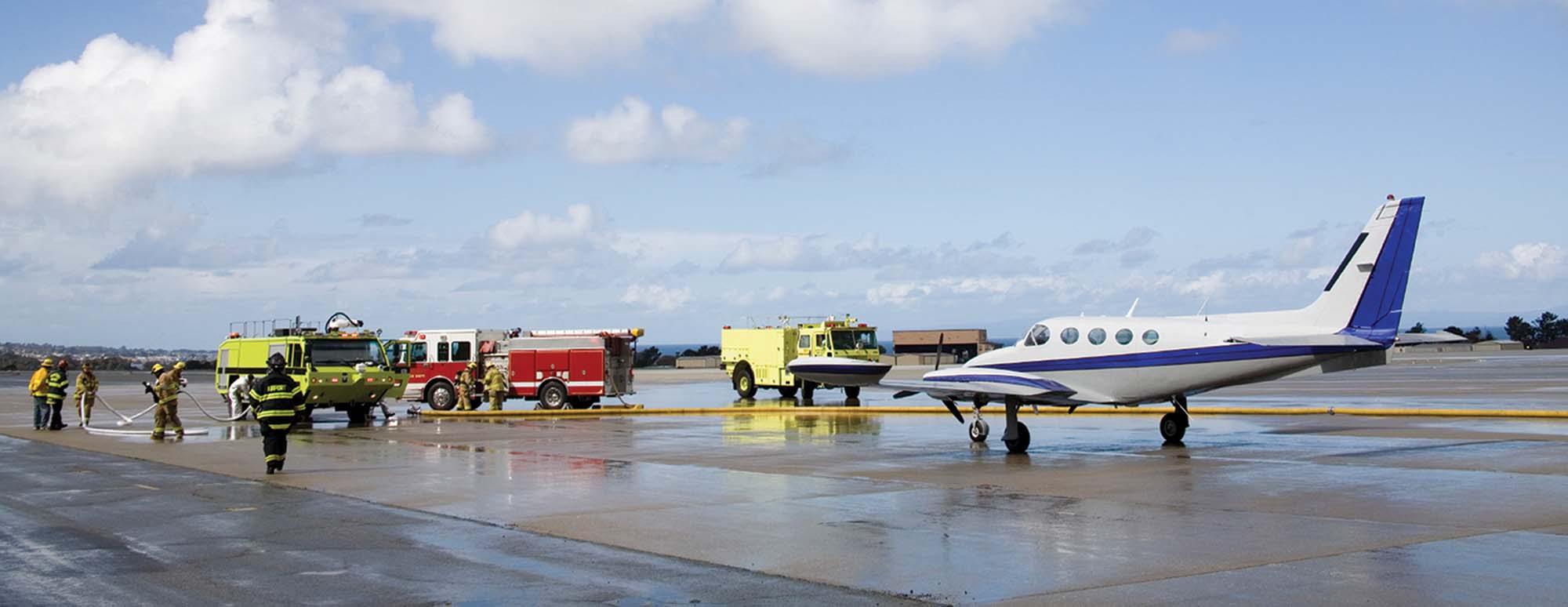


I find myself often thinking (and writing) about emergencies. Over the past few years, I’ve discussed the importance of declaring emergencies, the effects of time pressure in abnormal situations and landing off-airport. Thought exercises and briefings can help with more routine maneuvers, like landings, but at the end of the day, experience is the best teacher. Pattern work, a stall series…the actions need to be performed and repeated until proficiency is gained.
Emergencies are trickier. Sure, we can go simulate engine failures in different phases of flight or a flight instructor can exclaim, “There is smoke coming from the engine. What would you do?” Even advanced simulators with full-motion cockpits and smoke generators cannot take you through a complete evacuation or fully replicate the amount of coordination required between the flight deck, flight attendants, passengers, ATC and ARFF.

Training For Resilience
An emphasis item on our most recent recurrent training was resilience to threats. The European Union Aviation Safety Agency, EASA, defines resilience as “the ability of a flight crew member to recognize, absorb and adapt to disruptions.” When an emergency occurs, the startle factor and the need to shift your focus from routine tasks can cause performance deterioration. Airbus has the perspective that resilience can be increased by improving pilot confidence and competence.
For example, consider evacuating a fully loaded two-door, four-seat aircraft. In what order will everything occur? Will the people in the front seats open the doors, hop out and then move the seats up? Will they open the doors and scrunch forward to let the passengers in the back out, and jump out behind them? If the occupant in the right seat is not a pilot, do they understand how to operate the door?
These questions and more should be covered in the passenger briefing. About 30 seconds of pre-flight planning and information imparted to the non-pilots aboard can save critical time when there isn’t any.
The enemy of resilience is complacency. As pilot in command, it is important to plan for all outcomes, whether it be a minor hiccup or a catastrophic failure.
Unexpected Threats
Airlines have implemented threat and error management in their training, standard procedures and as a general cornerstone to safe operation. Data show recovery from briefed and expected threats is much smoother than with unexpected threats. This makes sense, right? If we notice shifting winds on arrival and plan a backup approach, we are less likely to end up high and fast after ATC changes things around at the last minute. Conversely, unexpected threats generally leave us startled. Flight path deviations occur; responses to the situation may be incorrect or nonexistent.
While no checklist, guidance or roadmap can meet the requirements of every scenario, there are some general steps—building blocks—that can tip the scales toward a favorable outcome.
Fly The Airplane
The first building block should be familiar: Fly the airplane. Aviate, navigate, communicate. Perhaps easier said than done when completely inundated with time-sensitive tasks during an emergency. It is not atypical to see a pilot presented with an emergency situation and completely depart the desired flightpath, which in the wrong situation can quickly degrade into a loss of aircraft control or CFIT. Ensure the airplane always is in a desired energy state and pointed away from obstructions.
Identify
As previously mentioned, one of the challenges in the training environment is accurately simulating emergencies. Often they are not clearly understood at first, and incorrect action can exacerbate an abnormality. For example, consider a January 2016 accident involving a Pilatus PC-12 attempting to depart Savannah, Ga. The long and short of it is the pilots responded to a crew alerting system message at 200 feet agl and elected to land ahead, with about 2700 feet of runway remaining. The aircraft ended up in a drainage ditch with substantial damage and a post-accident fire, with the crew sustaining minor injuries. The real rub? According to the report, it was likely an erroneous engine indication and had the crew not reacted, the aircraft could have continued the climb normally.
This was a tough situation for the crew to handle, because if it was a catastrophic engine failure, the actual outcome would have been positive. Every second is critical, and many operators were training to land if there was runway remaining. I was working as a sim instructor in PC-12s at the time, and there was no way (at that time) to accurately recreate this situation in my employer’s Level D sim.
The overarching lesson here is sometimes there is value in taking your time and properly identifying the cause of the emergency, which is incredibly challenging when time is of the essence. Multiple instances exist of simultaneous but unrelated—and even erroneous—error messages confronting crews. Sorting the real from the false requires time, of course, but also intimate systems knowledge.
There is a second step to identifying an emergency, involving time. An emergency is a wide umbrella. For example, a radio failure in IMC is considered an emergency, but in no way should that encourage a pilot to land in a nearby parking lot. Conversely, an unidentified source of smoke in the aircraft could warrant extreme, decisive action.
At our airline, we train that emergencies should be considered time or no-time events. A time event means that while we may need to exercise the pilot-in-command authority (or other perks) granted by declaring an emergency, we do not need to rush to get the aircraft on the ground yesterday. All normal and emergency checklists should be completed and the goal is a normal, stabilized approach.
A no-time emergency requires a landing as soon as possible. Some examples of no-time items are fire, smoke with an unknown source, a security threat or a medical emergency. With any other issue, including an engine failure, rushing can create more hazards.
Time is relative, as we all know. Consider an engine failure. In a modern jet airliner in cruise flight? Maybe not so bad. Right after takeoff in a Skyhawk? Better get moving. Consider how much time pressure really exists and decide how much rushing is required.
Divvy Up The Duties
At first glance, this exclusively applies to aircraft flown with two or more pilots. One pilot is focused on flying the plane while the other troubleshoots. If you are operating with two pilots on board, this is an excellent technique. If you have non-pilot occupants on board, use them to your advantage when possible. Anyone can read or hold a checklist, or grab approach plates or other equipment, stuff like that. While flying solo, ATC is probably your best resource. They can often give quick info on the closest airports, options and other unknowns.
Memory Items And Flows
When I conduct flight reviews or IPCs, I am not always intimately familiar with the aircraft, especially relative to the applicant. Often they own the airplane, and are very familiar with the systems just from experience and maintenance. One thing I always make sure to ask about is memory items and flows.
Some aircraft manufacturers may publish memory items via bold print or boxed items; others may not publish any at all. When there are no bold-faced, immediate-action items, the onus is on the pilot to ensure that situations requiring quick action, like engine failures or fires, can be expedited. Some aircraft are simple enough that this can be driven by common sense, but it still proves beneficial to have a plan.
Bringing It All Together
To summarize, when an emergency occurs, ensure someone is monitoring the flight path, always. In single-pilot operations, this requires multi-tasking, something at which humans are not that accomplished. Identify the failure or other emergency, verifying whatever action is taken will not make the situation worse. Better to pause fighting a fire and let it get a little worse than take blind action and throw fuel on it. Decide how much time pressure exists, because rushing almost never improves human performance.
Once the memory items and flows are completed, jump into the checklists/QRH. A normal landing is far from guaranteed in an emergency; make sure to fly the plane to a complete stop and evacuate, taxi clear or whatever is required to meet the extent of the emergency. Finally, discussing the event and lessons learned with others helps us all become safer, more competent pilots.

Emergencies to Consider
As discussed earlier, having a plan in place can be the difference. There are some scenarios that do not apply to all aircraft but if they do apply to yours, you should have an idea of how you will handle it.
- Evacuation: Nobody will be happy to be stuck on an airplane that’s on fire. Plan multiple exits.
- Engine Failure: The difference in a successful outcome in single or multiengine planes experiencing an engine failure can be determined in the first few seconds.
- Fire: A fire needs fuel, spark and oxygen. Depending on what is on fire, can it be fought?
- Emergency Descent: This can be a no-time bucket emergency, especially depending on the altitude and oxygen capabilities of the plane. But even a medical emergency can be mitigated by a timely executed descent.
