













Register

Fronts

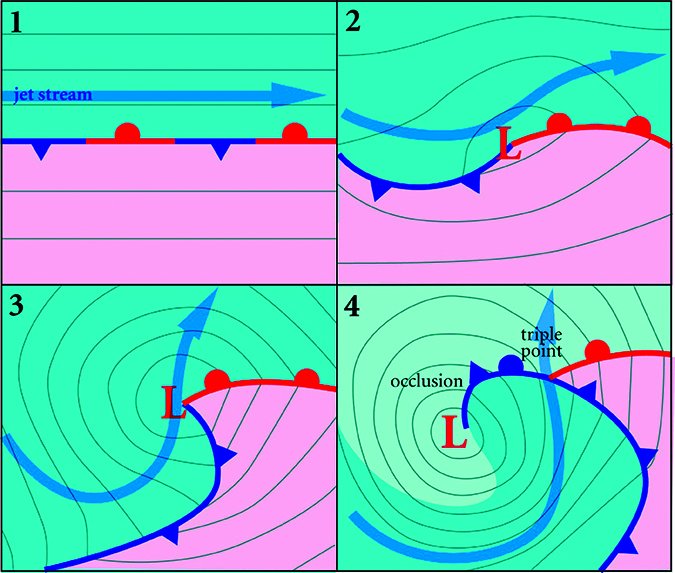
Fronts in TAFs and weather briefings often mean a day of delays and canceled plans. Considering the impact that they have on flight operations, we should understand fronts. Lets study them so you can make a good guess about the resulting weather. Our modern knowledge of fronts began around 1910 in the Bergen School of Meteorology in Norway. Their early work laid out the mathematics of forecasting and described fronts, showing that they are defined by a change in air mass density. Changes in wind speed, humidity, or pressure are all secondary.


Gemini Sparkle

Key Takeaways:

  • Fronts are atmospheric boundaries primarily defined by differences in air mass density (temperature and moisture), forming when distinct air masses meet.
  • They undergo a complex life cycle, from stationary to occluded fronts, and are central to generating strong upper-level pressure gradients that drive the jet stream.
  • Frontal zones are characterized by rising air (ascent), leading to adverse weather such as clouds, precipitation, turbulence, and icing, with specific weather patterns varying by frontal type.
See a mistake? Contact us.

Fronts in TAFs and weather briefings often mean a day of delays and canceled plans. Considering the impact that they have on flight operations, we should understand fronts. Let’s study them so you can make a good guess about the resulting weather.

Our modern knowledge of fronts began around 1910 in the Bergen School of Meteorology in Norway. Their early work laid out the mathematics of forecasting and described fronts, showing that they are defined by a change in air mass density. Changes in wind speed, humidity, or pressure are all secondary.

Ready to Sell Your Aircraft?

List your airplane on AircraftForSale.com and reach qualified buyers.

List Your Aircraft
AircraftForSale Logo | FLYING Logo
Pilot in aircraft
Sign-up for newsletters & special offers!

Get the latest stories & special offers delivered directly to your inbox.

SUBSCRIBE