














Republic Airways Pilots Fly Electric Aircraft in Florida

Three-day campaign sees Beta’s CX300 fly into Orlando International Airport (KMCO).

Beta Technologies electric Alia CX300 aircraft with Signature livery
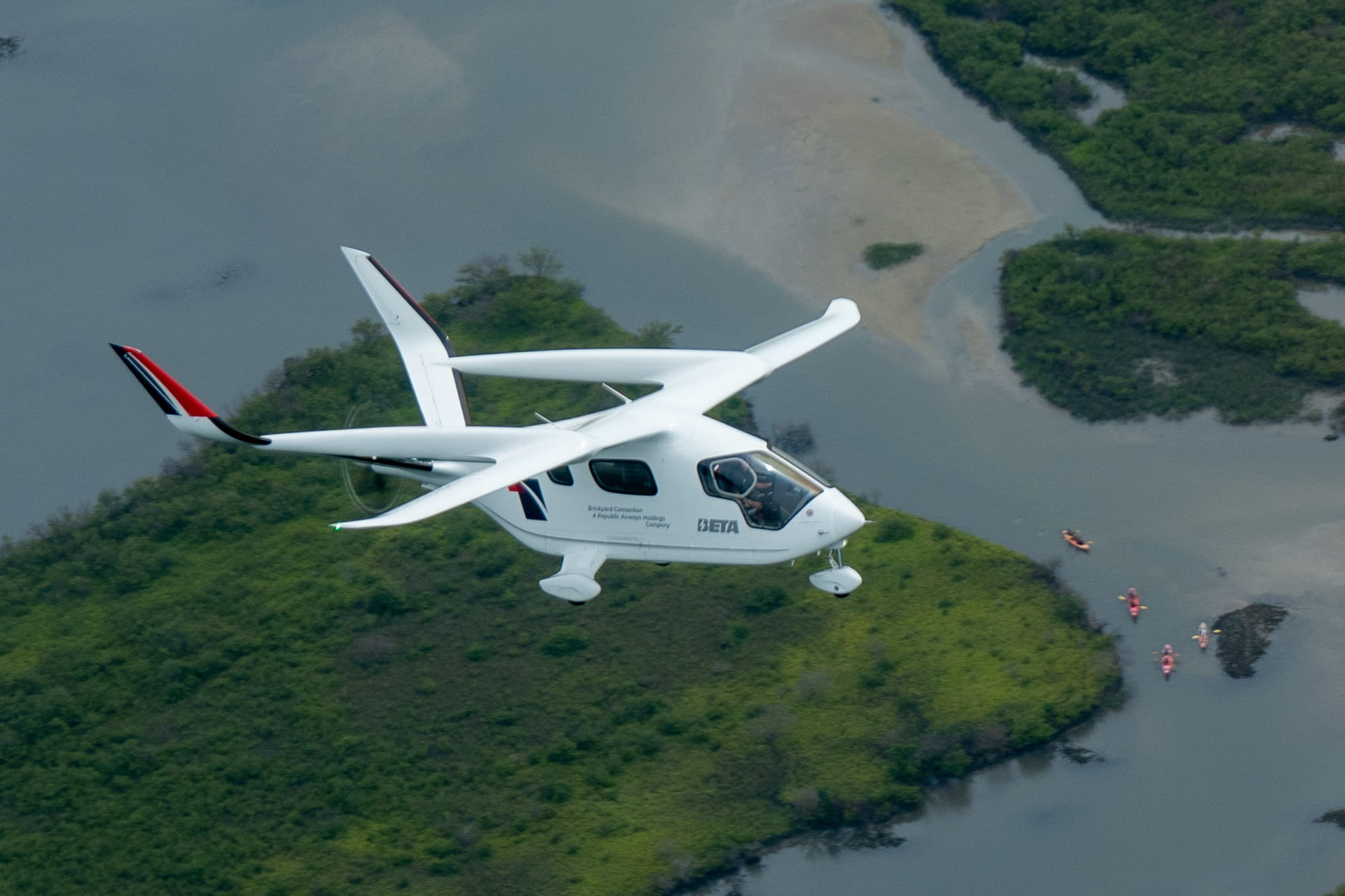
Beta Technologies’ Alia CX300 electric aircraft, N916LF, soars in the skies over South Florida during a three-day campaign. [Credit: Beta Technologies]
Gemini Sparkle

Key Takeaways:

  • Beta Technologies is conducting extensive "high-cadence" flight demonstrations of its Alia CX300 electric aircraft in South Florida with partners Republic Airways and Signature Aviation, as part of the FAA's eVTOL Integration Pilot Program.
  • The Alia CX300, a versatile electric aircraft designed for passenger, cargo, and medical applications, is undergoing rigorous testing to validate its capabilities, including a 336 nm range, 5-passenger capacity, and lower operating costs.
  • Florida is actively embracing electric aircraft adoption, with Signature Aviation installing charging infrastructure and new legislation supporting vertiport development, making it a key state for future eVTOL operations and commercial services.
See a mistake? Contact us.

The skies in South Florida are buzzing.

Last week, manufacturer Beta Technologies joined forces with Republic Airways and FBO Signature Aviation to conduct “high-cadence” demonstrations with the Alia CX300—its flagship electric aircraft for passenger, cargo, medical, and military applications. The three-day campaign culminated Sunday with a flight into Orlando International Airport (KMCO), one of the first in the nation to actively pursue an electrified vertiport for the novel aircraft.


The demonstrations are just a preview of what is to come. Within the next few months, Beta and other electric aircraft manufacturers will begin airport operations in Florida and 25 other states under the FAA’s eVTOL (electric vertical takeoff and landing) Integration Pilot Program (eIPP). The operational testing will continue for at least three years.

In the winter, Beta and Republic completed cold-weather demonstrations in Plattsburgh, New York, and the former’s headquarters in Burlington, Vermont, flying 34 times over four days. Matt Koscal, president of Republic, said the demonstrations are “helping illuminate what’s possible as we explore new ways to expand local air services in Florida and beyond.”

The carrier in 2025 took delivery of what Beta CEO Kyle Clark, speaking at the Paris Air Show, called a “precertified” CX300. The aircraft is powered by Beta’s H500A electric motor—for which it is seeking separate type certification—and Hartzell’s FAA-certified electric aircraft propeller. It has a demonstrated range of 336 nm, projected top speed of 135 knots, and capacity for a pilot plus five passengers or about 1,250 pounds of cargo.

Capable of charging in under an hour using electric power, Beta claims the CX300 will be far cheaper to operate than models powered by jet fuel.

Putting Them to the Test

Beta in Paris agreed to deliver the aircraft to Republic so the latter could study possible routes, familiarize pilots with its operation, and test use cases from passenger shuttle to cargo delivery. The partners trained three pilots from Republic’s Brickyard Connection unit, putting them through coursework, simulator sessions, and check rides.

Last week, Beta and Brickyard pilots flew up to nine legs daily with the CX300, each consuming about $16.80 in energy costs. Per FlightAware, N916LF—the same aircraft that flew into John F. Kennedy International (KJFK) after completing a 25-state, 8,000 nm barnstorm across the U.S. last year—made 27 out-and-back flights at Kissimmee Gateway Airport (KISM) over three days.

The aircraft flew into Orlando International on Sunday. It arrived in Daytona Beach and Jacksonville on Monday before heading to Georgia and then North Carolina on Tuesday. N916LF’s most recent flight was Wednesday into Raleigh Executive Jetport (KTTA).

Beta Technologies Alia CX300 electric aircraft with Republic livery
N916LF, wrapped in a Republic Airways livery, takes flight in Florida. [Credit: Beta Technologies]

Beta also flies N214BT, which traversed Europe and landed in Norway for a test campaign with customer Bristow Group last year. Another CX300, N401NZ, was a test article for Air New Zealand and is now operating in Japan, per FlightAware. N889CD, the company’s first type-conforming aircraft, and N336MR are both conducting testing in Burlington and Plattsburgh.

Simon Newitt, Beta’s head of sales and support, said Thursday in a statement that the aircraft have collectively flown more than 140,000 nm. That makes the CX300 one of the most active electric models yet to be certified.

“That operational experience is what positions us to scale deliberately and efficiently in states like Florida, where near-term, short-haul cargo, medical, and passenger demand is strongest,” Newitt said.

Florida Embraces Electric Aircraft

Signature Aviation, which also took part in the recent campaign, recently installed Beta’s Charge Cube and thermal management system—designed to weather Florida’s sweltering heat—at Kissimmee. The company’s charging solutions are also installed at Eglin Air Force Base’s Duke Field (KEGI), Tallahassee International Airport (KTLH), Jacksonville Executive Airport (KCRG), Bob Sikes Airport (KCEW), and Gainesville Regional Airport (KGNV).

That infrastructure will only continue to expand. Signature and Beta in November agreed to explore CX300 operations across the former’s Florida network. The operator would be UrbanLink Air Mobility, which has a lease for up to 10 CX300s. Signature said the partners are “actively pursuing” an UrbanLink base at an unnamed Florida airport. The effort could be helped by recent legislation that streamlines vertiport permitting in the state.

In addition to Orlando International, Signature has hubs at Miami International (KMIA), Fort Lauderdale-Hollywood International (KFLL), Tampa International (KTPA), and Jacksonville International (KJAX) airports.

Beta Technologies Alia CX300 electric aircraft charging on runway
Beta’s CX300 juices up at a charging station on the tarmac. [Credit: Beta Technologies]

Florida is one of four states planned to anchor a network of vertiports developed jointly by Signature and UrbanV. The FBO is also working with Boeing’s Wisk Aero, which has positioned Miami as a launch market for its autonomous air taxi. Also eyeing Florida are Archer Aviation and Vertical Aerospace.

Beta, Archer, Joby Aviation, and Electra will additionally take part in the Florida Department of Transportation’s eIPP project. Beta will work with Republic and Metro Aviation to conduct cargo and medical demonstrations.

Before that, Floridians could see operational testing of drones and air taxis at Miami Executive (KTMB), Miami International, and neighboring airports under a new pilot program called SafeLand. Bell-Dancy Industries, the company providing air traffic management technology for those demonstrations, is working on a similar pilot program with Signature in California.

Jack Daleo

Jack is a staff writer covering advanced air mobility, including everything from drones to unmanned aircraft systems to space travel—and a whole lot more. He spent close to two years reporting on drone delivery for FreightWaves, covering the biggest news and developments in the space and connecting with industry executives and experts. Jack is also a basketball aficionado, a frequent traveler and a lover of all things logistics.

Ready to Sell Your Aircraft?

List your airplane on AircraftForSale.com and reach qualified buyers.

List Your Aircraft
AircraftForSale Logo | FLYING Logo
Pilot in aircraft
Sign-up for newsletters & special offers!

Get the latest stories & special offers delivered directly to your inbox.

SUBSCRIBE
