












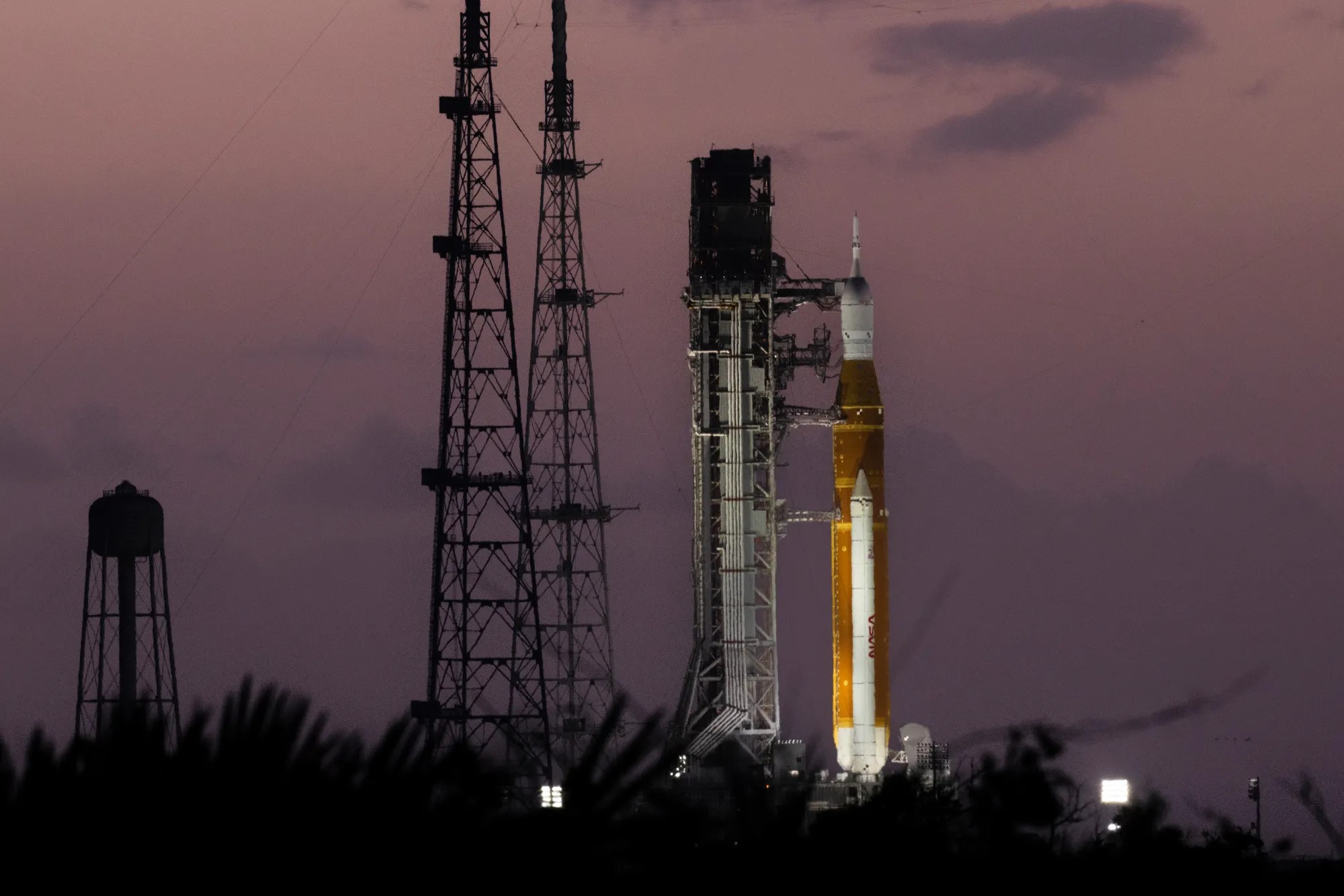


Following the roaring success of NASA’s Artemis II mission, the space agency is devising plans for a final test flight before attempting to land the first humans on the moon in decades, as soon as 2028.
Whereas Artemis II sent four astronauts slingshotting around the moon and back—and farther from Earth than any human has ever ventured—Artemis III will stay in familiar Earth orbit. The mission is designed as a test of NASA’s Orion capsule’s ability to dock with the human landing system (HLS) that will deliver its crew to the lunar surface.

NASA does not yet know which HLS—SpaceX’s Starship or Blue Origin’s Blue Moon Mark 2—will fulfill that role. But officials have hinted that Artemis III could include both spacecraft.
The space agency appeared to confirm this in a news release Wednesday.
“We’re integrating more partners and interrelated operations into this mission by design, which will help us learn how Orion, the crew, and ground teams all interact together with hardware and teams from both providers,” said Jeremy Parsons, acting assistant deputy administrator of NASA’s Moon to Mars program, in a statement.
Parsons notably said “both providers” will be involved. The release adds that the mission is intended to test “rendezvous and docking capabilities” between Orion and “commercial landers from Blue Origin and SpaceX.” Later, both Starship and Blue Moon are described as mission elements.
The “preliminary” blueprint stated that Artemis III crewmembers could even enter one of the HLS vehicles, though NASA is still developing a concept of operations based on what SpaceX and Blue Origin believe they could achieve.
The Apollo 9 astronauts freely flew their lunar module after undocking from the command module during a test flight. But that required separate life support systems, flight controls, and other hardware that the SpaceX and Blue Origin landers may or may not have by mid-2027—NASA administrator Jared Isaacman’s stated timeline for Artemis III.
Isaacman in April told lawmakers that SpaceX and Blue Origin informed him that their landers would not be ready until late 2027. He has indicated that he will follow through on U.S. Transportation Secretary Sean Duffy’s pledge to reopen SpaceX’s HLS contract, which covers the first two crewed Artemis landings. Duffy, interim NASA administrator at the time, cited delays as his rationale for the proposal.
Now, it appears the space agency will either move forward with SpaceX’s HLS or limit the competition to only Blue Origin.
Here’s what else we now know about Artemis III, which Parsons called “one of the most highly complex missions NASA has undertaken.”
Artemis III Blueprint
NASA said that in the wake of Artemis II, engineers have been “evaluating mission profile options and operational considerations” to ensure a safe, successful follow-on flight.
Previously, Artemis III was planned to be the first crewed lunar landing since the Apollo era. But NASA in February shook up Artemis, modifying it to an orbital mission and pushing the landing to Artemis IV, scheduled for early 2028.
For Artemis III, the space agency’s plan is for its Space Launch System (SLS) rocket to lift off from Kennedy Space Center in Florida, carrying Orion and four crew—just like the previous mission. But whereas Artemis II placed the crew into a highly elliptical Earth orbit, allowing it to gather speed to reach the moon, Artemis III will use a circular, low-Earth orbit (LEO).
Because the mission will fly close to Earth, NASA on Wednesday said it determined the SLS will not require an upper stage. Artemis II’s upper stage was called the interim cryogenic propulsion system (ICPS). An ICPS was intended to power Artemis III when it was still a lunar mission but will not be necessary for the shorter trip.
Instead, the rocket will fly with what the space agency called a “spacer.” The spacer replicates the mass, dimensions, and interfaces of a typical upper stage but lacks propulsion, which will reduce the mission’s complexity.
NASA said the spacer’s design and assembly is “progressing rapidly” at Marshall Space Flight Center in Alabama. It rolled the Artemis III SLS core stage to the Vehicle Assembly Building at Kennedy in April, and other hardware is being delivered periodically.
The in-space docking and rendezvous demonstration between Orion and the HLS vehicles—possibly NASA’s only chance to do so ahead of Artemis IV—will be the mission’s key moment. Previous plans called for the first human transfer from Orion to the HLS to occur in lunar orbit.
The space agency notably made no mention of a propellant transfer demonstration. Due to their large size, Starship and Blue Moon will need to fuel up at an orbital propellant depot before heading to the moon. However, SpaceX and Blue Moon could conduct those demonstrations independently.
Beyond maneuverability, NASA views Artemis III as an opportunity to further test life support and other systems. It said the crew will spend more time in Orion than the Artemis II astronauts—about 10 days—implying that it will be a lengthier mission.
Over the next few weeks, NASA plans to solidify the mission’s duration, timeline for crew selection, and potential to demonstrate Axiom Space’s next-generation spacesuits, which will be donned by the Artemis IV astronauts. It completed initial crew testing of the suits in July.
The space agency is also seeking partners to launch small satellite experiments.
Questions Remain
“Whatever one can get us there first, to the moon, we’re going to take,” Duffy said of Starship and Blue Moon in October.
The hope is that Artemis III will make that decision clearer. It could also create more questions.
Per Isaacman, SpaceX and Blue Origin’s HLS timelines are already behind his mid-2027 launch target. Lori Glaze, acting associate administrator for NASA’s Exploration Systems Development Mission Directorate, in March predicted that Starship V3—the rocket around which SpaceX’s HLS is based—would debut in April. As of mid-May, it has yet to fly.
Blue Origin is expected to launch a prototype of its HLS as early as this year. But that mission’s timeline is unclear, and the lander intended for Artemis missions is about twice the prototype’s height. NASA earlier this month said a full-scale mock-up of Blue Moon Mark 2’s crew cabin is ready for training and testing.
NASA has spent nearly $7 billion on HLS development since awarding contracts to SpaceX and Blue Origin in 2021 and 2023, and Isaacman has indicated a desire to drive down costs. The contracts further call for the companies to complete uncrewed, pre-landing lunar ascent demonstrations.
Another wrinkle to Artemis III is the planned test of an “upgraded” Orion heat shield. Artemis I’s heat shield unexpectedly cracked and chipped away during the uncrewed 2022 mission, leading engineers to modify Artemis II’s reentry profile to reduce stress on the vehicle.
The next mission will use a new heat shield entirely. Though it is designed to address the flaws responsible for the issues on Artemis I, Artemis III could be the only time NASA gets to test it in space ahead of the Artemis IV landing. Alternatively, if issues arise, the landing could be pushed back again.
Either way, because Artemis III is a LEO mission, Artemis IV would be the first time the new heat shield faces the rigor of a lunar return, during which it approaches 24,000 mph.
Also untested before the landing would be the integration of a new SLS upper stage, the same that powers United Launch Alliance’s Vulcan rockets.
Artemis IV and beyond are expected to use ULA’s Centaur V after NASA scrapped Boeing’s contract for the SLS exploration upper stage (EUS), citing delays. NASA’s Office of the Inspector General in 2024 found that Boeing underestimated the complexity of the EUS, requiring billions of dollars in additional funding and a longer timeline.

