











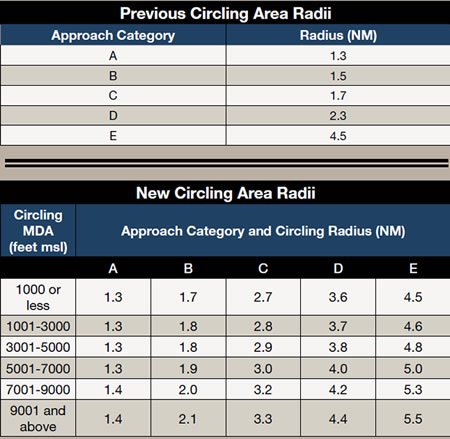
As noted in this articles main text, the FAA recently revised its criteria describing how much airspace is required to perform the circling maneuver. The new criteria consider the altitude at which the aircraft is circling. The higher the altitude, the greater the true airspeed when circling at the same indicated airspeed, and thus the greater the turn radius, which makes expanding the protected airspace desirable. The downside? Many minimum descent altitudes for circling approaches will be going up. The two tables below compare the previous criteria to the new.
Protected Airspace For Circling Approaches
As noted in this articles main text, the FAA recently revised its criteria describing how much airspace is required to perform the circling maneuver. The new criteria consider the altitude at which the aircraft is circling. The higher the altitude, the greater the true airspeed when circling at the same indicated airspeed, and thus the greater the turn radius, which makes expanding the protected airspace desirable. The downside? Many minimum descent altitudes for circling approaches will be going up. The two tables below compare the previous criteria to the new.

Key Takeaways:
- The FAA has revised its criteria for circling maneuver airspace, now considering altitude to account for increased true airspeed and turn radius at higher altitudes.
- This update will lead to higher Minimum Descent Altitudes (MDAs) for many circling approaches.
- New symbols on Aeronav and Jeppesen charts will indicate when these revised circling criteria have been applied to a procedure.
Key takeaways sponsored by Aviator Pro | Start Your Training ->
See a mistake? Contact us.

