












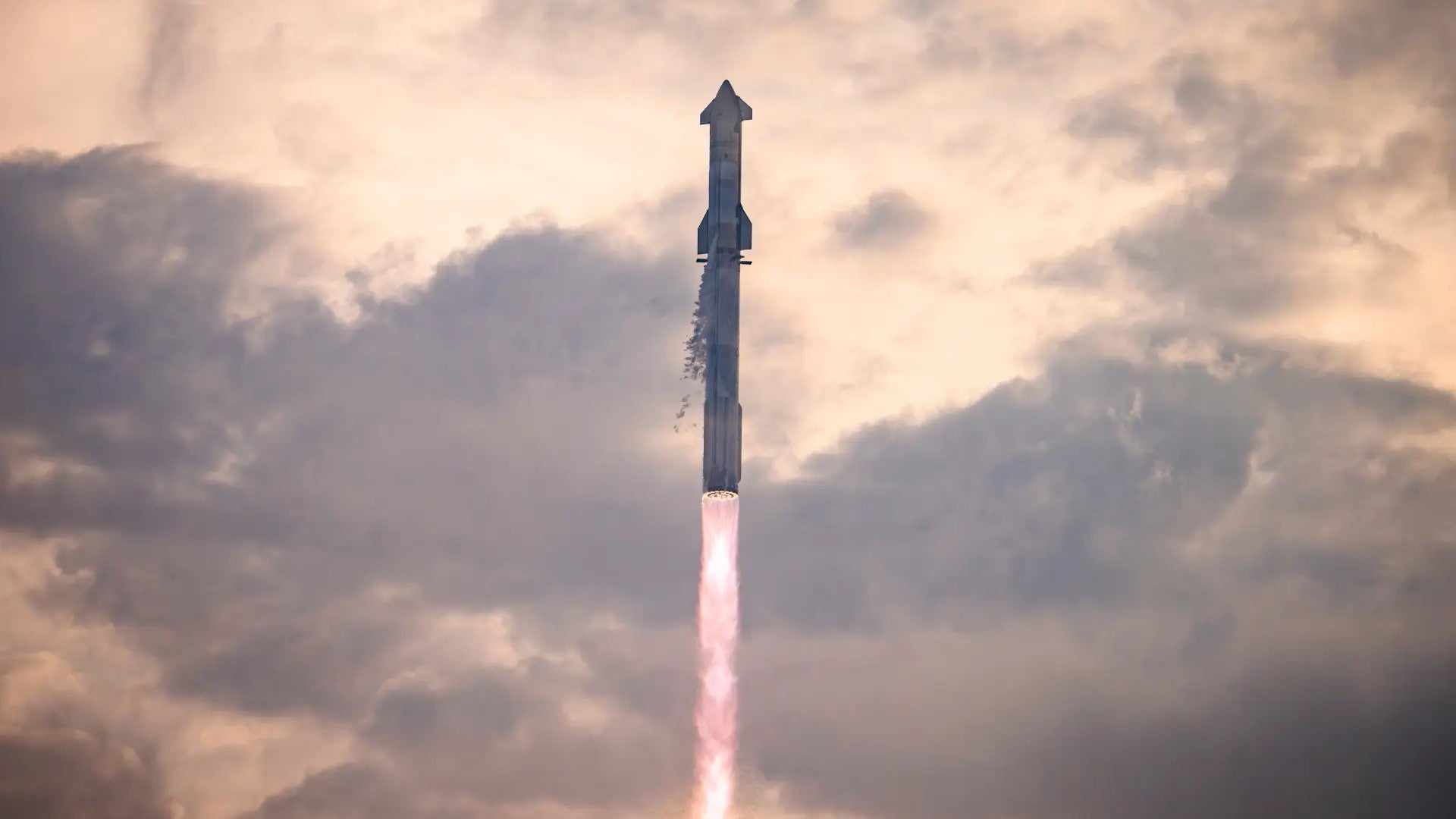


SpaceX this week moved one step closer to securing a launch license modification that would allow it to fly its gargantuan Starship rocket over portions of the mainland U.S., including Florida, Texas, and California.
The company will still need to obtain that modification from the FAA. But the regulator on Friday issued a finding of no significant impact (FONSI) for SpaceX’s proposal to add new Starship launch trajectories to its Starbase pad in Texas.

The proposed trajectories would require the FAA to create new aircraft hazard areas (AHAs), which are designed to segregate commercial space activities from normal air traffic. In its final tiered environmental assessment (EA) of the proposal, the agency estimated that an AHA for Starship launches over Florida could impact as many as 8,800 commercial aircraft operations per year. That trajectory would allow Starship—which has thus far been limited to suborbital test flights—to finally reach orbit.
That’s just one of SpaceX’s goals for 2026. It also aims to catch and return Starship to the launch pad in Texas—a feat it has achieved multiple times with the rocket’s Super Heavy booster—in order to achieve full reusability. An AHA for Starship returns could cover portions of airspace over Texas, New Mexico, Arizona, and California, as well as Mexico, affecting up to 4,400 commercial aircraft operations annually.
Each AHA could require “dozens” of airway closures over the Atlantic Ocean, the FAA said. They could also impact airspace around Mexico, Cuba, Jamaica, and the Cayman Islands, requiring the FAA to coordinate with those countries’ governments.
“The areas evaluated for environmental impacts in this Tiered EA include noise and noise‐compatible land use; aviation emissions and air quality; hazardous materials, solid waste, and pollution prevention; and socioeconomics,” the FAA wrote in the EA. “In each of these areas, the FAA has concluded that no significant impacts would occur as a result of the proposed action.”
At launch, Starship generates close to 17 million pounds of thrust—almost double that of NASA’s Space Launch System or Apollo-era Saturn V rockets. The rocket stands nearly 400 feet tall when stacked on Super Heavy.
SpaceX in 2025 launched Starship on a suborbital trajectory that took it over the straights of Florida and passed Cuba to the north. The area had to be cleared of aircraft twice after Starship exploded on test flights in January and March, prompting the FAA to activate a debris response area. By the end of 2025, though, Starship made it to splashdown on consecutive flights.
Commenters on the EA said the FAA lacks “adequate real-time tracking and alerting systems for falling debris during rocket launches and reentries.” After the explosion in January SpaceX reportedly waited about 15 minutes to alert the FAA. Some air traffic controllers (ATCs) reportedly learned about the incident from pilots who witnessed it firsthand.
Steve Jangelis, aviation safety chair for the Air Line Pilots Association (ALPA), criticized the FAA’s analysis of the new Starship trajectories as “extremely vague” in an October letter to the Office of Commercial Space Transportation.
Jangelis warned that there is “high potential for debris striking an aircraft resulting in devastating loss of the aircraft, flight crew, and passengers” and said the agency “continues to ignore fundamental airspace safety and operational issues essential to a safe and efficient [National Airspace System [NAS].”
“No aircraft have been put at risk and any events that generated vehicle debris were contained within pre-coordinated response areas,” SpaceX wrote on X in December, though neither it nor the FAA have shared exactly where debris fell after the January and March incidents.
The regulator in a Safety Alert for Operators dated January 8 warned pilots they should be ready to “exercise extreme caution” when flying below the trajectory of commercial spacecraft—some of which have the potential for “catastrophic failures resulting in debris fields.”
Era of Commercial Spaceflight
Fiscal year 2025 set a new high water mark for commercial spaceflight, with the FAA licensing more than 200 launches and reentries. That shattered its previous mark of 146 licensed operations in fiscal year 2024.
Already in fiscal year 2026, the agency has licensed 68 operations. Per its latest 10-year forecast, it expects to authorize anywhere from 2,000 to 4,000 launches over the next decade.
SpaceX—responsible for the bulk of those launches—will continue to be a ubiquitous presence in Earth orbit.
In 2025, the FAA signed off on an increased cadence for Starship at Starbase, raising the limit from five to 25 launches annually. Earlier this month, the agency finalized an environmental impact statement for up to 44 annual Starship launches from Launch Complex 39-A at Kennedy Space Center in Florida. And recently, the U.S. Air Force signed off on the construction of two Starship launch pads at neighboring Cape Canaveral Space Force Station, which could handle 76 launches per year.
Some stakeholders contend that the FAA is not adequately scrutinizing the potential impacts from spaceflight operations.
“Ensuring a safe NAS while promoting commercial space operations by the private sector is a direct conflict of interest with the FAA’s delegated responsibilities to ensure a safe and efficient NAS,” Jangelis wrote in October.
Nonetheless, the regulator could roll back environmental reviews and other portions of its Part 450 launch and reentry licensing requirements, as directed by an August executive order.

