When you write about aviation for a living, it’s easy to get buried in the narrative. But sometimes there are events and stories that we remember better than others.
As is tradition at FLYING, we’re taking a look back at 2025 for the stories we remember the most.
D.C. Midair
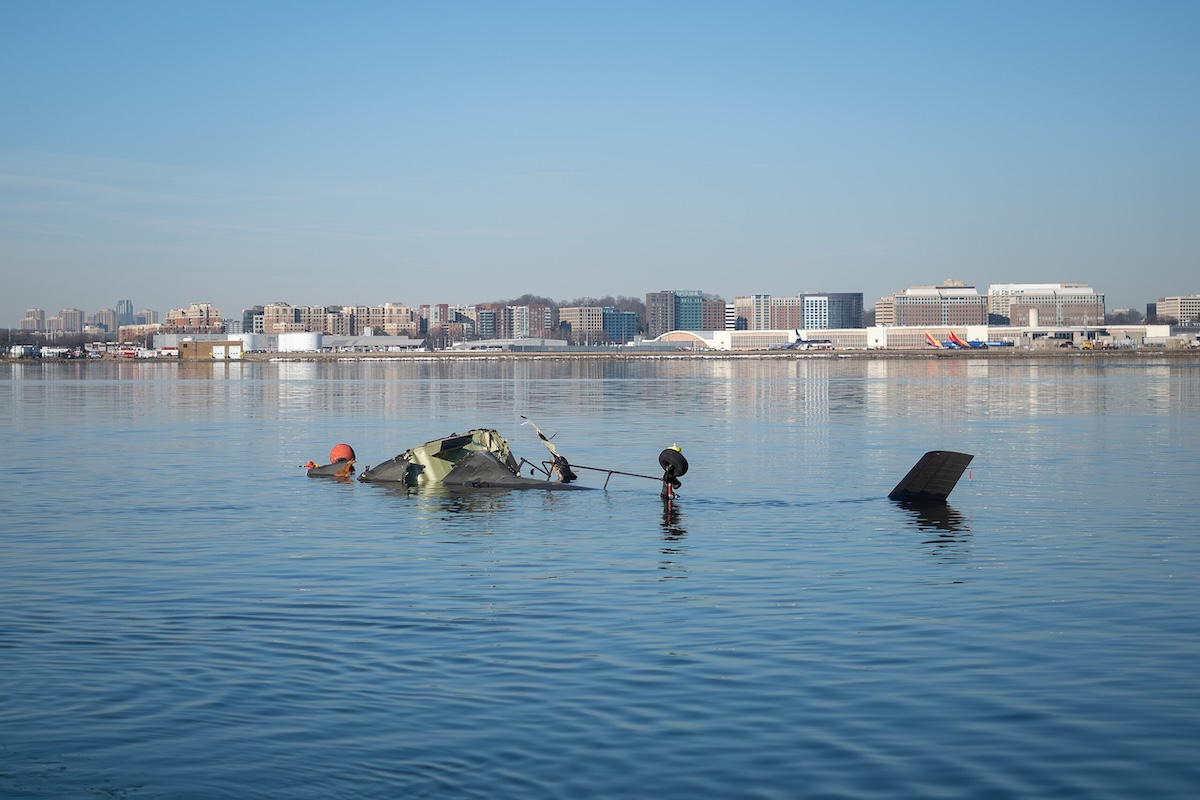
It was a deadly start to 2025. On the night of January 29, a U.S. Army Sikorsky UH-60L on a training mission over the Potomac River collided with a PSA Airlines Bombardier CRJ700 (Flight 5342) when the jet was on final approach to Ronald Reagan Washington National Airport (KDCA) in Arlington, Virginia.
The three-person crew of the helicopter and 64 people aboard the jet, including the two pilots and two flight attendants, were killed as the aircraft plunged into the river.
The National Transportation Safety Board (NTSB) is still investigating the accident. Of particular interest to authorities is that the helicopter, although equipped with ADS-B, was not broadcasting at the time of the crash. The agency has recommended better procedures to separate military and civilian traffic at busy airports.
The final report’s release is likely still several months away.
Delta Connection Rollover
In February the aviation world saw the dramatic video of Delta Connection Flight 4819, operated by Endeavor Air, experiencing a rollover crash during landing at Toronto Pearson International Airport (CYYZ) in Canada.
Video shot by someone in another aircraft awaiting takeoff showed the Bombardier CRJ900 landing hard and the landing gear collapsing, leading to a wing dragging on the runway and the aircraft rolling over and catching fire. According to information from the Transportation Safety Board of Canada, the weather at the time of the accident included gusting winds and icy conditions on the runway.

Although 21 people were injured, there were no fatalities, as the cabin crew was able to quickly evacuate all the passengers from the burning jet.
MOSAIC
In July the FAA released the Modernization of Special Airworthiness Certification (MOSAIC), appropriately enough during the annual aviation migration in Oshkosh, Wisconsin, known as EAA AirVenture.
The new rule expands the privileges of sport pilots by revamping the definition of aircraft eligible to be flown by them. Under the 2004 sport pilot rule, light sport aircraft (LSAs) were primarily defined by a gross weight of 1,320 pounds and a stall speed of 45 knots clean.
Under MOSAIC the weight limitation has been removed in favor of performance that expands sport pilot privileges to flying aircraft with stall speeds up to 61 kcas with flaps and a max airspeed of 250 knots. Industry leaders note this means many traditional training aircraft, such as the Cessna 150, 152, and 172, can now be flown solo by someone with a sport pilot certificate.

The new rule allows an expansion of privileges for sport pilots. Among them are the opportunity to receive additional training and obtain endorsements to fly complex aircraft and to fly at night.
MOSAIC will continue to evolve in 2026, as the light sport aircraft definition will be removed from 14 CFR 1.1, and after July 24, special airworthiness certificates will be issued to qualifying aircraft.
High-Profile NTSB Investigations
Fall 2025 saw the conclusion of the NTSB investigations into two high-profile general aviation accidents.
The first was the September 27, 2023, crash involving a Snapchatting CFI and a student pilot who were killed during a night cross-country flight in a Piper Warrior into a thunderstorm over Kentucky.
The final report revealed the flight was the first time student pilot Conner Quisenberry, 18, was flying with the CFI, 22-year-old Timothy McKellar Jr. The agency noted Quisenberry’s regular instructor could not provide instruction, as his medical certificate prohibited flying at night, so Quisenberry was paired with McKellar. Some years before, McKellar had trained up through first solo with Quisenberry’s CFI, then “by mutual agreement” finished his training elsewhere.
During the final flight, McKellar, who had a social media presence, documented his dissatisfaction with Quisenberry’s performance on Snapchat, making disparaging remarks. These comments went viral after the crash.
The NTSB final report revealed that McKellar had obtained a weather briefing prior to the flight, which revealed the probability of thunderstorms in the vicinity. During the flight he posted a screen grab of the storms they were heading toward.
The final report also included photographs of what was left of the cockpit of the Piper— parts of the fuselage, wings and the panel with a twisted control column—along with details of the widespread scattering of the wreckage over several acres.
The second NTSB final report was the October 1, 2023, crash of the Cessna Cardinal in New York that killed Richard McSpadden, the senior vice president of the Aircraft Owners and Pilots Association’s Air Safety Institute, and Russ Francis, a former NFL tight end for the New England Patriots and San Francisco 49ers and the owner of Lake Placid Airways.
The pair were flying a Cessna 177RG from Lake Placid Airport (KLKP) in New York for a photo shoot for the AOPA when shortly after takeoff they reported an issue later identified as an uncommanded loss of engine power that necessitated a return to the airport. According to witnesses, the aircraft entered a low-altitude steep turn to head back to the airport. The airport sits on a bluff, and the aircraft came down in a ravine short of the runway.
The final report revealed the aircraft was outside the forward CG limit at the time of the accident, “which likely degraded the controllability of the airplane,” and the “subsequent partial loss of power during the takeoff and climb” combined with higher-than-normal density altitude and the pilot’s aggressive turn back to the runway resulted in an aerodynamic stall “from which a safe recovery by the pilot was not possible.”
Government Shutdown
The shutdown of the government, starting on October 1 and lasting 43 days, was felt in the aviation world as federal workers, including air traffic controllers (ATCs), went without pay and were stretched to their limits. Commercial flights were cut back in the name of safety, stranding travelers.
Meanwhile, at the general aviation level, pilots experienced a reduction in available services triggered by a shortage in staffing.
The shutdown also closed the Smithsonian’s National Air and Space Museum, which created a temporary delay in the institution’s massive redesign that has been in the works since 2018. The phased project includes a redesign of all 20 galleries and modernization of the museum’s infrastructure, such as the mechanical systems.
When the government reopened, the project resumed. The redesign is scheduled to be completed by July in time for the museum’s 50th anniversary.