















Boeing-Backed Evio Unveils Regional Hybrid-Electric Concept

Company makes public debut with the announcement of a hybrid-electric model for up to 100 passengers.

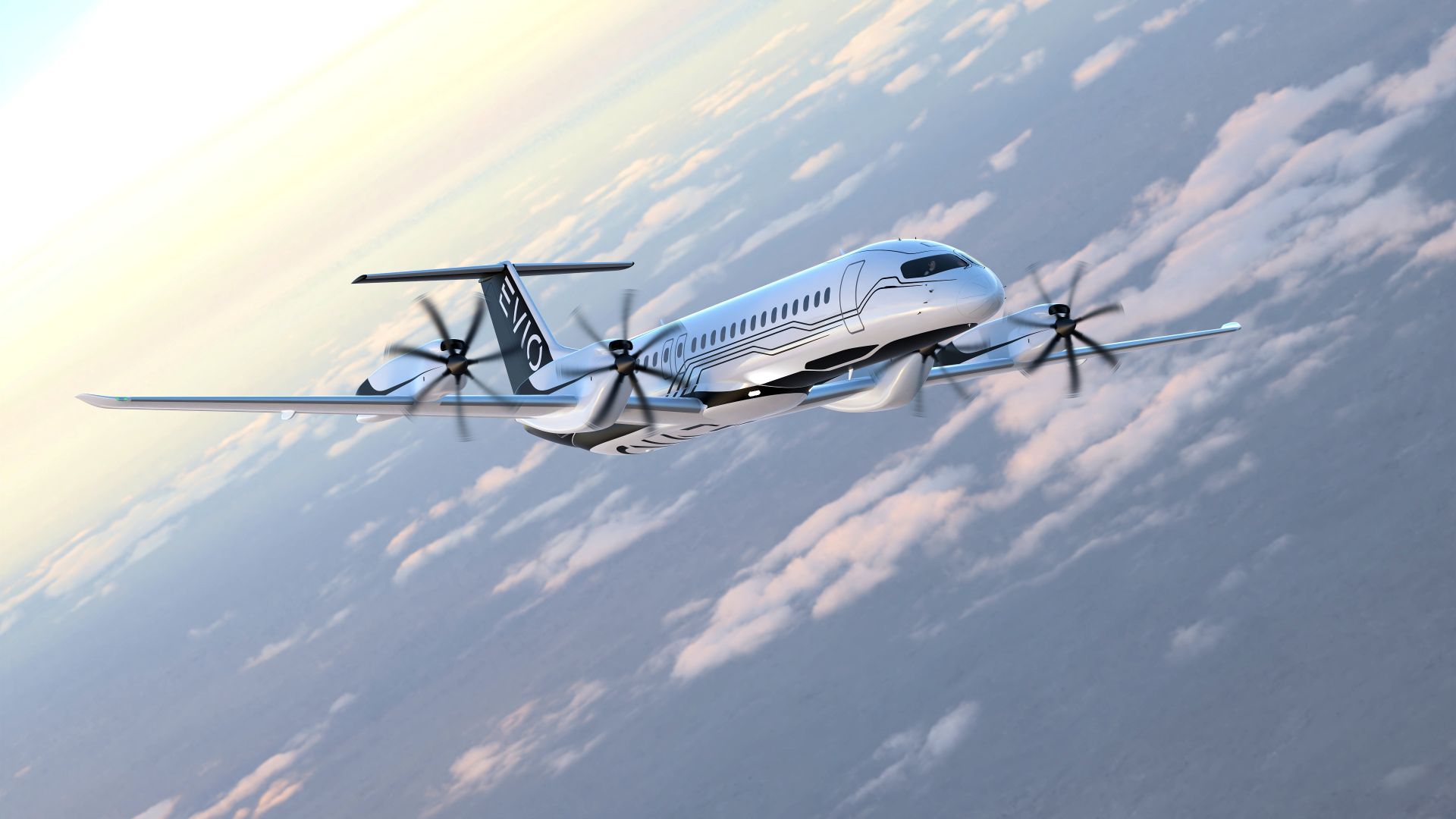
Evio 810 hybrid electric regional aircraft
The Evio 810 is planned to accommodate up to 100 passengers on regional flights spanning about 500 nm. [Credit: Evio]
Gemini Sparkle

Key Takeaways:

  • Canadian company Evio has publicly debuted its Evio 810, a hybrid-electric, 76-to-100-passenger aircraft, aiming for service by the early 2030s, with backing from Boeing and a propulsion partnership with Pratt & Whitney Canada.
  • The Evio 810 features a "strong-hybrid architecture" enabling all-electric takeoffs/landings and hybrid power for longer missions, designed to offer regional airlines reduced emissions and operational/maintenance costs.
  • Evio has already secured significant market interest, having signed conditional purchase agreements for 250 aircraft and an additional 200 options with "major airlines."
See a mistake? Contact us.

There’s a new player threatening to shake up regional aviation.

Thursday marked the public debut of Canada’s Evio—the developer of a clean-sheet, hybrid-electric, 76-to-100-passenger aircraft that it anticipates will enter service by the early 2030s. The company, which began exploring the hybrid concept in 2019, is bolstered by an undisclosed investment and “technical support” from Boeing.


It is also working with Pratt & Whitney Canada to develop what it described as a “highly innovative hybrid-electric propulsion architecture” based around the manufacturer’s PT6 E-series engine.

Evio aims to secure demand from regional airlines by offering reduced emissions and operational and maintenance costs. The company said it signed conditional purchase agreements with a pair of “major airlines” for 250 aircraft and an additional 200 options in 2023.

Evio told FLYING it will reveal those customers at a later date. But at least one of them may be an American carrier—the company’s boilerplate notes it has operations in Canada as well as the U.S.

“From day one, our focus has been on increasing profitability for regional operators and providing an exceptional passenger experience,” said Michael Derman, CEO of EVIO, in a statement. “We’ve recognized early on that a strong-hybrid architecture can provide unmatched efficiencies for airlines, helping them sustain vibrant regional networks in a cost-effective, responsible way.”

By “strong-hybrid architecture,” Derman means Evio’s flagship Evio 810 will be capable of hybrid-electric as well as fully electric operations. Takeoffs and landings will be all-electric, and longer missions will rely on hybrid power. But the company said that even with the energy density of today’s electric batteries, the aircraft would be capable of short all-electric flights.

Evio projects demand for more than 7,500 regional turboprops and jets over the next two decades. Per the company’s analysis of data from travel data provider OAG, of 100,000 daily global flights, about 47,000 are under 500 nm. That range, it told FLYING, will be optimal for Evio 810 operations. But longer missions could become available as battery energy density improves.

In addition to carrying passengers, Evio said the vehicle could fly cargo or conduct military missions such as intelligence, surveillance, and reconnaissance. Per its website, an autonomous defense variant could come equipped with the 463L Master Pallet, which is used to transport military air cargo.

Evio 810 hybrid electric aircraft in potential defense configurations
Evio shared a rendering of its Evio 810 in potential defense configurations, which could include autonomous. [Credit: Evio]

The company’s leadership brings plenty of expertise in that department. Derman, for example, was the former vice president of strategy and innovation for Sierra Nevada Corporation. His LinkedIn lists him as the CEO of another firm, Q Aerospace, that is described as a “defense aircraft design and development company.”

Evio’s board includes former Airbus senior vice president Rob Dewar, who led development of the A220 program, and former Lockheed Martin executive vice president Frank Cappuccio, who led the company’s Skunk Works unit from 2001 to 2011 and oversaw its successful bid for the military’s F-35 Joint Strike Fighter program—the largest weapons acquisition program in its history.

Introducing Evio

Evio has not yet built an aircraft. Derman told FLYING the company “remained in stealth mode while conducting rigorous trade studies.”

But it is working toward conceptual design readiness review—the “industry-recognized gate that provides the governance needed to validate that an airframer’s design and architectural approach offer product–market fit and a clear path to certification,” Derman said.

Engineers will work with Pratt & Whitney to study the PT6 E-series. Per the manufacturer, the E-series is the first engine family for general aviation turboprops that incorporates a dual-channel, integrated electronic propeller and engine control system, delivering 10 percent increased power for greater cruise and climb efficiency. In October, after only five years in service, it surpassed half a million flight hours, powering airframes such as the Pilatus PC-12 NGX and Daher TBM 960.

The PC-12 NGX and TBM 960 are smaller regional turboprops, designed for up to five and 10 passengers, respectively. But Evio said most of the power onboard its aircraft will come from the batteries and electric motors, allowing it to accommodate a less powerful—but smaller and more efficient—turbine.

That, it said, will reduce operational costs through fuel savings. And with fewer moving parts, the smaller turbine will require less frequent inspections, lowering maintenance costs. A digital rendering shared by Evio appears to depict a four-engine turboprop configuration.

“We will leverage the proven performance and unmatched reliability of the PT6E engine, as well as our decades of experience in propulsion technology innovation and systems integration, to unlock new possibilities for aircraft fuel efficiency and mission versatility,” said Scott McElvaine, vice president of sales and marketing for Pratt & Whitney.

Evio told FLYING the Evio 810 will also feature a proprietary fly-by-wire system. It will have a takeoff weight of 86,000 pounds and speed comparable to that of a regional turboprop. Per the company’s boilerplate, the 810 will be part of a larger “family” of hybrid-electric designs.

With an estimated capacity of 76 to 100 passengers, the Evio 810 immediately becomes one of the largest hybrid-electric regional aircraft concepts to be announced.

Maeve Aerospace, which is also working with Pratt & Whitney as well as Delta Air Lines, is similarly developing a 76-to-100-passenger model. But others are aiming smaller. Beyond Aero’s BYA-1 is designed for up to six passengers, Electra’s EL9 for up to nine, and Heart Aerospace’s ES-30 for up to 30.

Battery energy density is the key limitation on range and capacity for these designs—longer missions require additional batteries, which add weight. Evio, though, is making a bet that the technology will mature enough to enable much larger aircraft.

Jack Daleo

Jack is a staff writer covering advanced air mobility, including everything from drones to unmanned aircraft systems to space travel—and a whole lot more. He spent close to two years reporting on drone delivery for FreightWaves, covering the biggest news and developments in the space and connecting with industry executives and experts. Jack is also a basketball aficionado, a frequent traveler and a lover of all things logistics.

Ready to Sell Your Aircraft?

List your airplane on AircraftForSale.com and reach qualified buyers.

List Your Aircraft
AircraftForSale Logo | FLYING Logo
Pilot in aircraft
Sign-up for newsletters & special offers!

Get the latest stories & special offers delivered directly to your inbox.

SUBSCRIBE
