













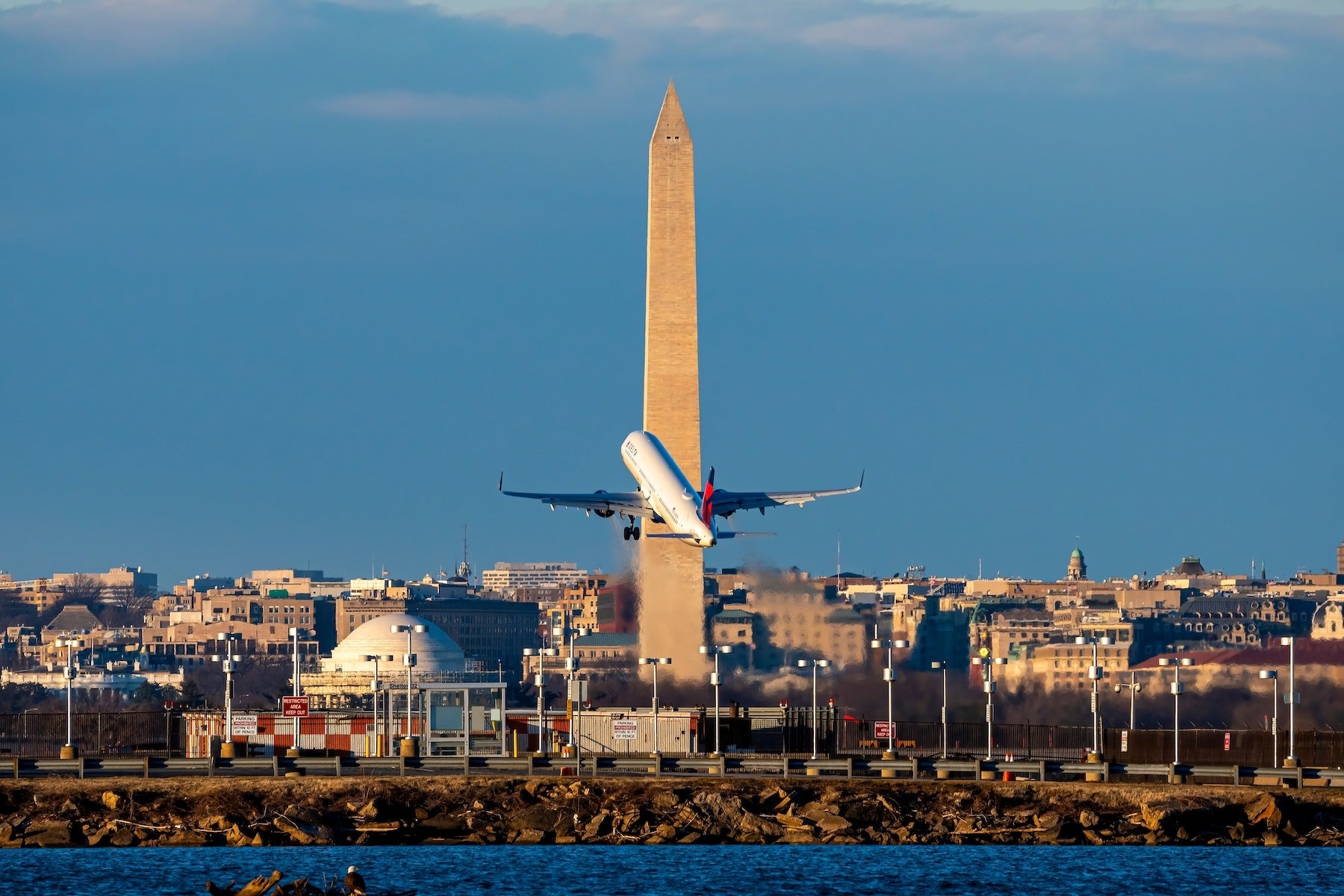


A compromise version of the national defense authorization bill for fiscal year 2026 imposes new requirements on military aircraft operating over the Washington, D.C., metro area but also provides exemptions not present in the U.S. Senate’s proposed ROTOR Act.
The legislation would restrict military training flights from operating within a roughly 30-mile radius of the capital city unless they are actively broadcasting their position. But the secretaries of the departments of Defense and Transportation would have the power to waive the broadcasting requirement over national security concerns, or if commercial flights are judged not to be at risk.

The departments would have to notify Congress about waivers that last more than 30 days.

The provisions of the National Defense Authorization Act (NDAA) are less stringent than the ROTOR Act, put forward by Senate Commerce Committee Chairman Ted Cruz (R-Texas) and Ranking Member Maria Cantwell (D-Wash.). That bill would require all civilian and military aircraft to operate with ADS-B Out broadcasting, and to be equipped with ADS-B In.
The ROTOR Act was drafted in response to the deadly January collision between an American Airlines flight and a U.S. Army Black Hawk helicopter over the Potomac River. All 67 people on both aircraft were killed.
The Black Hawk had ADS-B, but the system was not broadcasting at the time of the crash.
The National Transportation Safety Board (NTSB) is still investigating the accident but has advanced recommendations seeking to better separate civilian and military aircraft at busy airports like Ronald Reagan Washington National Airport (KDCA), where the American flight was preparing to land.
The ROTOR Act passed out of the Commerce Committee in October but has not been taken up by the full Senate.
NTSB Response
NTSB Chair Jennifer Homendy came out strongly against the NDAA subsection dealing with D.C.’s airspace in a letter addressed to the chairmen and ranking members of the Senate and House armed services committees. She labeled the language an “unthinkable dismissal” of her agency’s investigation that would undo much of the work done by the NTSB, the FAA, and the Department of Defense in the months since the Potomac collision to make the area safer.
“This section, to the lay reader, is drafted to seemingly enhance safety; it does not in any way enhance safety,” Homendy wrote. “In fact, it significantly reduces the safety of the airspace around Ronald Reagan Washington National Airport by allowing the secretary of any military department to operate training missions in the DCA airspace in a manner that already existed prior to the midair collision on January 29th.”
The provision effectively gives military aircraft on training missions “unfettered access to D.C. airspace,” she continued.
Homendy urged the lawmakers to reconsider the subsection and said she would work with them to address the NTSB’s safety concerns.

