














California manufacturer Alef Aeronautics said Tuesday that it began production on its Model A Ultralight—a “drive-and-fly” vehicle that it believes will be the first true “flying car” to be delivered to a customer.
Alef said the vehicle, which is designed to lift off directly from roads and allow its occupants to soar over traffic, will take “several months” to build. It will be delivered to “only a few early customers, for the purpose of testing flying cars in the real-world environment, under very controlled conditions,” Alef said. Customers will be selected from a queue of investors with the “highest deposit and priority,” the company told FLYING.

The strategy echoes that of Pivotal, which put its Blackfly prototype—a personal electric vertical takeoff and landing (eVTOL) design—in the hands of a few customers before opening sales of its production model Helix in 2024.
Like the Blackfly and Helix, the Model A Ultralight has VTOL capability. But the latter’s automobile-like features make it even more complex. It is powered by eight propellers embedded in a mesh shell surrounding the driver’s seat. After liftoff, the vehicle rotates so that its left and right sides become upper and lower wings. The driver’s seat gyrates forward to face what was the vehicle’s roof in car configuration, becoming a cockpit.
By putting the Model A Ultralight in customers’ hands and testing those features in a realistic environment, Alef believes it can chart a path toward scaled production of its larger Model A—the flagship design it plans to sell for $300,000. It intends to provide training, maintenance, and compliance services for pilots conducting testing with the ultralight variant, which it said has reduced weight and “some mechanical changes” to qualify for the FAA’s Part 103.
“The knowledge gained from this process will support the transition to manufacturing and delivering pre-orders in the queue,” Alef said in a statement.
Path to a Flying Car
Alef’s road to certifying the Model A won’t be easy.
Most of the information known about the vehicle comes from a 2023 press conference, during which CEO Jim Dukhovny unveiled it publicly. It will be designed for a driver-pilot plus one passenger, with a range of about 200 miles on the ground and 110 miles (92 nm) in the air.
According to Dukhovny, a Model A prototype has been flying for years. However, there are no videos of the vehicle making the transition from a car to an aircraft. It will need to prove that capability, as well as its adherence to the rules of both the road and the sky.
Dukhovny said the Model A will initially be certified as a “low-speed vehicle” on the ground, limiting it to about 25 mph on public roadways. But he has floated the idea of pursuing light-sport aircraft (LSA) certification under the updated MOSAIC framework.
“I think this is too good to be true (there are probably more sober restrictions in there, and this will not be fast), but this might be HUGE for Alef!” Dukhovny wrote of MOSAIC in a post on LinkedIn.
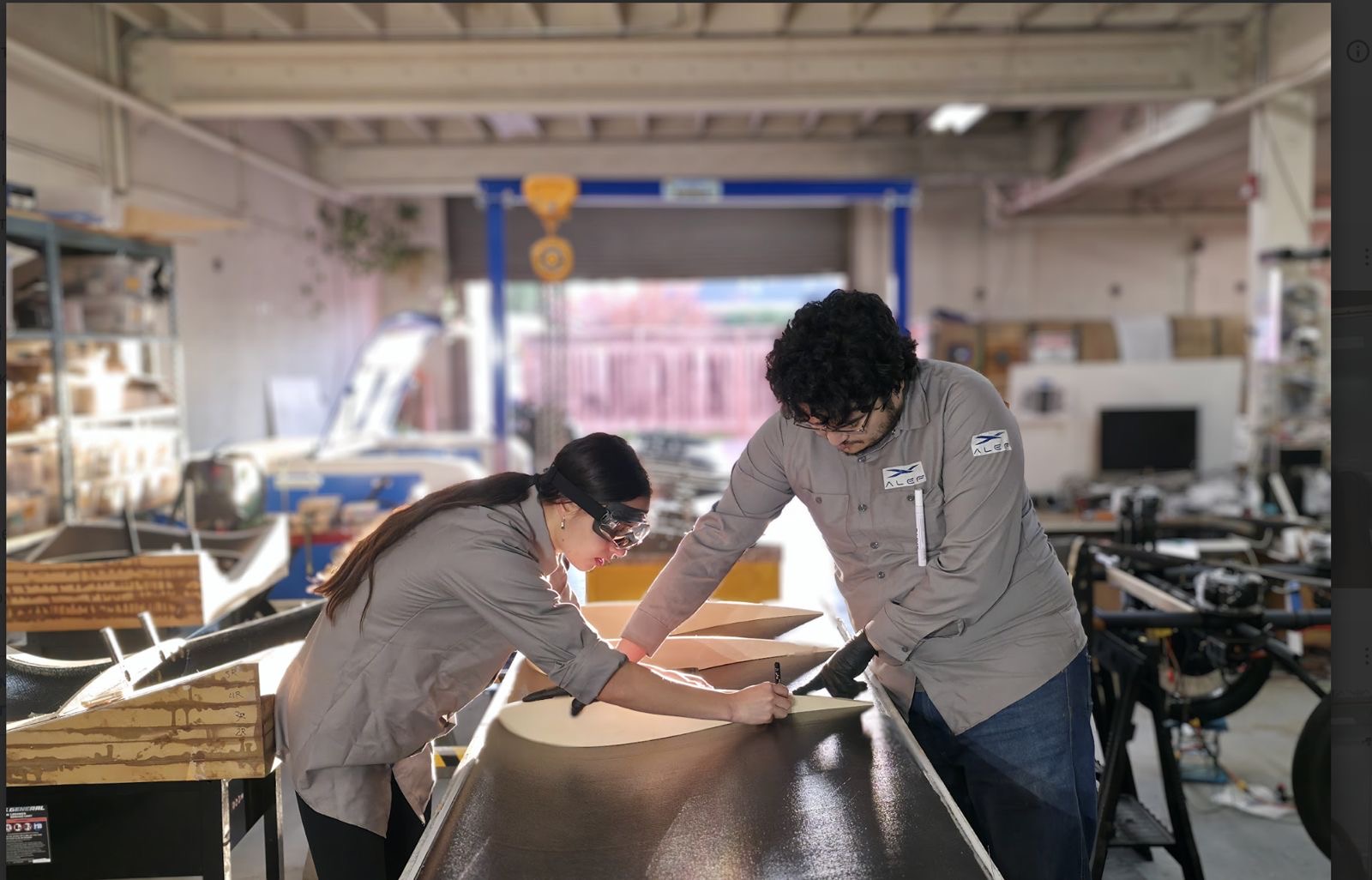
Alef said the Model A Ultralight production process will be aided by robotic and industrial manufacturing, but most work will be completed by hand at its Silicon Valley, California, facility. The company said it would conduct “rigorous testing” of individual components as well as full-aircraft flight testing before delivering to customers. It said the campaign will help it “optimize manufacturing” ahead of Model A production.
At the same time, Alef is conducting testing with its Model Zero Ultralight, a prototype, using an experimental category special airworthiness certification. Weighing about 250 pounds, the Model Zero can fly with a pilot or be controlled remotely from the ground. The remote pilot in command (PIC) receives real-time battery, temperature, vibration, and other data and can activate a “kill switch” that cuts propulsion. An automated system tells the aircraft if communications are lost, and a backup glider system can be used in emergencies.
The Model Zero Ultralight generated some buzz in February, when Alef shared videos of it flying over the streets of California—the first documentation of a car driving and taking off vertically on a city street, the company said.
Alef later signed flight testing agreements with California’s Half Moon Bay (KHAF) and Hollister Municipal (KCVH) airports, which it said could one day serve as bases for Model A fleets. Those tests will begin with the Model Zero Ultralight before moving to the Model Zero and finally the Model A.
Alef said the vehicles will demonstrate driving, VTOL, and flying, attempting to mirror common air traffic patterns. It will use visual observers and artificial intelligence-based obstacle recognition to monitor traffic, giving crewed aircraft the right of way.

