














Beyond Aero’s Hydrogen-Electric Aircraft Program Heads to Wind Tunnel

Testing represents one of the final stages in the company’s preliminary design phase, which it expects to complete soon.

Beyond Aero scale prototype hydrogen electric aircraft wind tunnel test
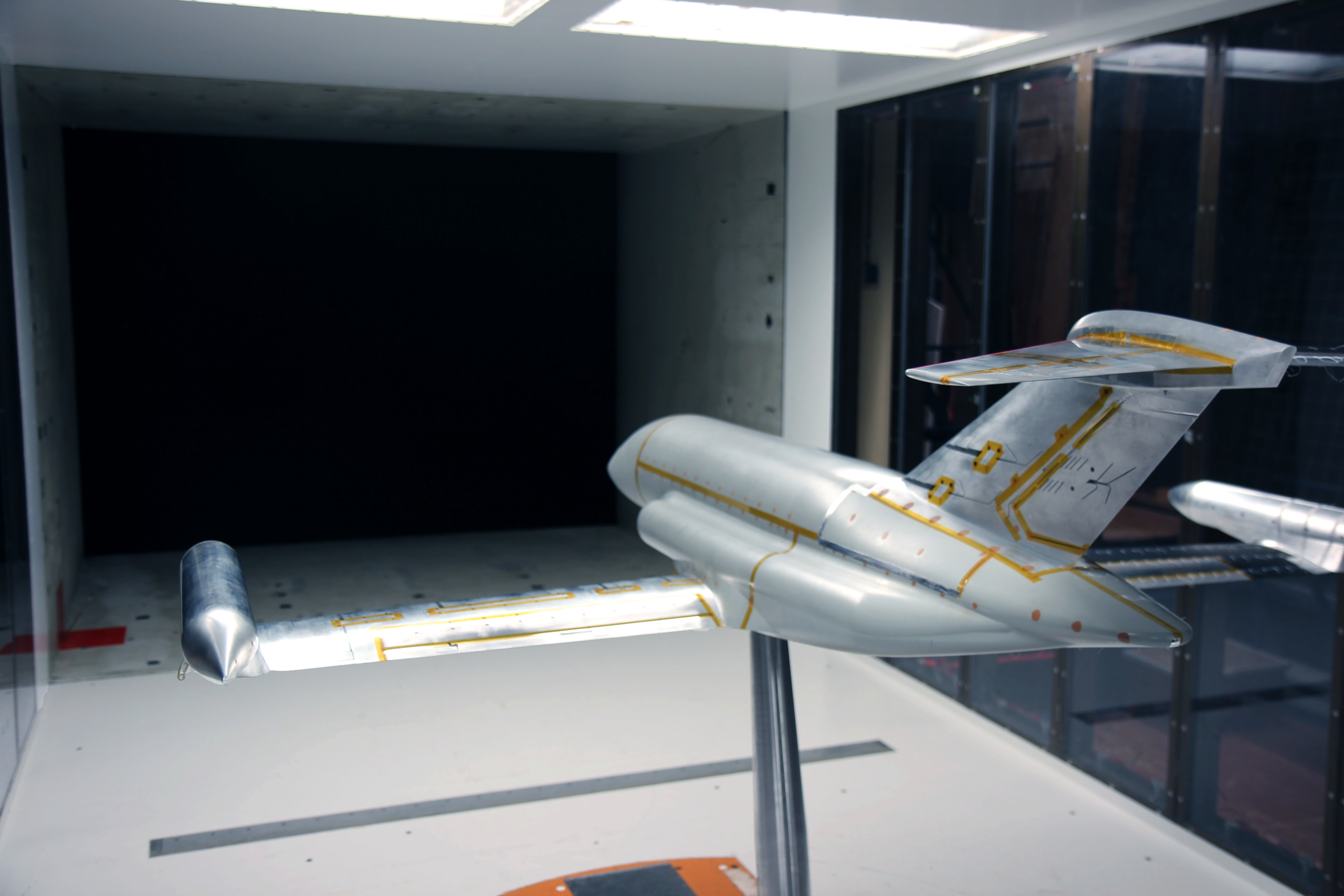
A one-eighth scale model of Beyond Aero’s hydrogen-electric BYA-1 concept completes wind tunnel testing in the Netherlands. [Credit: Beyond Aero]
Gemini Sparkle

Key Takeaways:

  • French company Beyond Aero successfully completed initial wind tunnel testing for its BYA-1 hydrogen-electric light business jet, validating its unique aerodynamic design predictions.
  • A core feature of the BYA-1 is its external 700-bar gaseous hydrogen fuel tanks, chosen to improve crashworthiness and maximize usable cabin space.
  • Beyond Aero is nearing its preliminary design freeze and plans for EASA certification, targeting an introduction of the aircraft around 2030.
See a mistake? Contact us.

A French company developing what it bills as the first hydrogen-electric light business jet is starting to put its unique architecture through experimental testing.

Beyond Aero—developer of the BYA-1, which it aims to introduce around 2030—on Monday revealed that it completed an inaugural wind tunnel test campaign using a one-eighth scale prototype. The company told FLYING it is nearing the final stage of its preliminary design phase, during which it will freeze the design. After that, it will begin formal certification efforts with the European Union Aviation Safety Agency (EASA).


Conducted over five weeks at the German-Dutch Wind Tunnels’ low-speed facility in Marknesse, Netherlands, in the fall, the testing validated performance that was predicted by Beyond’s numerical analysis of computational fluid dynamics (CFD), the company said. In other words, the model behaved in the wind tunnel exactly as expected.

German-Dutch Wind Tunnels low-speed facility Marknesse Netherlands
Beyond conducted the testing at the German-Dutch Wind Tunnels’ low-speed facility in Marknesse, Netherlands. [Credit: Beyond Aero]

Delphine Bonnaud, head of aerodynamics for Beyond, said wind tunnel testing was essential, since many performance metrics could not be studied numerically. That’s because the company’s concept positions a pair of 700-bar, gaseous hydrogen fuel tanks outside the fuselage—a decision it said was intended to improve crashworthiness.

“This approach makes sense because hydrogen is volume-driven: External storage preserves usable cabin space while addressing safety and integration constraints at the aircraft architecture level,” Bonnaud said. “Also, external tank positioning makes it easier to vent leaked hydrogen safely into the atmosphere rather than into the fuselage.”

Going Beyond

Beyond says its clean sheet design is optimized for gaseous hydrogen, with tanks that could store up to 250 kilograms. The hybrid propulsion system also includes electric engines and electric ducted fans.

Traveling with six passengers at 310 ktas, the BYA-1 has a predicted range of 800 nm with reserves. Per the company, that’s sufficient to cover about 80 percent of all European flight routes. It will also be capable of carrying up to eight passengers plus two pilots—or about 1,675 pounds of cargo—on shorter trips. Pilots will command it using fly-by-wire controls.

The aircraft was conceived with flexibility and comfort in mind. It has an expected takeoff ground roll of about 2,000 feet, approach angle of 5.5 degrees, and landing field length of about 2,500 feet. Passenger amenities include Starlink WiFi and large, elliptical windows.

Beyond unveiled the BYA-1 concept at the 2023 Paris Air Show. In March, though, it announced several key design changes, including moving the hydrogen tanks from the fuselage to above the wingbox structure. That removed high-pressure fuel lines from the aircraft’s cabin, addressing a potential safety concern. But it also added complexity to the design.

“Any shape deviation (such as a bump or cavity) can alter the flow around it, affecting all the aerodynamic forces like lift and drag,” Bonnaud said. “This is especially tricky at the ‘corners,’ particularly when they interact with the lifting surface. That’s why having the tanks outside makes aerodynamic optimization interesting.”

Numerical simulations were helpful in determining the optimal specifications for the BYA-1. But with such a unique configuration, wind tunnel testing was the only way to eliminate risk. The data gave Beyond a baseline for real-world performance that could be compared to its CFD analysis.

Beyond Aero team in wind tunnel with one-eighth scale hydrogen electric aircraft prototype
Beyond and German-Dutch Wind Tunnels personnel celebrate the inaugural wind tunnel test campaign. [Credit: Beyond Aero]

“While we knew where they could yield different results (such as the stall), we can now assign specific values to these differences,” Bonnaud said.

Testing at wind speeds close to 180 mph to reproduce the aerodynamic conditions of takeoff and landing, Beyond studied global aerodynamic forces and moments, such as lift and pitch. It also collected local data from more than 230 pressure taps spread across the airframe. Per Bonnaud, the data encompassed a “wide range of configurations,” including “wind speeds, local pressure coefficients, variations across flap settings, control surface deflections, sideslip angles, and high-angle-of-attack conditions, including deep stall.”

The campaign generated more than 60,000 data points that Beyond said validated its numerical models. Performance, stability, and control were predictable across the flight envelope, it said. And stall behavior aligned with preliminary design targets.

The Outlook

Bonnaud said that wind tunnel testing will inform decisions made during the upcoming final phase of preliminary design, which she said will “allow for some adjustments” to the concept. The company expects to begin that phase in the near future.

“The program is progressing in a structured, certification-focused manner, with each step based on validated engineering results,” Bonnaud said.

Beyond claims that the BYA-1 will cut operational costs by up to 55 percent, due in part to having fewer moving parts than conventional aircraft. The other cost-saving mechanism, it contends, is hydrogen fuel, which it predicted will be more cost-efficient than jet-A-1 by 2030.

Though hydrogen is more efficient than conventional fuel, it is also—at least for now—more costly. A 2023 study by research group Steer, commissioned by the European Federation for Transport and Environment, predicted that even in 2035, flying with hydrogen could be 8 percent more expensive than kerosene. And it predicted that a tax on kerosene would be required to make hydrogen competitive.

That said, Beyond’s hydrogen-electric propulsion system in October reached Technology Readiness Level 6 (TRL6), moving from laboratory conditions to full-scale testing in a representative environment. The demonstration was supported by about $90 million worth of intellectual property, flight test data, and assets acquired from Universal Hydrogen after the hydrogen fuel cell-powered aircraft developer shut down in 2024.

Beyond is also working with EASA to establish a special condition for hydrogen-powered aircraft within the regulator’s CS-23 standard for normal category airplanes.

The French company is not the only one exploring hydrogen-electric propulsion. Elsewhere, ZeroAvia is working with Scotland’s LoganAir, the U.K.’s Hybrid Air Vehicles, and Dutch flag carrier KLM to introduce its ZA600 hydrogen-electric powertrain on 10-20 seat aircraft.

Jack Daleo

Jack is a staff writer covering advanced air mobility, including everything from drones to unmanned aircraft systems to space travel—and a whole lot more. He spent close to two years reporting on drone delivery for FreightWaves, covering the biggest news and developments in the space and connecting with industry executives and experts. Jack is also a basketball aficionado, a frequent traveler and a lover of all things logistics.

Ready to Sell Your Aircraft?

List your airplane on AircraftForSale.com and reach qualified buyers.

List Your Aircraft
AircraftForSale Logo | FLYING Logo
Pilot in aircraft
Sign-up for newsletters & special offers!

Get the latest stories & special offers delivered directly to your inbox.

SUBSCRIBE
