












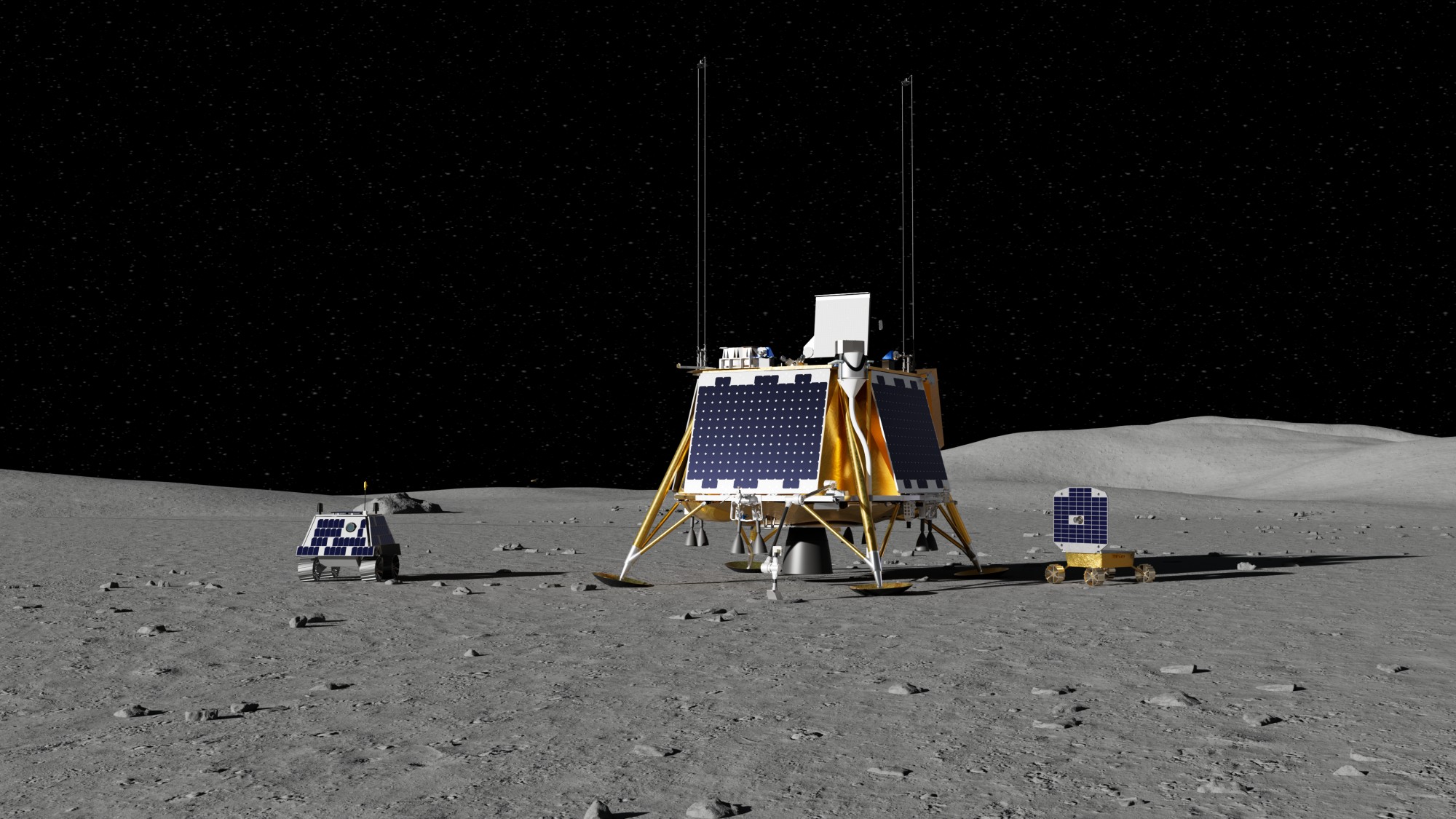


After a successful debut earlier this year, Firefly Aerospace’s Blue Ghost lunar lander has been tapped for a fourth moon mission.
NASA on Tuesday announced that Firefly won a $176.7 million task order for the delivery of two rovers and three scientific instruments to the lunar south pole in 2029. The award comes just months after Blue Ghost became the first privately built lander to survive a landing on the rocky satellite.

Over the course of its two-week mission, it deployed 10 NASA payloads and became the space agency’s most successful Commercial Lunar Payload Services (CLPS) project to date.
“These investigations will produce critical knowledge required for long-term sustainability and contribute to a deeper understanding of the lunar surface, allowing us to meet our scientific and exploration goals for the South Pole region of the Moon for the benefit of all,” Joel Kearns, deputy associate administrator for exploration for NASA’s Science Mission Directorate, said in a statement.
Launched in 2018, CLPS is designed to add commercial capabilities to NASA’s pool of rovers and landers.
CLPS contracts are end-to-end, meaning the awardee covers both build and launch costs. Beyond spurring the development of new technology, the initiative uses privately built landers to test systems and scout landing sites for the Artemis campaign—a successor to the Apollo missions.
The Artemis III lunar landing, scheduled for mid-2027, will send the first astronauts to the moon’s treacherous South Pole, portions of which have not seen sunlight in billions of years. Scientists believe these permanently shadowed regions may be hiding water, hydrogen, and other resources that humans could use to sustain a lunar presence.
But landing on the moon is not easy. Only five nations—the U.S., China, Russia, India, and Japan—have achieved soft landings, and there were none for the 37 years between the Soviet Luna 24 and Chinese Chang’e 3 missions.
It’s been a similar story for CLPS. Blue Ghost’s Mission 1 is the only success so far, though Intuitive Machines’ Nova-C Odysseus came close. A second Nova-C lander, launched in February, was rendered unusable after landing, while Astrobotic’s Peregrine was unable to attempt a landing.
Later this year, NASA expects to test Blue Origin’s Blue Moon Mark I lander and Astrobotic’s Griffin. Intuitive Machines is scheduled for another pair of CLPS missions in 2026 and 2027.
According to NASA, Blue Ghost Mission 4, a collaboration with the Canadian Space Agency (CSA), will be the first time it has deployed multiple rovers and instruments to explore the moon. A CSA-built rover and a second vehicle codeveloped by NASA, Carnegie Mellon University, and Astrobotic will survey the lunar regolith for resources and study the radiation and thermal environment.
The three scientific instruments, meanwhile, will each have a unique role to play. NASA’s Stereo Cameras for Lunar Plume Surface Studies (SCALPSS)—which snapped historic photos of a lunar sunset and total solar eclipse on Mission 1—will study how much dust is kicked up by rocket exhaust during the landing. Another payload will excavate, collect, and analyze lunar regolith samples. The third will use lasers to measure distances between the lander and orbiting spacecraft “for decades to come,” NASA said.
Blue Ghost will support data, power, and thermal systems throughout the approximately 12-day mission. It will land in an area with enough sunlight to generate solar power and use its antennae to beam data to Firefly’s mission operations center in Texas.
Notably, Mission 4 will feature Firefly’s Elytra Dark orbital vehicle, which is expected to debut on Missions 2 and 3. Elytra will deploy Blue Ghost to lunar orbit and continue orbiting the moon to capture imagery and serve as a communications relay. Both vehicles are built using flight-proven hardware and systems from Mission 1.
It’s unclear how the addition of Elytra Dark will affect Blue Ghost’s approach and landing on the moon, which was the toughest segment of its debut mission. The pickup truck-sized lander flipped itself and decelerated from about 3,800 mph to 90 mph, touching down on shock-absorbent legs.
The new CLPS contract is a big win for Firefly, which has struggled to get its orbital launch business off the ground. Mission 1 flew on a SpaceX Falcon 9 rocket. But the company envisions its Alpha launch vehicle filling that role in the future. Alpha was grounded in April after suffering its fourth partial or complete failure in six launch attempts.
Firefly is also developing a medium launch vehicle called Eclipse, codeveloped and backed by $50 million in funding from Northrop Grumman.
Like this story? We think you’ll also like the Future of FLYING newsletter sent every Thursday afternoon. Sign up now.

