


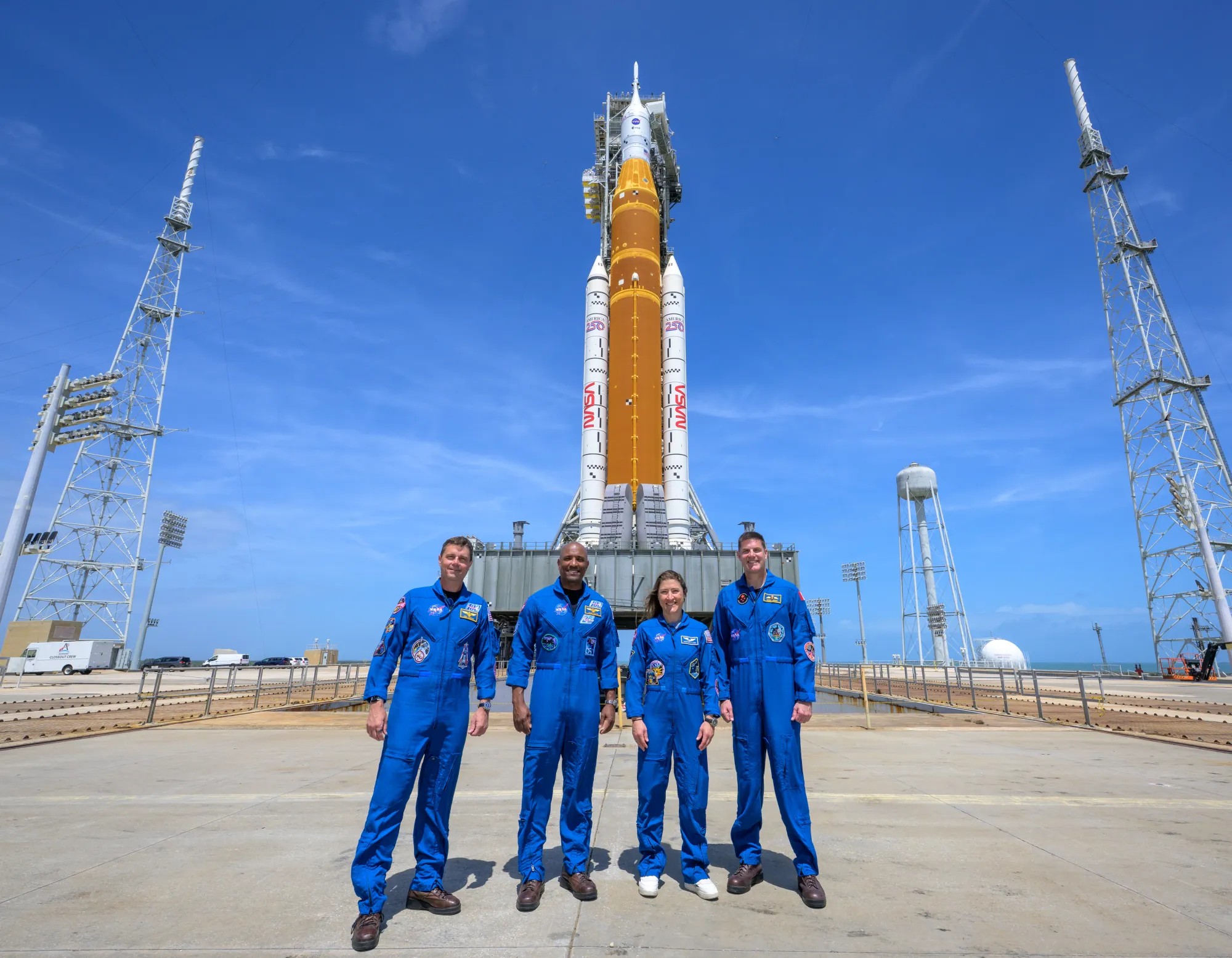


The countdown has begun. The crew is ready. And barring any last-minute hiccups, four astronauts on Wednesday will begin a journey that sends them farther from Earth than any human has gone before.
NASA astronauts Reid Wiseman, Victor Glover, and Christina Koch, and Canadian Space Agency (CSA) astronaut Jeremy Hansen—the crew of NASA’s Artemis II mission—are expected to travel more than 230,000 miles from Earth and 4,600 miles beyond the far side of the moon during their 10-day trip.
The crew will not actually land on the moon. But it will test the systems, procedures, and mission profiles that could enable landings in the future, beginning with the Artemis IV mission in 2028. Another crewed landing, Artemis V, is scheduled for later in 2028. After that, NASA hopes to conduct two per year.
Artemis II has been a long time coming. The Artemis campaign kicked off in 2022 with the uncrewed Artemis I mission, after which engineers discovered unexpected issues with the heat shield enshrouding NASA’s Orion crew capsule. Issues with the heat shield and other components have driven years of delays.
If Artemis II launches Wednesday, however, it would mark the first crewed flight of Orion and NASA’s Space Launch System (SLS) rocket, which will boost the capsule to Earth orbit. If scrubbed due to weather or another issue, there will be additional launch opportunities on April 2, 3, 4, 5, 6, and 30.
After that, the timeline is less clear. Due to the performance requirements of SLS and Orion, the mission’s precise trajectory, and other factors, launch windows will be open for about one out of every four weeks. NASA has not shared opportunities beyond April.
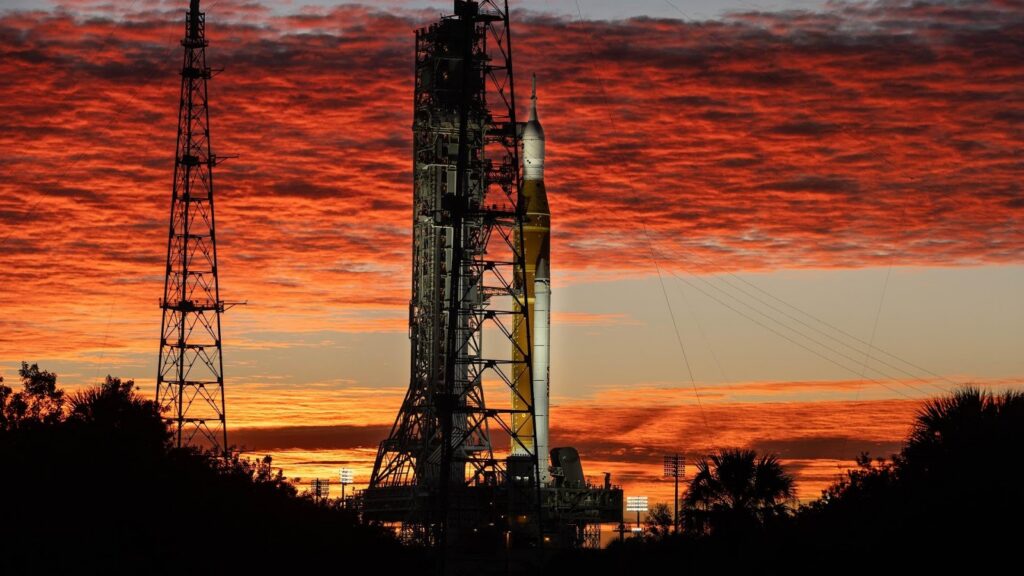
In short, there is plenty riding on Artemis II’s success.
If the mission goes to plan, it could keep the U.S. on pace for lunar landings in 2028, beating China’s plans for a 2030 mission. Looking further out, NASA aims to build a permanent $30 billion base, allowing Americans to live on the moon, study its resources, and use it as a waypoint for missions to Mars—and beyond.
At the same time, the mission is “not without risk,” one NASA official said earlier this month. Any major hiccups could continue to delay a program that is years behind schedule and tens of billions of dollars over budget, making it the target of substantial cuts by the White House. Congress last year had to step in to keep SLS and Orion funded through Artemis V.
Here’s what to watch for as you track Artemis II in real time.
Why We’re Going—Again
The Apollo program is widely and rightfully heralded as one of the greatest technological achievements in human history. Twelve NASA astronauts walked on the moon across six crewed Apollo missions. But ultimately cost and budget concerns brought Apollo to an end.
NASA in the years after Apollo focused much of its energy on Earth orbit with the International Space Station (ISS) and space shuttle programs, which had lower costs and risks than lunar missions. As priorities shifted with presidential administrations, there was little political will to carry out such an intensive project.
That changed in 2017 when President Donald Trump formally created the Artemis program. Artemis, named after Apollo’s twin sister in Greek mythology, aims to restore a capability the U.S. has lacked for more than half a century. Beyond that, it seeks to land the first humans at the lunar south pole and explore the moon’s permanently shadowed craters, which are believed to house water and other substances.
Despite U.S. officials viewing it as a strategic, economic, and national security imperative, Artemis has been slow going. By the Artemis IV lunar landing, NASA is projected to spend about $105 billion on the program. That’s a fraction of the estimated $290 billion in today’s dollars that it spent on Apollo through its first landing.
At the same time, SLS and Orion have been criticized for their cost. The Government Accountability Office (GAO) in 2021 estimated that a single launch costs more than $4 billion. Per a more recent GAO report, Orion has exceeded its original cost baseline by $3.2 billion, accounting for $363 million of the more than $500 million in cost overruns NASA recorded in 2025.
Concerns about Artemis’ cost and schedule prompted NASA Administrator Jared Isaacman to overhaul the program in February, adding a new mission between Artemis II and the first lunar landing. The hope is that switching to a more gradual approach will minimize the risk of hiccups that drive more delays.
The Spacecraft
The SLS and Orion are the two core vehicles of Artemis, and they are quite different from what flew in the Apollo era.
Orion
The Artemis II crew will enjoy about 30 percent more habitable space than the Apollo astronauts, whose capsule was designed for only three. Orion also adds modern hygiene, fitness, privacy, and galley areas that were absent on the Apollo crew module.
Orion’s computing system is about 75 percent lighter and 20,000 times faster than Apollo’s single flight computer. Its “glass cockpit” contains digital screens and interfaces, upgrading Apollo’s analog inputs. Those features allow Orion to adjust its trajectory in real time, enabling uncrewed or autonomous flight.
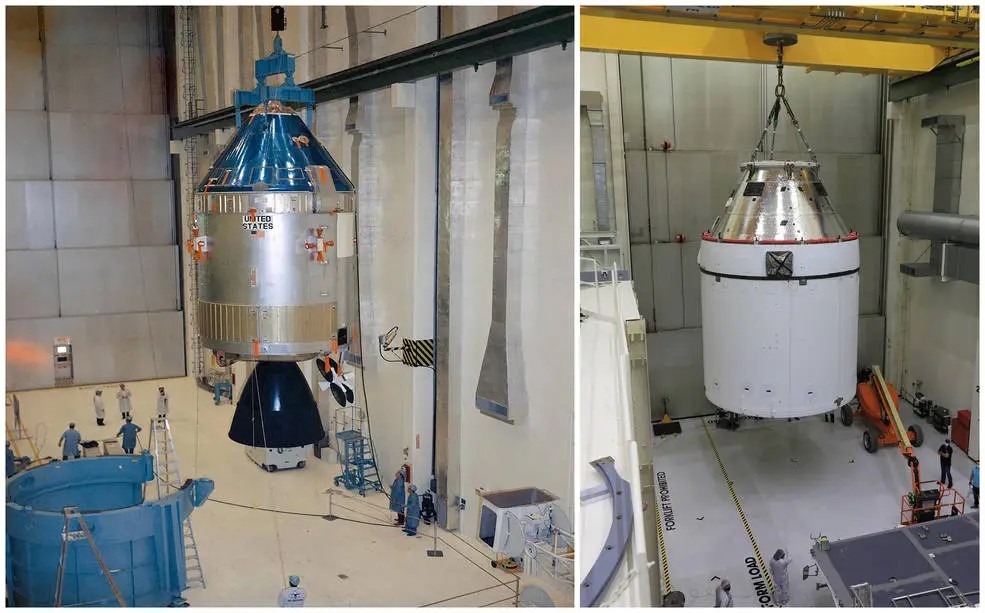
Whereas Apollo relied solely on finite supplies of hydrogen and oxygen propellant, Orion’s four solar array wings will unfurl to augment its fuel and provide power to the entire vehicle. Its components are more hardened for radiation than Apollo’s, enabling 21-day missions. Apollo maxed out at about 14 days.
Orion is built from aluminum as well as composite materials and 3D-printed parts. Nearly seven miles of internal cables receive and send commands for more than 1,200 sensors.
The crew portion of the spacecraft has 12 reaction control thrusters for small orbital adjustments. The service module—built by a European consortium led by Airbus—has a main engine, eight auxiliary engines, and 24 reaction control thrusters for added control. The service module manages the crew module’s thermal and life support systems and provides potable water, nitrogen, and oxygen to the astronauts.
SLS
To deliver Orion to Earth orbit, NASA’s SLS will generate more than 8.8 million pounds of thrust at launch—17 percent greater than Apollo’s Saturn V. The space agency in February canceled a future SLS version designed to produce up to 9.5 million pounds of thrust.
Standing about 322 feet tall, the SLS is slightly shorter than Saturn V. But with a payload of 59,500 pounds, it is the only rocket that can launch Orion, four astronauts, and heavy cargo to the moon in a single mission.
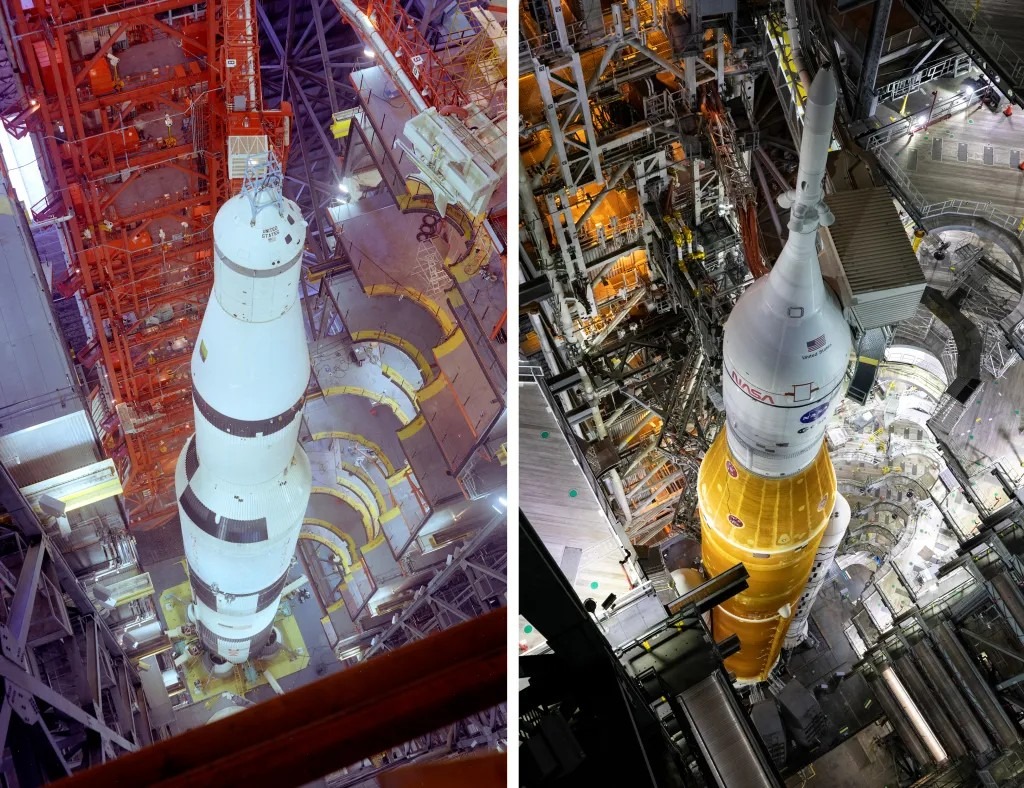
The SLS’ twin solid rocket boosters are the largest of their kind in history. Each produces about 3.6 million pounds of thrust, equivalent to 25 airliners firing at full throttle. Northrop Grumman developed them by modifying space shuttle boosters.
The four RS-25 engines powering the SLS core stage also come from the space shuttle program. They have been upgraded to produce about 2 million pounds of thrust for the eight-minute ascent to orbit. During the countdown, NASA will load the core stage with more than 725,000 gallons of supercooled liquid hydrogen and liquid oxygen.
Sitting atop the SLS is the rocket’s interim cryogenic propulsion stage (ICPS), which will separate with Orion after liftoff. The ICPS generates about 24,750 pounds of thrust, accelerating Orion to about 24,500 mph to raise its orbit.
The Crew
The Artemis II astronauts bring plenty of flying experience to the table.
Commander Reid Wiseman is a 27-year Navy veteran who was deployed at sea when NASA picked him to be an astronaut. He has flown the F-38, F-18, and other fighters and served as a flight engineer aboard the ISS.
Artemis II pilot Victor Glover is a traditional pilot as well, having served as a test pilot for the F/A‐18 Hornet, Super Hornet, and EA‐18G Growler. Glover has logged more than 3,500 flight hours across more than 40 aircraft. In 2020, he piloted the first crewed SpaceX Dragon mission to the ISS.
Mission specialist Christina Koch already has a storied history with NASA. Koch in 2019 participated in the first all-female spacewalk and set the record for longest spaceflight by a woman, spending 328 consecutive days in space. On Artemis II, she has the opportunity to fly farther from Earth than any woman in history. Koch served in several roles with NASA before becoming an astronaut in 2013.
Rounding out the crew is CSA astronaut and mission specialist Jeremy Hansen, who will be the first Canadian to fly around the moon. Like Wiseman and Glover, Hansen is a fighter pilot, having commanded the CF-18 for the Canadian Armed Forces.
The astronauts had the chance to get back in the cockpit as they prepared for Artemis II, flying T-38 Talons over Ellington Field (KEFD) at NASA’s Johnson Space Center in Houston. The supersonic trainers helped the crew practice decision making under intense, dynamic, conditions.

Within Johnson’s Orion Mission Simulator (OMS), the astronauts rehearsed tasks from nominal operations to emergency procedures. They practiced safe splashdown and recovery practices at the facility’s Neutral Buoyancy Laboratory. Integrated ground systems tests at Kennedy Space Center in Florida pulled everything together, with the crew donning their spacesuits and completing full rehearsals.
Crewmembers even traveled to volcanic fields in Iceland to learn how to identify and document the moon’s geology and regolith. At the lowest point in their lunar orbit—about 4,000-6,000 feet from the lunar surface—the moon will appear about the size of a basketball held at arm’s length.
The Mission
About six hours prior to launch, a closeout crew will secure the Artemis II astronauts within Orion. Stacked atop the SLS, they will launch from Kennedy’s Launch Complex 39B—and be on their way to the moon.
Should the crew encounter an emergency during ascent, a launch abort system could generate 400,000 pounds of thrust to pull Orion to safety. Otherwise, the system will be jettisoned along with the SLS boosters and fairings.
Leaving Earth
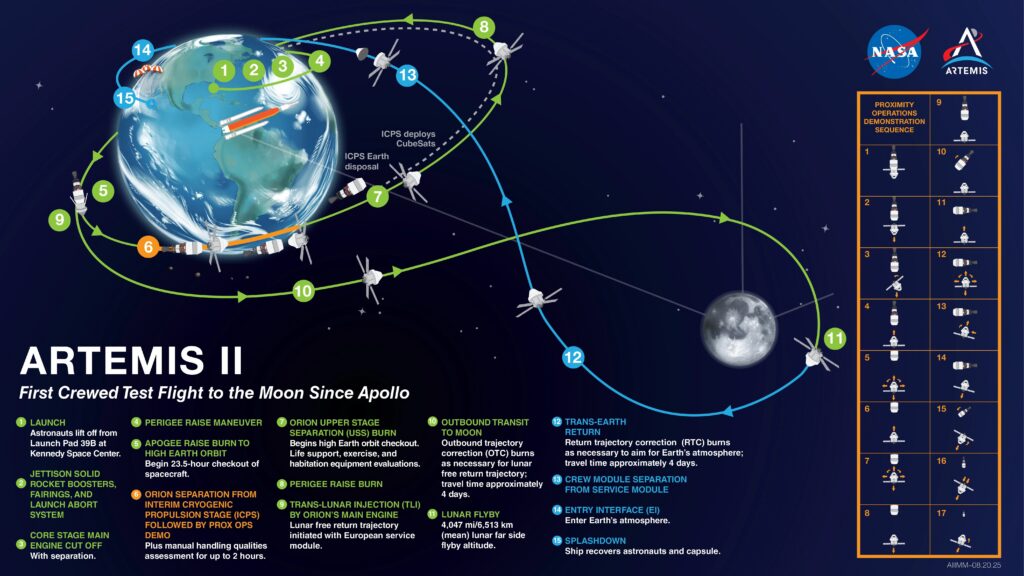
Once in orbit, Orion and the ICPS will separate from the core stage and circle the Earth twice, completing a perigee raise and apogee burn to gradually rise from a low to high-Earth orbit. Over about 23 hours, the crew will perform checkouts on Orion’s systems. During that time, keep an eye out for Rise—a plush toy that will let the astronauts know when they are in zero gravity.
In high-Earth orbit, Orion will separate from the ICPS, which after completing its job will be used for target practice during a proximity operations demonstration. The crew will take manual control of Orion, flying it toward and around the ICPS to simulate docking with other spacecraft. That will be required for future lunar landings.
Mission controllers at Johnson will take over for the remainder of the mission in Earth orbit. They will fly Orion beyond the range of traditional communication and navigation systems in a test of NASA’s Deep Space Network. Meanwhile, the crewmembers will shed their spacesuits and gauge the life support system’s ability to supply breathable air.
Moonbound
On flight day two, Orion’s service module will fire its main engine to initiate the translunar injection burn—a final push for the approximate four-day journey to lunar orbit. By day five, the moon’s gravitational pull will exceed that of Earth’s.
In lunar orbit, the crew will practice emergency procedures, test the capsule’s radiation shelter, and conduct science experiments. It will collect imagery of the moon from a distance closer than human eyes have come in decades.
The astronauts will lose communication with mission control for about 30-50 minutes as they fly behind the moon, surpassing the distance achieved on Apollo 13.
Getting Back
The return phase of the mission is perhaps the most risky.
Orion will attempt what is called a free return, disengaging its propulsion systems after it slingshots around the moon. The capsule will instead rely on Earth’s natural gravity to pull it home, conducting only three small trajectory correction burns.
Apollo 13 is the only mission to actually travel around the moon in a free-return trajectory, though Apollo 12 used a hybrid free return on approach to the moon.
Another critical phase is atmospheric reentry. Orion’s service module will jettison and burn up in the atmosphere, exposing the crew module’s heat shield. Reaction control thrusters will fire to steer the shield into position, protecting the astronauts from external temperatures up to 3,000 degrees Fahrenheit. Superheated plasma will form around the vehicle, blocking communications.
NASA is reusing Artemis I’s heat shield and accepting a degree of risk in doing so. The structure is coated in an outer layer of material designed to absorb heat, but it unexpectedly cracked and splintered during the 2022 mission. Rather than replace the heat shield, teams addressed the issue by modifying Orion’s reentry profile. A new shield will be installed for Artemis III.
Ahead of Artemis II, John Honeycutt, manager of NASA’s SLS program, estimated the mission has between a 1 in 2 and 1 in 50 chance of failure. But Honeycutt highlighted the perigee raise and translunar injection—not reentry—as its riskiest phases. NASA’s crew loss threshold is 1 in 40 for lunar missions and 1 in 30 for Artemis missions overall, better than the Apollo program’s 1 in 10 figure.
After braving peak heating, Orion starting at about 25,000 feet will deploy eight parachutes, slowing it from a projected reentry speed of 25,000 mph—which would be the fastest speed ever achieved by humans—to about 17 mph. The capsule could splash down upside down or on its side. However, airbags will flip it upright.
There are sure to be bombastic cheers when the astronauts emerge from Orion and board recovery ships—fittingly, as they will have gone where no human has before.
What’s Next?
NASA has a few core objectives for Artemis II, mainly demonstrating crew survival and testing vehicle systems and operations, including for emergency scenarios. Hardware and data obtained from the flight could inform future lunar landings.
That won’t happen right away. The next Artemis mission, scheduled for 2027, will add more spacecraft to the equation, testing one or both human landing systems (HLS) developed by SpaceX and Blue Origin. These vehicles are designed to rendezvous with Orion in lunar orbit, delivering astronauts to and from the lunar surface and serving as a temporary habitat.
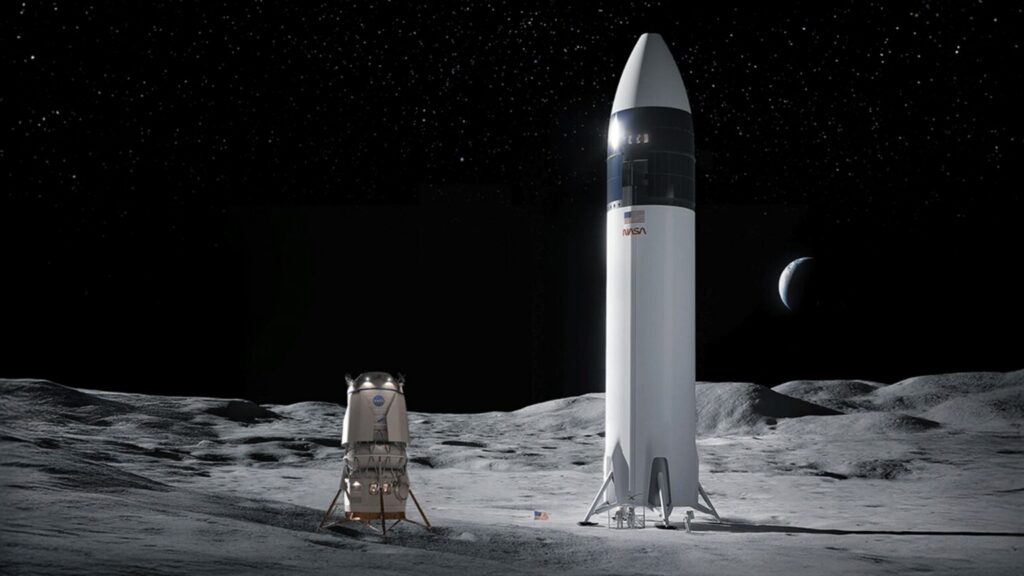
Artemis III will evaluate the HLS in low-Earth orbit, where it will need to stop at an orbital fuel depot before heading to the moon. It will test the vehicles’ ability to dock with other spacecraft and receive cryogenically stored propellant, which has never been transferred between vehicles in orbit.
In 2025, SpaceX and Blue Origin shared revised HLS architectures designed to accelerate their development. But neither vehicle is close to being operational. SpaceX since 2023 has conducted test flights of its gargantuan Starship rocket, around which its HLS is based. Blue Origin expects to launch its Blue Moon Mark 1 lander, a prototype, this year.
NASA has plenty of work ahead to iron out the HLS architecture. It could even contract a third company for a new vehicle design. But Isaacman has made clear that any delays that could jeopardize a lunar landing in 2028 will not be tolerated.
“We are not going to sit idly by when schedules slip or budgets are exceeded,” the NASA administrator said this month. “Expect uncomfortable action, if that is what it takes, because the public has invested over $100 billion and has been very patient with respect to America’s return to the moon. Expectations are rightfully very high.”