













Why Va Usually Is Too Fast

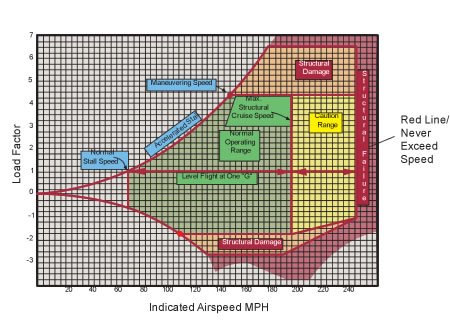
Youve probably seen something like the chart above before in your studies. Its known variously as a V-G diagram, gust diagram or simply an airplanes flight envelope. From it, we can determine the g-loading the represented airplane will experience when accelerated beyond 1G at various airspeeds. For example, the airplane depicted may suffer structural damage at 200 mph if it encounters conditions leading to a 4G loading. Those conditions can include pilot input, turbulence or some combination.


Gemini Sparkle

Key Takeaways:

  • The V-G diagram (flight envelope) illustrates how an aircraft's airspeed dictates whether a specific G-loading will result in a stall or structural damage.
  • Pilots must reduce airspeed in turbulence to the turbulence penetration speed (VA) to prevent potential airframe damage.
  • The published VA is for maximum takeoff weight and decreases with the aircraft's actual weight (e.g., due to fuel burn), requiring recalculation for current weight to ensure safety.
See a mistake? Contact us.

Youve probably seen something like the chart below before in your studies. Its known variously as a V-G diagram, gust diagram or simply an airplanes flight envelope. From it, we can determine the g-loading the represented airplane will experience when accelerated beyond 1G at various airspeeds. For example, the airplane depicted may suffer structural damage at 200 mph if it encounters conditions leading to a 4G loading. Those conditions can include pilot input, turbulence or some combination.

From it were reminded one of the important things to remember about potential damage from G-loading is the airplanes airspeed. That same 4G loading will result in a stall at 135 mph, instead of airframe damage. One of the takeaways, then, is we should slow down in turbulence. Duh.

Determining the speed we want to fly in turbulence can be difficult, however. The value for the airplane you fly is published in its POH/AFM, and usually is valid at its maximum takeoff weight. One problem: The only time the airplane is at its gross weight is when its taking off. At all other times during a flight, its lighter-sometimes only slightly; other times grossly so. For example, the airplane I fly easily and legally can see its takeoff weight change by 1000 pounds from flight to flight.

When the airplanes weight is lower than its maximum, so too is its published turbulence-penetration speed. Thankfully, its a linear transition from maximum to minimum, and its easy to calculate for each airplane type (though not perhaps when things are bouncing around and you need it most). Use the following formula to calculate VA for any given weight:

As an example, presume youre flying a Cessna 182Q Skylane, with a maximum gross weight of 2950 pounds, and a VA at that weight of 111 KIAS. Applying the formula above for 2500 pounds results in a weight-adjusted VA of 102 KIAS. Its rather obvious, but its important to remember that as fuel is burned, the airplanes weight decreases. What was the correct VA early in the flight wont be correct later. That said, VA is the maximum airspeed you should use when flying in turbulence. Its usually a good idea to be a few knots below it, just to be sure.

Ready to Sell Your Aircraft?

List your airplane on AircraftForSale.com and reach qualified buyers.

List Your Aircraft
AircraftForSale Logo | FLYING Logo
Pilot in aircraft
Sign-up for newsletters & special offers!

Get the latest stories & special offers delivered directly to your inbox.

SUBSCRIBE