“Fix your altitude.”
How many times have you heard this during an instructional flight? Let’s say you were told to fly at an indicated altitude of 1,900 msl and because you got a little distracted, you’re now at 2,100.

The discrepancy could mean busting a checkride or busting airspace if you were trying to skirt under the shelf of the class C or B airspace. Or it could go the other way. Perhaps the pattern altitude is 1,300, which puts you 1,000 feet above terrain, and because you were distracted and didn’t set the altimeter to the correct setting per the ASOS or ATIS, you’re flying the pattern too low.
If it is daylight and you are familiar with the area, you may notice that the cars and houses look larger than normal and realize you forgot to get the altimeter setting from the automated weather—if available—and realize that you are too low from the visual cues.
At night it is more difficult. Lights on the ground can be mistaken for airplanes, and airplanes mistaken for lights on the ground. You may not know what you are looking at, and that can be deadly. Such was the case in Washington, D.C., in January when an Army Black Hawk helicopter collided with a PSA Airlines CRJ700 at night over the Potomac River.
The accident happened as the PSA Bombardier CRJ700 operating for American Airlines was on approach to Runway 33 at Ronald Reagan Washington National Airport (KDCA). The aircraft inbound from Kansas was just minutes from landing.
Video of the accident shot from the approach end of the runway shows the well-lit jet approaching the runway. The helicopter, which was also using its running lights, approaches from the left. According to the cockpit recording from the jet and the video, it appears the crew saw the helicopter at the last moment and initiated a climb, but it was too late, and in the next frame of the video, there is an explosion as the aircraft collided.
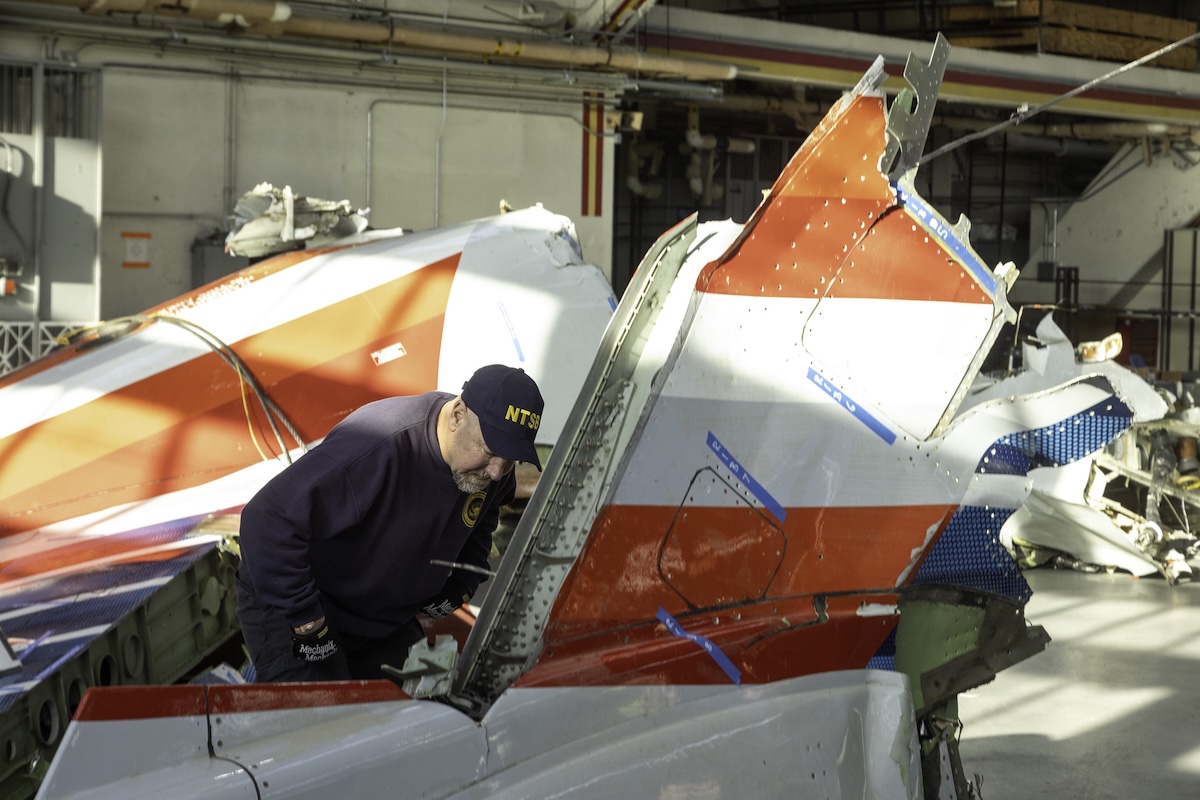
The National Transportation Safety Board (NTSB) has just wrapped up three days of a public hearing about the event. The focus was on identifying the factors that contributed to the accident. Altitude was one of them. Midairs occur when at least one of the aircraft is in the wrong place and the wrong time—too low or too high, and definitely too close.
While going through pages and pages of investigative reports, it was suggested that the altimeters on the helicopter were unreliable. Therefore, the three crewmembers on board may not have realized they were at the wrong altitude.
During the testimony, there were references to the altimeters being glitchy and sometimes being off by more than 75 feet. That last number struck a chord with me, as per the FAA’s Instrument Procedures Handbook (H-8083-16B), “if the altimeter is off field elevation by more than 75 feet with the correct pressure set in the Kollsman window, it is considered to be unreliable.”
Do You Trust Your Altimeter?
The altimeter is part of the required instrumentation of most aircraft in the training fleet, so says cFAR 91.205, and is required equipment for VFR flight rules. Under IFR flight, the altimeter needs to be a “sensitive altimeter adjustable for barometric pressure,” and per 14 CFR 91.411, the altimeter altitude reporting equipment and static pressure systems need to be tested and inspected for IFR operations every 24 months.
Pilots are taught that before takeoff they should set the altimeter to the value as given by the automatic weather, be it the ASOS or ATIS, and if that is not present, set the altimeter so it shows field elevation.
Sometimes the numbers don’t match. When I set the altimeter to the value given by the one-minute weather, it showed us at 560 feet, but the field elevation is 540 feet msl. That put us 20 feet agl when we were sitting on the ground.
The instructor I was flying with noted the automated weather had given us an altimeter setting. I pointed out the physical proof showed us it was off. I trusted the physical proof more than the “tin man” and set it to field elevation instead. During the flight, every time we passed near an airport, we listened to the automated weather and updated the altimeter as necessary.
A day later, one of my coworkers and a client were flying the aircraft on an IFR flight in VFR conditions when ATC radioed them with a check altitude alert reminding them that they were assigned 2,000 feet and they “showed 1,700.” They were VFR at the time, and the CFI replied to ATC that they were indicating 2,000, and he knew what 2,000 feet looked like, and this was it.
ATC asked them to recycle the transponder, and they did, which fixed the issue for a few minutes—then they got another warning. The flight was terminated at this point, and the squawk was written up. This is why the transponder check is also required every 24 calendar months along with the pitot-static system—the two work hand in glove.
The pitot-static system must be checked every 24 calendar months if that aircraft is going to be used for IFR flight. Flying under IFR usually means a lack of outside visual references like a horizon, so the altimeter needs to be accurate — and you probably wouldn’t want it any other way.
It is not uncommon for busy flight schools to placard the aircraft that needs a pitot-static check with “VFR FLIGHT ONLY”, and that remains in place until the inspection can be performed (often as part of the aircraft’s 100-hour check) and the maintenance logbooks updated. Finding this placard often generates a discussion among the learner and CFI about the difference between IFR and VFR grounded aircraft. We do want you to ask questions and pay attention to details.
Some CFIs can get really sneaky, and when the learner is distracted during a VFR flight (“Look at the size of that corn maze down there!”) they will intentionally adjust the altimeter—sometimes putting it off by more than 1,000 feet just to see if the learner is paying attention.
To the learners: You can thwart this by making it a habit to update the altimeter setting periodically during the flight. If you catch your CFI monkeying with you in this fashion, a “nice try” response is always in good taste.