











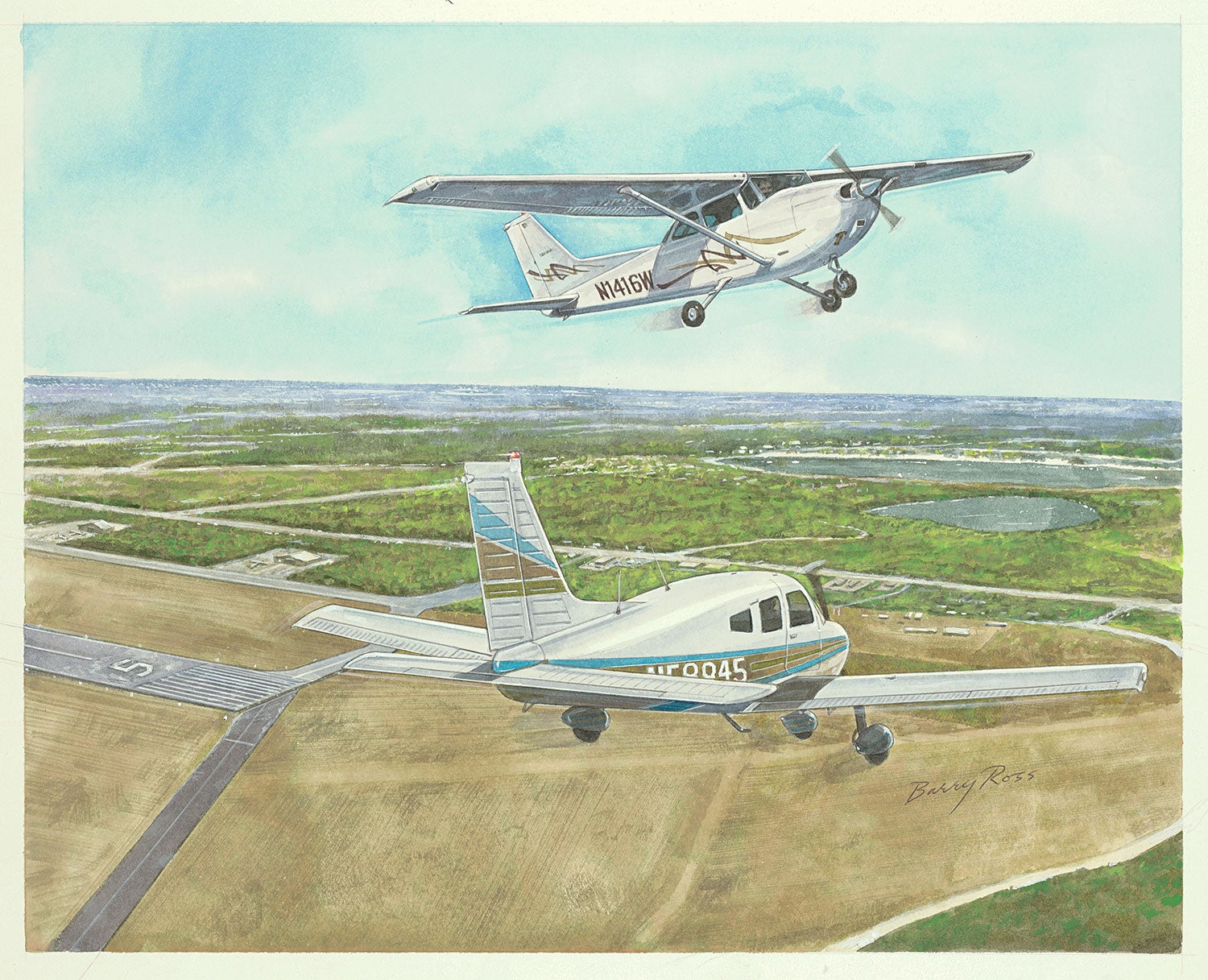


The phrase “armed and dangerous” is an idiom I apply to a pilot with hazardous attitudes such as anti-authority (“don’t tell me”), invulnerability (“it won’t happen to me”) and macho (“I can do it”). These individuals fly by their rules in unpredictable and potentially dangerous ways, disregard established flight-safety practices, seem unconcerned for their own safety and that of others and appear a step away from an accident. The following flight involved such a pilot whose airplane nearly collided with the airplane I was flying as a flight instructor in the traffic pattern at a nontowered airport. Before the near midair collision, I did not fully consider a series of red flags from the pilot and assumed he would fly a normal traffic pattern.
My flight student and I performed a preflight risk-management assessment by 1) identifying potential hazards (using the FAA’s PAVE model, i.e., Pilot, Aircraft, enVironment and External pressure); 2) assessing risks (using the FAA’s risk-assessment matrix to determine the likelihood and severity of risks); and 3) mitigating risks of high likelihood and severity. We self-evaluated our personal physical fitness for flight by “passing” the IMSAFE checklist (Aeronautical Information Manual, Chapter 8). The airplane (a Cessna 172 NAV III, N1416W) was in excellent operational condition (no squawks), had nearly full fuel tanks, weight and balance parameters were within appropriate ranges, and it was appropriately equipped for the flight. Regarding the environment, visual meteorological conditions prevailed; ceiling and visibility were unlimited; and wind direction and speed were 60 degrees at 8 knots. There were no TFRs along the route of flight, no notams adversely affecting the departure and arrival airports, and the flight was to be conducted on a weekday morning with light traffic expected in the area. A restricted area used by the military, immediately northeast of our destination airport, was inactive at our estimated time of arrival. While en route, we planned to monitor ATC to remain situationally aware if the restricted area were to become active. Also, there were no significant external sources of pressure compelling us to complete the flight on schedule. Because no significant hazards were identified, the likelihood of risks was assessed as remote to improbable, and the severity of risks was assessed as marginal to negligible.

