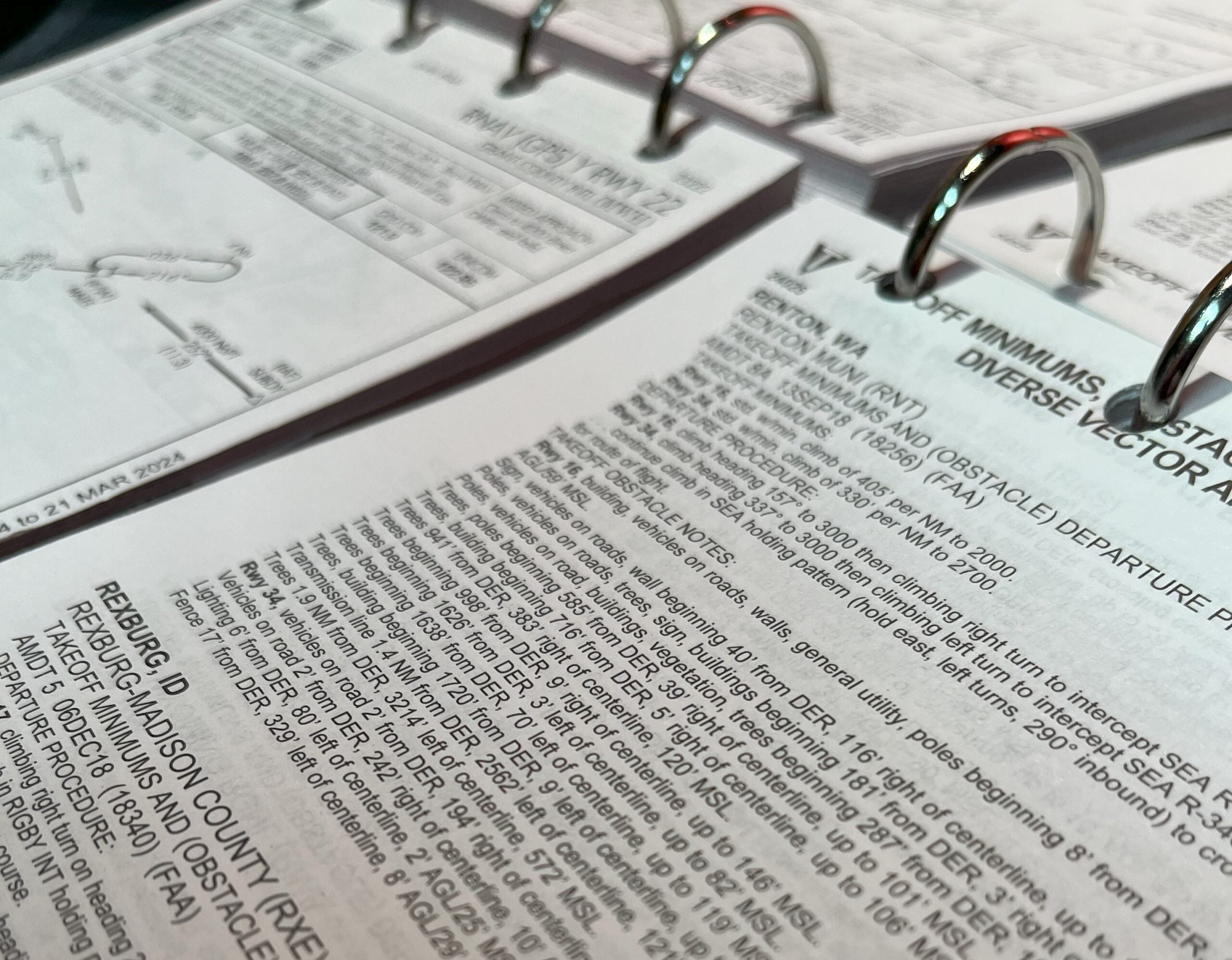
National Ocean Service (NOS) binder. [Courtesy: Meg Godlewski]
Key Takeaways:
Before electronic flight bags (EFBs), pilots relied on paper instrument approach plates, primarily choosing between government-issued National Ocean Service (NOS) charts and commercial Jeppesen products.
Jeppesen and NOS charts differ significantly in layout, detail, paper quality, and specific features, such as Jeppesen's comprehensive briefing strip and NOS's indicators for takeoff/approach obstacles.
While EFBs have largely replaced paper charts, understanding both Jeppesen and NOS formats remains a valuable skill for pilots in training and for professional employability.
Before electronic flight bags became as obsequious as Starbucks, pilots relied upon paper charts for information, especially in the IFR environment.
There were two choices for instrument approach plates: the government-printed National Ocean Service (NOS), or Jeppesen. Every fledgling instrument candidate had to choose which they would use.
CREATE A FREE ACCOUNT
Sign up to keep reading
Create a free account to continue. Already a member? Sign in below.
Meg Godlewski has been an aviation journalist for more than 24 years and a CFI for more than 20 years. If she is not flying or teaching aviation, she is writing about it. Meg is a founding member of the Pilot Proficiency Center at EAA AirVenture and excels at the application of simulation technology to flatten the learning curve. Follow Meg on Twitter @2Lewski.