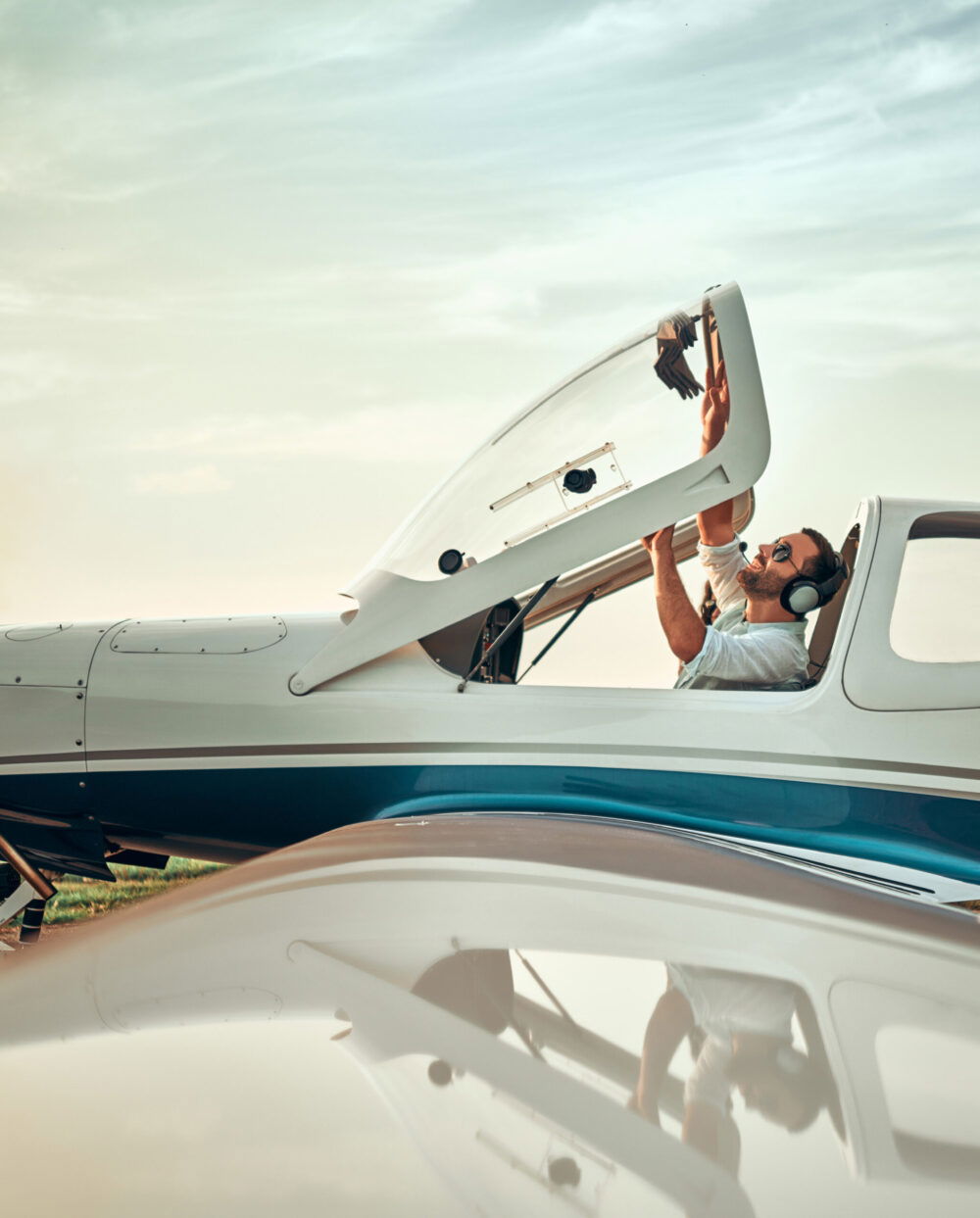

![Expect to pay top dollar on the used aircraft market for any Cirrus SR20 that’s in good condition. [Credit: The Aviation Consumer]](https://flyingmag1.b-cdn.net/wp-content/uploads/sites/2/2025/12/FLY1225_3.0-Used_ajs-1.jpeg?width=2372&height=2069)


The first Cirrus sure has matured since its introduction in 1999 as the SR20 G1. While the SR20 was generally looked at as a trainer, it has plenty of performance to work as a personal traveling airplane. That’s why later-model SR20s—sporting nearly identical cabin ergonomics, avionics, and aesthetic styling as the faster SR22—sell for a price premium.
When The Aviation Consumer looked at the market for used SR20s a few years ago, we found the airplane was in huge demand. Although inventory appears to be slightly better, and there are various configurations of OEM and retrofit avionics (plus two engine options), you won’t find any smoking deals. In fact, expect to pay top dollar for any SR20 that’s worth buying.
American Success Story
It’s been told ad nauseam, and the Cirrus success story started not with the big-engine SR22 but with the lower-performance SR20.
If you're not already a subscriber, what are you waiting for? Subscribe today to get the issue as soon as it is released in either Print or Digital formats.
Subscribe Now
Company founders Alan and Dale Klapmeier maintained that traditional airplanes from Cessna, Piper, and others were too hard to fly, lacked intelligent safety features, and failed to push the technological edge in both design and manufacturing. With composite construction, a sidestick (half yoke, really), swing-up doors, and a big multifunction display, the SR20 was a big departure from the familiar Cessna, Piper, Beech, and everything else, really.
And, yes, the CAPS whole-airplane parachute was a must, living on to this day in the SR20, SR22, and SF50 jet.
Pick Your Package
The first SR20s were delivered as 1999 models. Cirrus initially offered the SR20 in three option tiers, originally designated A, B, and C.
The A-spec airplanes came with a Garmin GNS 430, GNC 250XL GPS/comm, audio panel, and GTX 320 transponder, plus the ARNAV ICDS 2000, a then state-of-the-art, multifunction display. But Cirrus eventually switched to the Avidyne FlightMax EX3000C, a higher-resolution model.
For autopilots, the A aircraft have S-TEC System 20s, upgradable to System 30s, which includes altitude hold. All of the early aircraft used vacuum instruments but had an electric backup vacuum pump. Rounding out the panel are analog engine and systems gauges clustered on the far right.
Meanwhile, B airplanes have a GNS 420 (a GNS 430 without the VHF nav) in place of the GNC 250XL, the System 30 is the standard autopilot, and a Century NSD360 vacuum/electric HSI is fitted in place of a vacuum-powered directional gyro. The C-spec airplanes have dual GNS 430s, System 55 autopilots, dual alternators, and a Century NSD1000 electric HSI. Options for the B included dual alternators, leather seats, and three-blade propellers, with roughly 70 percent of SR20s being loaded C models.
- READ MORE: Used Aircraft Guide: Cessna 340 Boasts Cabin-Class Comfort and Pleasing Handling
- READ MORE: Used Aircraft Guide: Turbocharged Mooney M20K Still Worthy Choice for Efficient Traveling
Beginning with serial number 1268 and the 2003 model year, Cirrus did away with vacuum systems and introduced the all-electric airplane. The A, B, and C designations evolved to 2.0, 2.1, and 2.2, respectively. The all-electric airplanes have dual alternators—a 75-amp main alternator and a 35-amp secondary unit—plus dual batteries. There also are two buses, a main bus and an essential bus for critical load items such as nav and comm functions and lighting. There have been plenty of opportunities for avionics improvements to the older SR20s, and it’s tough to find one that hasn’t had at least some upgrades.
With the exception of aluminum control surfaces, all SR20 airframes are entirely composite. The wing is constructed with a beefy, continuous spar. Control surfaces are activated via cable from side controllers mounted on the cockpit walls. Trim is electric only, with coolie hat buttons on each stick, a sore spot for some owners who say they would like a manual trim wheel for backup and fine-tuning.
![Later-gen SR20s feature upswept wing tips with Whelen Spectra smart LED lighting for better ground visibility. [Credit: The Aviation Consumer]](https://flyingmag1.b-cdn.net/wp-content/uploads/sites/2/2025/12/FLY1225_3.0-Used-4.jpeg?width=1024&height=678)
The Cirrus wing has a stepped leading edge that’s supposed to stall the inboard section first—allowing roll control throughout—and be resistant to spinning. The airplane is not approved for spins, nor did it undergo official spin testing. If a spin develops, the first anti-spin response is roll input with ailerons. Ultimately, Cirrus prescribes pulling the CAPS handle. Cirrus airplanes are designed with crashworthiness in mind. The SR20’s fuel supply, for example—60.5 gallons total, 56 gallons usable—is stored between the wing spars and well outboard of the cabin, providing significant crash protection.
Moreover, the landing gear is designed to absorb energy and flex into the wing inboard of the fuel cells, thus leaving them intact in the event of a hard landing or crash. The seats are 26-G-impact designs, and each has four-point harnesses with inertial reels and airbags in the front seat shoulder harnesses on newer models.
More Than Avionics
In early 2004, Cirrus introduced the G2 models of both the SR20 and SR22, featuring a new door design, better interiors, redesigned firewall for improved crashworthiness, and other upgrades.
It’s said that G2 airplanes have slightly less drag and are thus a knot or two faster than previous models. Later that year, Cirrus began offering the SRV, a VFR-only model intended for the training and low-end market. It was discontinued by 2010.
For 2008, the G3 SR20 variant was introduced, featuring the wing from the SR22 G3, redesigned landing gear, and 50-pound useful load increase, among other changes. The new wing added a few knots to the airplane.
In 2012, a flex seating arrangement was introduced for the rear seat. The 60/40 split allowed room for three passengers and for the seat back to fold down in sections. As for the powerplant, the SR20’s Continental IO-360-ES was a somewhat unusual choice, but it made sufficient power. The engine’s TBO is 2,000 hours, but overhaul costs are on the high side at about $60,000.


Most earlier-gen SR20s have been upgraded in the aftermarket (left). Later-model SR20s sport Garmin’s Perspective+ G1000 avionics with either mechanical backup instruments (right) or a single backup EFIS. [Credit: The Aviation Consumer]
Throttle and rpm control are done via a single lever that moves both cables. On the Continental, full throttle will yield 2,700 rpm. A reduction of power brings 2,500 rpm, where it will stay until power is so reduced that it can’t be maintained. This is done through a cable-and-cam arrangement that works well enough, but there’s no way to find an rpm sweet spot.
Some owners have complained about rigging difficulties and trouble getting precise power settings. Most of these airplanes have three-blade props, but those with two-blade props (especially the earlier ones) may have better weight-and-balance numbers without a hit to performance.
In 2017, Cirrus ditched the Continental in favor of Lycoming’s 4-cylinder 215 hp IO-390-C3B6. Cirrus also certified the airplane with an optional lightweight Hartzell composite prop, which shaves nearly 30 pounds from the airplane.
With the new engine and lighter G1000 avionics, Cirrus was able to change the maximum gross takeoff weight to 3,150 pounds—an increase of 100 pounds from the old airplane. With as much as 150 pounds increase in useful load (1,030 pounds), you can haul around another passenger or more of your stuff. Flap extension speed went from 110 to 150 knots.
A selling point for training operators is the G6 SR20’s engine TBO. For high-time usage (flown more than 40 hours per month), the IO-390’s recommended TBO gets bumped to 2,400 hours. The Continental IO-360-ES has a 2,000-hour TBO.
As for ergos, improved creature comforts and better styling make the later models a pleasant experience for pilots and passengers, while early-gen SR20s are downright stark by comparison.
Performance and Upkeep
Although the SR20 is adequately powered, it’s not overpowered. At 3,050 pounds for the later versions (3,150 for the G6), it’s heavier than most airplanes with 200/215 hp. At moderate weights, expect 700-800 fpm initially, falling off to 500 fpm above 4000 feet.
The POH is on target for fuel burn at about 10.5 gph for typical cruise, 9.0 gph when lean of peak. Still-air range is about 675 miles, with 45-minute reserve, when planning to use the full 56 gallons legally available.
Initial max weight for the SR20 was 2,900 pounds but a later service bulletin, if complied with, allowed a gross of 3,000 pounds. The SR20 G3, meanwhile, has a max gross of 3,050. Empty weights are typically 2,000 pounds or more with useful loads of just under 900 pounds. With full fuel, that leaves 560 pounds for people and stuff.
![Cirrus switched to the four-cylinder 215-hp Lycoming IO-390 in 2017. [Credit: The Aviation Consumer]](https://flyingmag1.b-cdn.net/wp-content/uploads/sites/2/2025/12/FLY1225_3.0-Used-5.jpeg?width=1024&height=662)
The flaps have three positions: 0, 50 percent (16 degrees) and 100 percent (32 degrees), and the first notch can be extended at 150 knots. The CAPS parachute deployment is done at 133 knots or slower.
The SR20 really does make a good primer for someone planning to step up to an SR22. Approach and landing in the SR20 isn’t much different than in the SR22, although everything happens more slowly—and that’s good for training. Like all SR models, the pitch-and-roll compression springs create moderate control pressure (and impressive roll-and-pitch stability), which means you absolutely must keep the aircraft trimmed.
As for upkeep, like any Cirrus you’ll want to bring the SR20 to a shop that’s familiar with the type, though the engines should be easily wrenched by most shops.
There is a six-year replacement on a pair of line cutters used in CAPS deployment that can cost north of $2,000, which is cheap compared to the 10-year CAPS repack, which is over $10,000 in parts, plus 30 hours of labor for pre-2004 aircraft and eight hours for later ones. The difference comes from a CAPS access panel added in the G2 revision of the design. An AD issued in 2008 (AD 2008-11-18) requires a 100-hour pressure-test inspection of the exhaust systems installed on early SR20s, serial numbers up to 1815.
Another issue, and one resulting in AD 2006-21-03, involves the brakes.
Since all Cirrus models have free-castering nosewheels, directional control at low speed is done via differential braking. Some pilots may have used the brakes to control taxi speed instead of reducing power. The predictable result: overheated brakes, leaking fluid, and the occasional fire. Depending on serial number, the AD calls for a one-time O-ring or caliper replacement, plus trimming the wheel fairings and installing temperature indicators and inspection holes.
The Cirrus Owners and Pilots Association (COPA) is a good source for maintenance advice and just about anything else having to do with flying and ownership. The organization maintains an excellent website (www.cirruspilots.org) with both public access and members-only forum sections. It’s an absolute must for any would-be Cirrus buyer.

Editor’s note: The Aviation Consumer (aviationconsumer.com), a Firecrown Media Inc. brand, features in-depth technical reviews on everything from headsets to avionics to new and used aircraft. We have incorporated its popular Used Aircraft Guide (UAG) into FLYING Magazine to bring greater resources to our readers. The above article was originally published in May 2024.
This column first appeared in the December Issue 965 of the FLYING print edition.