












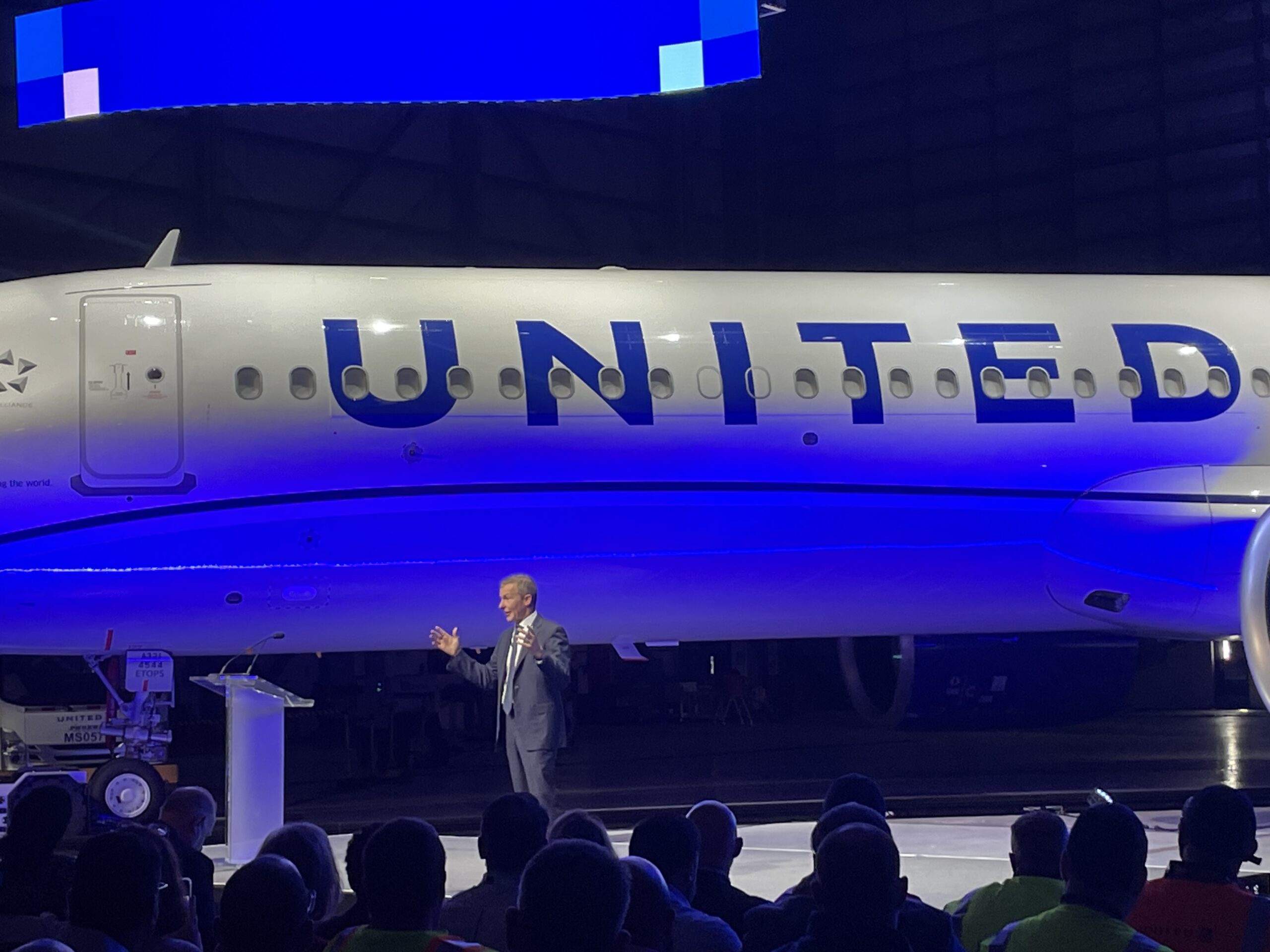


After a tumultuous spring during which runway construction and air traffic control staffing and equipment problems disrupted hundreds of flights, United Airlines had the “most reliable summer operationally that we have ever had” at Newark Liberty International Airport (KEWR), CEO Scott Kirby said Tuesday.
The airline said more than 6 million United passengers flew on time through Newark this summer, with a 70.1 percent on-time rate actually beating its performance at LaGuardia (KLGA) and John F. Kennedy International (KJFK). Speaking during an event in the airline’s hangar near Newark, Toby Ennqvist, United’s executive vice president and global chief operations officer, said its busiest day at the airport was August 16, when it flew about 650,000 customers.

“To put that in perspective, that’s like carrying Detroit or everybody from Nashville in one day,” Enqvist said.
Kirby said United is on an eight-day stretch without a ground delay program at Newark—a welcome change from the chaos of April and May, when ATC issues, runway construction, and weather prompted severe disruptions. The United boss heaped praise on the airline’s Newark team as well as Transportation Secretary Sean Duffy and the FAA, which he said “has been a huge part of this.”
Recent actions taken by the agency, Kirby said—such as the replacement of old copper wiring with fiber optic cables—will “let us grow our schedule back to as big as we would like to be. It’s going to let us add more international service.” The FAA in August proposed limiting operations to 72 per hour through October 2026.
“I don’t even think we’re in the first inning yet,” Kirby said. “We just finished the preseason. Now we’re getting ready to start the season. And we’re going to go out and continue to invest.”
For example, he said United intends to hire more than 2,500 personnel at Newark through 2026. It employs about 14,000 people in the area. The airline also aims to be the first to use sustainable aviation fuel (SAF) at the East Coast hub. It plans to purchase 1 million gallons of SAF from Neste.
“This is great news: great news for the airline, great news for the industry, great news for the city of Newark,” said Newark Mayor Ras Baraka.
New international routes to Rome, Venice, Porto, Dublin, and other destinations are also on the horizon. The airline said Newark this summer accounted for more international departures and departures to Europe than any United hub. On Tuesday, Kirby set a target of 100 international widebody departures out of Newark per day.
“Newark really is a crown jewel, not just for United Airlines, but for the United States,” he said. “This is the biggest launching pad for European service, the biggest hub for European service, the most international airport for a U.S. airline to launch aircraft from anywhere in the country.”
Newark Bounceback
Kirby on Tuesday called Newark the “crown jewel” of United’s network. But for a few months earlier this year, it was a thorn in the airline’s side.
Since July 2024, arrivals and departures at Newark have been overseen by personnel at Area C of the Philadelphia Terminal Radar Approach Control (TRACON) facility, which like many ATC facilities is understaffed. As of August, Area C had 22 certified professional controllers (CPCs)—less than half of its target of 46. A further 20 controllers and six supervisors are training at the facility, but it could be years before they are certified.
Staffing shortages have been compounded by equipment issues, including multiple occasions in April and May during which controllers lost all communications and radar data for 90 seconds. Following an outage in April, several controllers took mental health leave. The FAA attributed the incident to a faulty copper wire, which beams data from New York to Philadelphia. It has since been upgraded with fiber optic cables.
More improvements could be coming under Duffy’s ATC modernization plan, which secured $12.5 billion in congressional funding. The plan calls for the construction of more TRACONs and the replacement of outdated hardware, among other measures.
“They’re making investments in technology,” Kirby said. “They got $12,500,000, and this team is intent on using it and using it effectively.”
The FAA in May limited hourly operations at Newark to 68, down from an earlier high of 86, United said. It moved quickly, though, when runway construction finished ahead of schedule in June, proposing to increase the hourly limit to 72 through October 2026.
“We’re not where we want to be yet, but we are on our way to greatness,” Enqvist said.
While its Newark team was getting things back on track, United simultaneously invested in fleet improvements. It now has about 60 small planes with SpaceX Starlink integrations, which Enqvist said will be included on its new aircraft. The airline on Tuesday also showcased its new inflight entertainment systems and upgraded seats.
The company said it is about two-thirds of the way through upgrading its narrowbody fleet, a process Enqvist said would be complete next year. At the same time, it continues to add widebodies, with more than 140 orders for the Boeing 787.
Kirby earlier this week said United would phase out its Boeing 767s toward the end of the year and may look to firm up its Airbus A350-900 order. The airline on Tuesday displayed an A321neo at its hangar.
“It is a natural time to at least think about whether to make the Airbus A350 order firm in the 2030 timeframe,” Kirby said at the APEX Global Expo 2025.
Like this story? We think you’ll also like the Future of FLYING newsletter sent every Thursday afternoon. Sign up now.

