











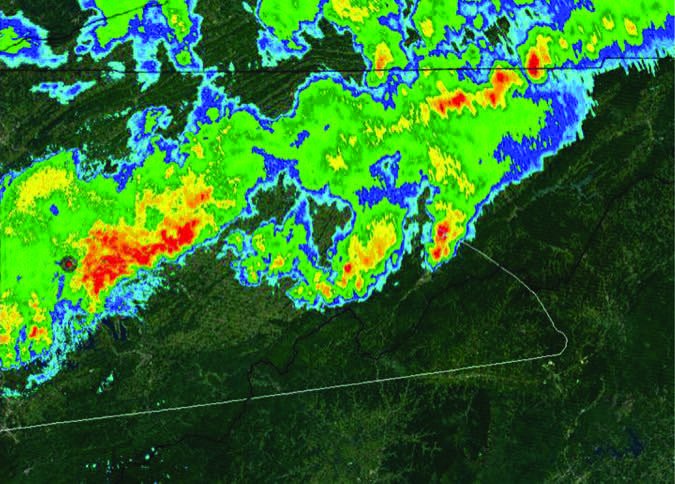


When I first started flying what I consider to be serious cross-countries, there was no such thing as in-cockpit weather radar. Even when flying the best-equipped singles, it was rare to have an sferic device like a Stormscope or Strike Finder. When my route was filled with a line of thunderstorms, I either went around them or landed and found a hotel for the evening. These days, we have near-real-time Nexrad weather radar from a variety of sources, and even ATC is better at pointing out storms and helping us around them.
All of this technology has its limitations, of course. For one, in-cockpit Nexrad can have as much as a 20-minute lag between the time the system captures the radar plot and it appears on your iPad. A lot can happen in that 20 minutes, and the hole you thought you could sneak through can easily fill in, leaving you with few options. For another, it’s foolhardy to let ATC navigate you through thunderstorms; their radar’s resolution just isn’t that good, and depending on a controller to guide you has latency issues of its own. As we’ve repeatedly written, the only way to safely circumnavigate thunderstorms is to remain in visual conditions as you go around them, and sometime that’s much too close. All of this implies you’re tackling these thunderstorms in the daytime, and that there’s good VMC surrounding them at your altitude.

