












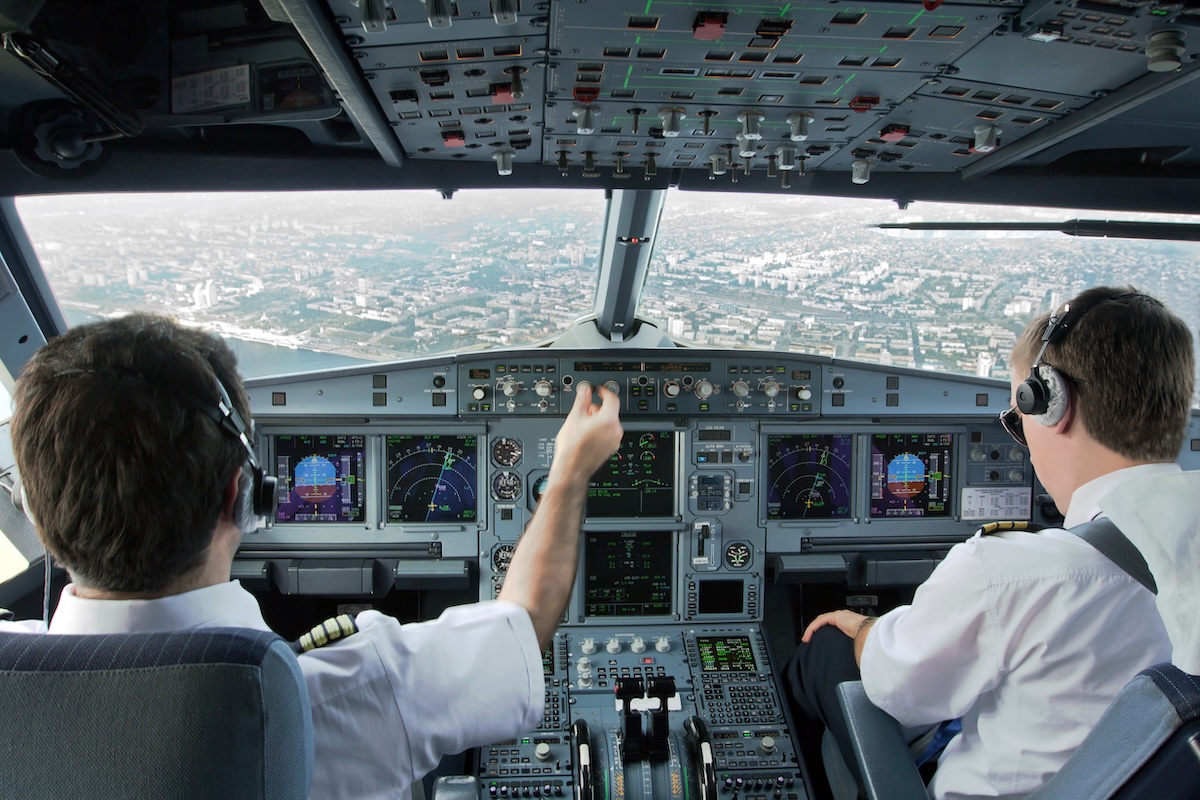


A group of 45 U.S. senators is urging Transportation Secretary Sean Duffy to take a firmer stand against efforts to examine and test out proposals for having a single pilot operate commercial passenger flights.
In a letter sent to Duffy on Thursday, the lawmakers said the U.S. should use international forums like the International Civil Aviation Organization (ICAO), a specialized agency of the United Nations, to push back on proposals that would reduce minimum air crew requirements. Current U.S. policy dictates that no certified airline can operate an airplane “with less than the minimum flight crew,” and that the “minimum flight crew is two pilots.”

“Single-pilot operations jeopardize safety procedures, undermine established best practices, and risk putting pilots and passengers in unmanageable situations,” the letter read. “We believe FAA should counter single-pilot proposals and help maintain U.S. leadership in aviation safety by vigorously opposing reduced crew efforts at the International Civil Aviation Organization.”
The group includes Democrats and Republicans and was led by Senators Tammy Duckworth (D-Ill.) and Tim Sheehy (R-Mont.).
The ICAO is particularly contentious ground because it develops standards for international civilian air transportation. Any successful push to undo minimum pilot staffing standards would likely have to start there.
The U.S. is on the ICAO’s governing council for the 2022-25 term, but it has not had a permanent representative at the organization since the 2022 resignation of Chesley “Sully” Sullenberger, best known for safely landing a US Airways flight on the Hudson River in New York after a bird strike in 2009. Sullenberger was nominated by former President Joe Biden and confirmed by the Senate but served only seven months.
President Donald Trump recently nominated former Delta Air Lines pilot Jeffrey Anderson to fill that position, but the pick has proved controversial. The Air Line Pilots Association (ALPA), which represents about 77,000 pilots in the U.S. and Canada, came out against Anderson and said he was chosen for political reasons.
“Unlike the last Senate confirmed ICAO ambassador, [Captain] Sully Sullenberger, Mr. Anderson fails the basic experience and qualifications test and could set back America’s aviation leadership for years to come,” the union said in a statement. “In fact, it appears that Mr. Anderson’s only real qualification for the post is his support of a position—raising the mandatory pilot retirement age—that would leave the United States as an outlier in the global aviation space and create chaos on pilot labor, and international and domestic flight operations.”
The White House has defended Anderson’s nomination, pointing to his past service as a Naval aviator and his decades of experience with Delta.
‘No Replacement for Human Talent’
The senators also drew attention to a single-pilot framework being developed by the European Union Aviation Safety Agency (EASA), which they said aims to enable “full-time single-pilot operation by the end of the decade.” That effort requires more advanced automation technology than is available, they said, and even if it eventually arrives, it will not be a full substitute for humans at the controls.
“Redundancy, including the protection afforded by two well-trained and qualified pilots on the flight deck, is a key guardrail for the maintenance and promotion of effective global aviation standards,” the senators continued. “Technological advances can capture the imagination and sound compelling in theory, but as pilots recognize, safety standards exist for emergencies and there is no replacement for human talent and judgement.”
Duffy has not spoken publicly about the potential for single-pilot commercial flights since becoming DOT secretary. He has mainly focused on plans to ramp up the training of air traffic controllers to make up a roughly 2,500-person shortage, as well as an overhaul of the nation’s air traffic control (ATC) technology and infrastructure.
ALPA on Thursday threw its support behind the senators’ message. The union said an erosion of pilot staffing standards anywhere would eventually undermine air safety in the U.S., as market pressure would likely push American-based airlines toward the single-pilot model.
“There is no safety rationale for removing pilots from the flight deck, and we fully support the Senate’s effort to halt these initiatives,” said ALPA president Jason Ambrosi. “Whether a flight is carrying cargo or passengers, there is no replacement for two pilots on the flight deck.”


