Register

Search Results for: oxygen

Pilot Proficiency

Shorter Days Mean Revisiting Night Flying Technique

As the days slowly get shorter, it’s worth considering that statistics prove flying after dark increases risk. While hazy, marginal weather may still provide a visible horizon during daylight hours, after dark, distinguishing the blend between sky and landscape becomes even more difficult. Even on a clear night, ground lighting can blend dangerously with starlight […]

Read More »
Photos

Cirrus SR20 G3

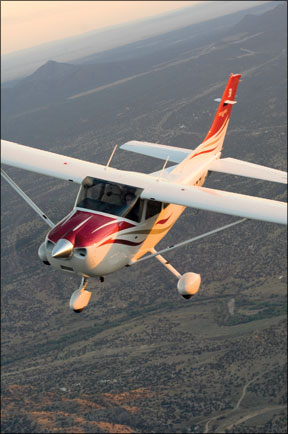
It’s official. With the introduction of the G3 version, the seminal Cirrus SR20 piston single is all grown up. I hadn’t fully realized that until recently, when I had the lucky chance to fly a pair of SR20s, one really old one (well, as old as they get) and one brand spanking new one, in […]

Read More »
Pilot Proficiency

The Rest of the Story

I thought I had covered the whole subject of the controller/pilot interface pretty thoroughly. In the January 2008 issue (“The Controller Failed to Inform…”), I used two accidents to illustrate the perils of depending on the controller to keep out of weather and away from high terrain. In the July issue (“Saved by the Controller”) […]

Read More »
Unicom

Handling Heat

Excellent article by Tom Turner in Julys issue (“Hot And High How-To”) but a couple of things come to mind. First, in the sidebar Cruise Considerations, you infer that a high density altitude decreases the available amount of oxygen for breathing. This is technically true, but the difference is so small it is hardly worth considering. Obviously, if one feels the need for it oxygen should be taken regardless of altitude, density or otherwise. A pulse oximeter is a huge help here, and the basic guideline is to maintain a saturation level that is within 10 percent of sea level saturation to avoid judgment impairment. Dr. Jack Hastings, former author of the American Bonanza Societys Aeromedical column, and a past president of the group, was kind enough to research and answer my question concerning density altitude and human saturation. Briefly stated, he said that oxygen saturation in the human body is dependant upon the “partial pressure” of oxygen in the atmosphere to create the osmotic exchange in the lungs. That partial pressure is only slightly affected by density altitude, and therefore insignificant.

Read More »
Features

Deviant Behavior

Its been said that experience is what you get when you dont get what you wanted to get. Well, taking significant liberties, a pilot might then say that a deviation is where you go when you dont get to go where you planned to go. Got it? We pilots are typically a robust and determined bunch. We dont like to admit we cant travel our planned route. Once were on our way and it looks like Mother Nature doesnt want us on our planned route, the common technique is to simply go have a look before deciding on a different, longer route. To understand the fallacy in this, lets cover a little basic geometry to see that its better to deviate early for the shortest practical addition to your route while maintaining your sanity and keeping your blood pressure in check with a conservative deviation.

Read More »
Features

Unfamiliar Territory

Theres little I find more exciting than launching for a new destination across unfamiliar territory. Exploring the great unknown makes adventurers out of pilots who use their planes for, you know, actually going places. But, getting there requires a little-sometimes a lot of-extra planning. My bride enjoys the adventure of personal airplane travel as much as any pilot; she also appreciates the added risks involved when tackling new terrain, new airspace, new weather systems and new destinations. Shes such a good sport, in fact, weve enjoyed the thrill many times. Our first “real” trip took us on a 2300-mile journey starting only five days after passing my private pilot checkride. Then, there was our first time to Sun n Fun; to coastal North Carolina and the sands of the Wright Brothers; our first flight to Oshkosh and-well, you get the picture. We also made a couple of international trips that still stand out years later: Key West to Grand Cayman for one, and Cancun, by hugging the Bay of Campeche to Vera Cruz, then the West Yucatan city of Campeche and across the Yucatan. The latter one took two days each way.

Read More »
Airmanship

Are Some FAA Flight Regulations Too Lax?

Theres no way the FAA can come up with a regulation covering every possible scenario, which is a good thing. If they did, wed rarely be able to roll our airplanes out of their hangars except on the clearest of days when no airliners were about. So, the FARs set certain minimum standards for pilots and once we determine were in compliance, its up to us to decide if the proposed operation is safe, morally acceptable and non-fattening. Or something like that. Frequently what we want to do complies with both the FARs letter and spirit. Sometimes its borderline; certainly legal but safe only if everything goes our way and nothing on the airplane breaks. And then, there are occasions when the proposed operation is both legal but really not smart.

Read More »
General

Five Years With Melmoth 2

Last Halloween my homebuilt, Melmoth 2, celebrated its fifth birthday-if age be counted not from conception (in which case it would not be five but 26) but from first flight, and if being an inanimate object parked in a hangar be called celebrating. _Melmoth_2 was not really finished in 2002, but what original-design homebuilt ever […]

Read More »
Airmanship

Smoothing The Bumpy Ride

Nothing can spoil a nice trip on a good-weather day like bumpy air. Like most other things in meteorology, its somewhat possible to predict turbulence. But unlike most other things in meteorology, as well as in life itself, there is something you can do about it. Altitude, time of day, tall-and not-so-tall-buildings and the relative flatness of the terrain over which were flying can all combine to make what should have been a smooth, relaxing flight into your (or your passengers) worst nightmare. Sometimes, those are the cards youre dealt. Most of the time, though, it doesnt have to be that way. The air that supports our aircraft is a fluid subject to the laws of physics. Ignoring the local influence of the sun and obstructions for a moment, when the wind blows, its flow is laminar-all air moves together smoothly. Even though that air might be moving rapidly it will be pretty smooth. If you upset the laminar flow of that wind, things can get interesting in a hurry. The upset can be something physical like a mountain or just a different air flow. The result on the nice days is just a slight change to the laminar flow of the wind. On bumpy days, though, the result is air in the boundary between the laminar flow and the upsetting influence is not smooth at all. In fact, there are often eddies and backflows, same as you get aft of an airfoil thats just at or past the its critical angle of attack. Depending on the strength of the wind and the opposing forces, those eddies and backflows can be slight or quite severe, with the corresponding flight through them being either a little jittery or enough to separate wing from fuselage.

Read More »
Aircraft

Cessna Caravan Perfected?

If you had listened to critics sounding the death knell of the turboprop some years back, you might have thought that the Cessna Caravan would be a museum exhibit by now. Competing, as it seemed to be, against every imaginable kind of airplane-jets, turboprop twins, pressurized singles, even piston singles-how could Cessna’s big nonpressurized turboprop […]

Read More »
Pilot in aircraft
Sign-up for newsletters & special offers!

Get the latest stories & special offers delivered directly to your inbox.

SUBSCRIBE