Register

Search Results for: general aviation inc

News

NATA’s ‘Day on the Hill’ Puts GA Leaders In Touch With Lawmakers

The National Air Transportation Association (NATA) is the trade group representing FBOs, charter operators and other segments of the general aviation industry. NATA coordinates an annual ‘Day on the Hill’ meeting between leaders of the general aviation industry and members of Congress on Capitol Hill. This year’s session, the 13th annual event, included close to […]

Read More »
News

GA Leaders Rally for NextGen, and How They Propose to Fund It

It’s not often you hear lobbying groups speak up in favor of tax increases for their constituents. But NBAA President and CEO Ed Bolen told the Senate aviation subcommittee that business aviation would shoulder an increase in fuel taxes to pay its share of the cost of the NextGen air-traffic-control modernization program. He told lawmakers, […]

Read More »
News

EBACE Numbers Belie Economic Gloom and Doom

Someone must have forgotten to tell tradeshow visitors that general aviation is in a death spiral. Last week’s European Business Aviation Convention and Exhibition (EBACE) proved to be among the most highly attended since the show launched in 2001. Figures reached well into five digits, and there were 65 aircraft on static display, compared with […]

Read More »
Aircraft Analysis

Tire Tech

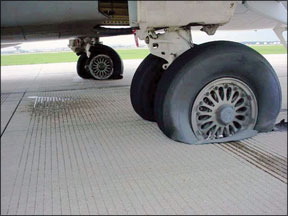
Few pilots pay much attention to their tires. They kick them a couple of times before lighting the fire, or put air in them when they look really low, but thats about it. Thats a little cavalier to us, considering those three (or more, if youre lucky) small, round, rubber donuts not only support the airplanes weight, but also supply the friction necessary to follow the yellow brick road and stop when you get to its end. As part of a project for sister publication Aviation Consumer, we recently had the opportunity to speak with industry executives about tires and tire failures, as well as a myriad of other related topics, while researching why aircraft tires fail. We found that, short of suffering a puncture, paying close attention to the airframe manufacturers recommended inflation pressure is your best bet to prevent tire failures. We also found that, to understand why proper inflation is key, we need to understand how these tires are made. The basic light-plane tire isnt that much different from the ones your grandparents used on their Model T. The current standards for aircraft tires are embodied in the FAAs Technical Standard Order (TSO) C62e, last revised in 2006 (that TSO only addresses tires; inner tube standards are set by the Society of Automotive Engineers). Instead of the radial-ply tires common on modern automobiles, your light airplanes tires likely are a bias-ply design, where the internal fabric cords are sandwiched between two layers of rubber and laid diagonally-at 30- and 60-degree angles to the tires centerline-and extend from bead to bead. Additional plies are laid opposite to each other. This contrasts with a radial-ply tire, a technology widely used by larger, faster aircraft. Its based on plies laid from bead to bead but at right angles to the tread.

Read More »
Airmanship

Getting Higher

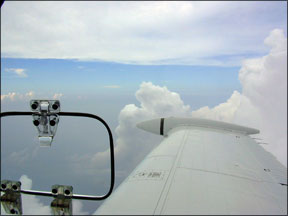
I doubt I ever flew higher than 4500 feet while earning my private pilot certificate. I remember 9000 feet as “high-altitude flying” when working on my instrument rating. Perhaps it was a function of the training environment, or a result of piloting low-powered airplanes. I think more likely it is expediency and the “little-plane” mindset that causes most training to be done at lower altitudes. Which begs the question: Are there any advantages to flying higher up, and if so, how should pilots plan for higher-altitude flight? Many pilots have found theres a “sweet spot” for cross-country flying, above the general crowd but below the realm of turbine airplanes, where traffic is scarce but the advantages are many. This is flight in the mid-teens (of altitude), which Ill define as anything from about 12,000 feet to 17,500 feet MSL. Here youll avoid much of weathers worst, enjoy almost-certain direct-to routing and overfly the majority of “ATC required” airspace. What are the advantages of flying between 12,000 and 18,000 feet? Probably the biggest one is youll usually find clear air. I find the mid-teens to be especially advantageous when flying in areas of forecast thunderstorms-usually youll be above the general haziness and murk abounding on the muggy days that promote thunderstorm development, allowing you to see and maneuver around the big build-ups from dozens of miles away. Mid-teen flying often puts you in less turbulent air than the skies down below, and the airs much cooler, improving pilot and passenger comfort. Its much less stressful to cruise in VMC, so mid-teen flying can reduce fatigue and workload. Be careful, however, to avoid overflying weather thats outside the certified capability of your airplane, or that youre not equipped or experienced enough to handle if an engine or instrument malfunction forces you to descend from your planned cruising altitude (see the sidebar, “Unplanned Descent,” on page 14).


Read More »
Features

Beyond Standard Rate

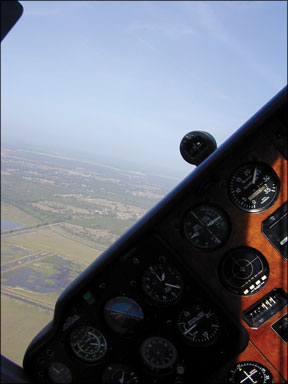
From Day One of our flight training, maneuvers practice fills much of our hours of dual instruction: turns around a point and such, unusual attitudes and recovery from them, and that most-basic skill from putting together all the control elements, flying pattern work. In aircraft so equipped, most of us learn to use the turn gyro when practicing maneuvering flight, striving to master the standard-rate, two-minute turn depicted by our little friend. But as we learn later in actual flying, that training also instilled flexibility and the skill to adapt maneuvers to the conditions. Among the best of all flexibilities is the ability to maneuver beyond our standards-both beyond the standard-rate turn and past the point where turns become steep. At times it seems that too few of us practice to maintain competence at the higher demands of flight beyond 30 degrees of bank. Thankfully, with a bit of caution and common sense, steep turns are skills we can practice on our own or, even better, with the security and added safety of an instructor or safety pilot. The payoff can be a lifesaver. Steep-turn skill holds significant real-world application in everyday flying, whether for something as potentially dangerous as trying to escape from a dead-end canyon or the more routine need to complete a non-precision instrument approach by circling while remaining within sight of the runway. With a little regular practice, a pilot should be ready to safely, sanely fly steep turns up to and including the most demanding of such unusual maneuvers: the 60-degree bank, 360-degree turn, all while holding altitude within 50 feet, plus or minus, of our entry altitude. Acknowledging that such circumstances when we need that skill should be relatively rare only heightens the need to regularly hone your real-world steep-turns skills. And should we never actually need to, a great sense of self-satisfaction comes from bumping through ones own wake.

Read More »
General

Down for Repairs

About 60 miles out, a surprise. Georgetown, Delaware, reports a ceiling of 200 feet and visibility of a mile. This comes to us via the automated surface observation system (ASOS) and is below minimums for all approaches to the airport. We’re already descending, talking to Washington Center, carrying my daughter, her husband and their two […]

Read More »
Photos

Learning From a Role Model

Just as gourmands judge a meal by the quality of the dessert, nonpilot passengers rate a pilot’s skills by the landing at the end of the flight. No question, based on their recent “landing” Captain Chesley B. “Sully” Sullenberger and First Officer Jeff Skiles, of US Airways Flight 1549, have gotten top marks for their […]

Read More »
News

User Fees Planned for 2011 Budget

A footnote in the Obama administration budget plan has grown to become a serious threat to those opposed to user fees to support the FAA budget. According to the Transportation Department, cost-based user charges are expected to yield $9.6 billion of the FAA operating budget for Fiscal Year 2011. Details are under development, according to […]

Read More »
News

GA Shipments Down in First Quarter

Few were surprised to learn the results of the General Aviation Manufacturers Association (GAMA) report for the first quarter of this year. “This is an extremely difficult time for our industry,” said GAMA President and CEO Pete Bunce. Shipments, overall, were down 41.1 percent compared with last year’s Q1 numbers. Billings dropped 18.2 percent to […]

Read More »
Pilot in aircraft
Sign-up for newsletters & special offers!

Get the latest stories & special offers delivered directly to your inbox.

SUBSCRIBE