Register

Search Results for: general aviation inc

Features

How Rain May Affect Aircraft Performance

To my mind, only a couple of decent reasons exist to fly through rain: First, because your destination is out there in or beyond the precip-and its light rain and not far through it, at that; second, because youre too cheap or lazy to wash the plane normally. Otherwise, rain stands among those conditions to not take lightly-and on many fronts, to be taken as a condition to avoid as much as possible. When you think about it systematically, a lot goes on with the airplane when exposed to rain and-aside from the possibility of improved cooling on a hot day-its difficult to conjure up much to commend rain flying to anyone. But, we know youre going to fly in the rain; we do, too, but begrudgingly and guardedly-or avoid it if the datalink weather returns show orange or red. So instead of saying, “Dont do what we do, have done, and will probably do again,” we offer five strong reasons to make you think about whats happening to the aircraft when flown in rain.
Read More »
Features

Why So Many CFITs?

Theres one undeniable constant in aviation: All accidents eventually terminate by contact with the surface of the planet. We have various ways of describing how that contact occurs, thus the somewhat oxymoronic phrase “controlled flight into terrain,” or CFIT. This category of accident is an attempt to explain the unexplainable: why pilots so often fly perfectly functioning airplanes into the ground, killing themselves and all aboard. However anomalous the concept, the occurrence of CFIT is anything but. Pilots fly into the ground-terrain, trees, obstacles, water-nearly as often as they stall or lose basic control of the airplane. As we reported in our January 2010 article on the causes of fatal accidents, stalls lead the list, but CFIT is essentially tied for second, along with loss of control.

Read More »
Features

Five Airspeeds Youve Got To Nail

So much of operating personal aircraft is a numbers game: How many gallons of fuel are required, how many inches aft is the center of gravity and how many more minutes until we arrive? The automation available in todays avionics makes some of this childs play, but we still need to know how to do the basic computations, if for no other reason than the day our expensive panel soils the bed. The same is true for just basic stick and rudder skills, also. For example, there are several performance airspeeds that, when the need arises, youve got to be able to predictably attain. Some may be obvious, others perhaps not, and some reference speeds well address a little differently than you might have been taught. Unfortunately, recent NTSB accident histories show a growing trend away from proper airspeed control, so with that in mind, lets review five speeds youve got to nail.

Read More »
Features

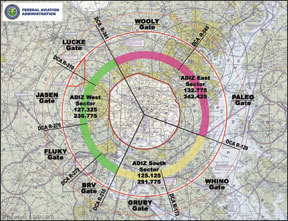
The New SFRAs

Airspace designations, along with what is and isnt permissible inside specific areas, are perennial sources of frustration and confusion among pilots of even considerable experience. Once ones understanding develops beyond the different classes and past special use airspace, theres always the issue of how to deal with airspace in which more and different rules or procedures apply. In recent years, special flight rules areas, SFRAs, have been created to ease the flow of traffic and prevent unsafe conditions at the Grand Canyon and at the Los Angeles International Airport (LAX). The dimensions, rules and procedures for these areas are clearly documented in various places, including FAR Part 93, the FAAs Airport/Facility Directory and the respective visual charts. (Its always helpful, of course, to ask local pilots about any tricks they may know or additional information necessary to safely operate in these and similar areas.) Meanwhile, two additional SFRAs were created recently-one over Washington, D.C., and the other at New York, N.Y. Both were created in the aftermath of significant events and demand pilots planning to operate in or near them become familiar with their requirements.

Read More »
Features

Deep Stall Aerodynamics

In October 22, 1963, a prototype of the British Aircraft Corporation One-Eleven (BAC 1-11) short-haul jet airliner, registration G-ASHG, crashed near the village of Chicklade in southwest England. The aircraft was evaluating stall characteristics at varying center of gravity locations when the flight crew found the flight controls unresponsive after entering a stable stall and the aircraft struck the ground at a wings level attitude with a high rate of descent and little forward speed. All aboard died in the crash. The 1-11 was one of the second-generation of jet airliners-others being the Douglas DC-9 and Boeing 727-featuring aft-mounted engines, swept wings and all-moving T-tail horizontal stabilizers. Post-crash investigation concluded the prototype 1-11 had experienced an unrecoverable deep stall in which the wake of the stalled wing covered the high-mounted horizontal stabilizer, thus blanking the elevator controls and preventing normal recovery techniques.

Read More »
Accident Probes

Proper Plane Maintenance after Snow Storms

By the time this magazine hits your mailbox, winter will be full-on in most parts of North America. Even if you spend most or all of your time in a warmer climate, your weather will change, with cooler temperatures, more wind and the occasional low-lying clouds, with rain. In other parts of North America, youll likely experience the full range of winters offerings sooner or later this season. Good luck. Of course, winters colder temperatures and denser air mean enhanced aircraft performance, at least when compared to summers typical heat and humidity. But the season brings its own set of aircraft performance challenges, especially when it comes to precipitation. This time of year, moisture from the sky can come in many different forms, not all of it liquid. And an airplane doesnt have to be airborne to be affected; merely parking one outside in winter precipitation can have a major impact on flight operations.

Read More »
Airmanship

Night Flying Lessons

Night flying can be just as safe as flying in the daytime-but it isnt. Although accidents are more likely to occur during the daytime, according to the AOPA Air Safety Foundations 2007 Nall Report, accidents at night (and in IMC, for that matter) are more likely to be fatal. “Only 19.2 percent of daytime accidents resulted in fatalities, but over one-third (34.6 percent) of all night accidents were fatal.” Meanwhile, the same report states, “At night, nearly half of the accidents in VMC conditions were fatal (45.0 percent), compared to nearly three-fourths of night IMC accidents (74.1 percent). Night-flying accidents are generally thought of as being caused by inexperience-by students, or low-time pilots-but nighttime offers an equal opportunity for embarrassment, or worse. Experienced airmen are involved, too.

Read More »
Features

Wing Icing and Datalink Weather

Risk-and the management thereof-is a diffuse concept, for it remains true that one mans risk is anothers Saturday afternoon recreation. But its also true that in order to place degrees of risk into categories remotely capable of being ranked requires as much information as it is possible to have. It applies to airplane systems, to stick and rudder skills and above all, to weather. Weather has always been the stickiest thorn in the FAAs concept of “all available information.” Even in the era of five-minute Nexrad loops and ever more sophisticated ice prediction products, theres occasionally a large disconnect between what is expected to happen and what is really happening. The advent of real-time weather data in the cockpit has reduced the surprise factor, but it hasnt eliminated it. And it cuts both ways-having lots of information thats just wrong can be worse than having no information, and it can lure you into a decision you might not have otherwise made.

Read More »
Features

Reasons Behind Fatal Accidents

Some pilots are, by nature, worriers. They worry about fuel, about engine failures, about hazardous weather, about midair collisions. Bluntly, pilots worry about things that can kill them. But do they worry about the right things? In other words, does the risk framework that most of us construct in our personal aviation universe reflect the reality of the serious killers in aircraft accidents? Our guess is that it does not, unless pilots are out there really sweating about stalls, spins and controlled flight into terrain. And even if the pilot population is wide awake about these hazards, it could do a better job of avoiding them. Stalls and CFIT (controlled flight into terrain) pop up as the two biggies in fatal accidents in general aviation to a degree that, frankly, startles us.

Read More »
Features

Top Five Reasons To Cancel An IFR Flight

An overly long list of chores guaranteed a couple of things for flying from my home in Wichita, Kan., to Atlantic City, N.J., some years ago. First, the entire trip would be flown IMC and with instrument departures and arrivals at all three airports involved. Second, the timing of my departure meant not only was the first leg assured to be IMC and with ILS conditions, it was going to be mostly at night-with a night ILS. The questions running around in my head prompted me to undertake a higher-than-usual degree of preparation, starting by making a serious personal risk analysis. The questions didnt need 100-percent affirmative answers, but getting a negative response on more than one merited a longer look at the elements of the flight, in search of a way to turn one of the “no” responses into a “yes.” Three “no” responses would warrant a new decision on going, starting with “not going now.”

Read More »
Pilot in aircraft
Sign-up for newsletters & special offers!

Get the latest stories & special offers delivered directly to your inbox.

SUBSCRIBE