Register

Search Results for: general aviation inc

Briefing

Briefing: July 2019

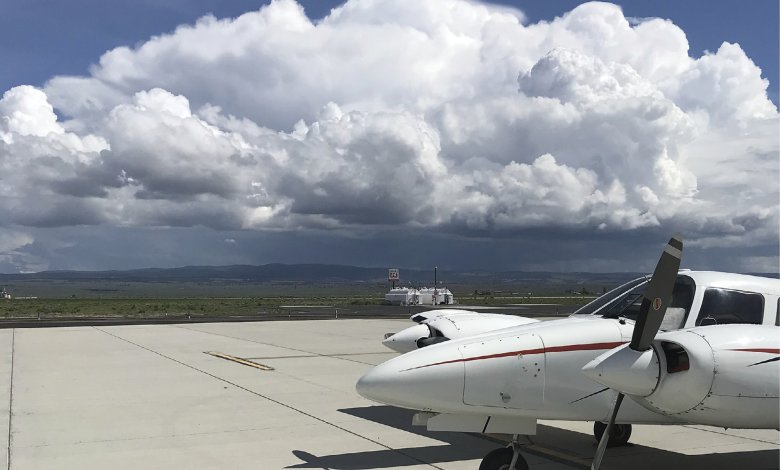
A prominent Alaskan airline and tour company voluntarily ceased operations in late May after two fatal crashes involving its floatplanes in a week. A total of six people, most of them cruise ship passengers, died May 13 when two Taquan aircraft collided while taking the passengers on a flightseeing trip. On May 21, a pilot and passenger died when a Taquan commuter flight from Ketchikan to Metlakatla Harbor cartwheeled on landing and came to rest inverted with the cabin submerged. On May 22, the airline issued a statement saying it had stopped flying indefinitely and that the tragedies left the company and staff reeling.
Read More »
Airmanship

Air Mass Storms

I used to ground myself when I saw a forecast of thunderstorm weather. I had an immediate visceral response rooted in memories of growing up in Kansas, seeing vast tornado-spawning squall lines, their blue-green tint indicating they were pregnant with hail. At age 11, I watched a barn across the road explode in one of those storms, flying in pieces across the fields, followed by a barrage of baseball-sized hail. Surely you cant fly when convective weather and thunderstorms are nearby or on the way, can you? Well, Dorothy, sometimes you can. You just need to know what to look for and what to avoid.

Read More »
Accident Probes

Diesel Additive Again Contaminates Jet Fuel

After noting that five incidents of aircraft uncommanded roll events with the ATLAS activated have been reported to EASA and the FAA, the U.S. agency on May 24 issued an airworthiness directive (AD) grounding Cessna CitationJet 525, 525A and 525B models equipped with Tamarack active load alleviation system (ATLAS) winglets. The action is related to an EASA AD and is mandatory continuing airworthiness information (MCAI) issued by the aviation authority of another country to identify and correct an unsafe condition on an aviation product.

Read More »
Accident Probes

Five Reasons Not To Fly A Coupled Approach

And like every other technology, autopilots have their limitations. For one, they have to be set up correctly-along with the navigation equipment-to reliably follow a heading and descend along a glidepath. Details like when to take over from the autopilot, how you might handle an equipment failure-if you notice it-and even whether to let Otto fly the missed approach or do it yourself need to be worked out ahead of time. Thats the short version of why we might want to consider hand-flying the approach. Lets expand on them.

Read More »
Pilot Proficiency

Leading Edge: Customizing Your Aircraft

Like many before me, as a child I wedged a baseball card (that’s what doubles were for) into the spokes on my bike to make it sound like a motorcycle. The result, from what I am told by those that had to listen to it, was expertly annoying. But it was an auspicious moment in […]

Read More »
News

NBAA Details Upcoming Changes to FSS

The National Business Aviation Association (NBAA) last week highlighted a number of changes coming soon to the FSS system managed for the FAA by Lockheed Martin Flight Services. Later this month, the FAA will complete its Clearance Relay initiative to streamline clearance delivery procedures at non-controlled airports. A clearance delivery telephone number, direct to the […]

Read More »
Pilot Proficiency

Taking Wing: Airports of the Caribbean

It’s a Tuesday morning in February, and I’m headed to work. Don’t cry too hard for me, dear reader; work in this case involves a round trip to Rio de Janiero and back in the 767. Today’s commute to my base airport is a rare two-legger, and on the first leg I’m traveling on an […]

Read More »
News

Flying Magazine Launches On-Demand Video Service

The editors of Flying Magazine are excited to announce the launch of FlyingTV.com, an on-demand video service offering 24/7 access to a vast library of more than 700 high-definition aviation titles including original series, live events, historic footage and more, all accessible from viewers’ smartphones, computers, tablets and TVs. This exclusive programming was developed in […]

Read More »
Training and Proficiency

How To Fly Single-Pilot IFR with a Digital Copilot

Like many aviation enthusiasts, my introduction to general aviation and piston airplanes was Flying magazine. As a kid in the 1990s, I always looked forward to heading to the barbershop with my dad where I could read the latest copy of Flying while waiting my turn for a haircut. I hoped to see a full […]

Read More »
Briefing

Briefing: June 2019

Boeing 737 MAX pilots will get increased ground training on the aircrafts Maneuvering Characteristics Augmentation System (MCAS) but wont drill the anti-stall software in the sim according to updated training requirements under consideration by the FAA. The Boeing 737 MAX Flight Standardization Board (FSB) has sent draft recommendations to the agency saying MCAS ground training must address system description, functionality, associated failure conditions, and flight crew alerting. These items must be included in initial, upgrade, transition, differences, and recurrent training. To this point, there was no requirement for pilots to be trained on MCAS, which is an anti-stall system designed to push the nose of the aircraft down. In fact, many MAX pilots were unaware that it had been added to the aircraft to combat an increased tendency for the plane to pitch up because of the revised placement of the larger and more powerful LEAP engines.

Read More »
Pilot in aircraft
Sign-up for newsletters & special offers!

Get the latest stories & special offers delivered directly to your inbox.

SUBSCRIBE