Register

Search Results for: Lear 45

Accident Probes

Underrated

Way back in the Dark Ages, when we were younger and less experienced in airplanes, a buddy and I spent a long holiday weekend huddled in my cold, dark Washington, D.C., apartment waiting on better weather. We had a Piper Archer II reserved for the period, along with a hotel room in Key West, Fla. Try as we might, we couldnt figure out how to get around an area of low ceilings and visibility perched in our path over the Carolinas. Both of us were in the early stages of work on the instrument rating; two half ratings doesnt equal one full rating.

Read More »
Preliminary Reports

October 7, 2007, Ekalaka, Mon., Cessna 310N

The airplane collided with terrain about 1148 Mountain time, sustaining substantial damage. The private pilot and the one passenger aboard received fatal injures. Instrument conditions prevailed for portions of the flight; visual conditions prevailed at the accident site.

Read More »
General

Day Job?

My copilot walked over to the counter top in JFK Operations where I had scattered various segments of the flight plan paperwork. His pace was quick. He introduced himself and apologized for his slight tardiness. He had commuted in from South Carolina to La Guardia and had taken a taxi ride through rush hour traffic […]

Read More »
Aircraft

Living With the Piper Meridian

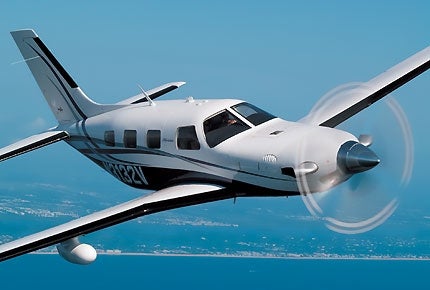
A decade ago when Piper introduced its new single-engine turboprop, the Piper Meridian, nobody was quite sure what to make of it. How would it coexist in Piper’s lineup with the popular pressurized piston single Malibu Mirage, on which the Meridian is based? And perhaps most importantly, would a new, expensive-to-develop turboprop single save Piper […]

Read More »
Preliminary Reports

September 12, 2007, Alsea, Ore., Piper PA-28-140

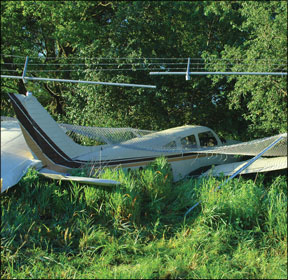
At about 1845 Pacific time, the airplane collided with terrain and was substantially damaged. Visual conditions prevailed; the private pilot and flight instructor were fatally injured. Witnesses in the area reported that they observed the aircraft maneuvering in the valley at altitudes between 1000 feet agl to about 50 feet above the trees. No one saw the aircraft hit the ground in a clear cut area behind a dense stand of trees.

Read More »
Unicom

1:60

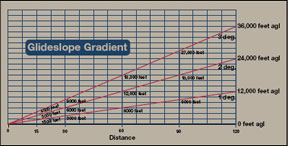
Mr. Meragers “Letting Down Easy” (September 2007) helped remind me again of that quickly needed and often used relationship in aviation: If you travel one degree on a circle and you travel one mile, the circle has a radius of 60 miles. In other words, your distance traveled and the distance from the center of the circle has the ratio of 1:60. Remember how we used this to determine the distance we are from the NDB? Flying abeam the station, we travel one degree and note the time. The time required to fly to the NDB will be 60 times the time required to fly the single degree. Knowing our airspeed, we can compute distance from the station or, knowing the distance, our airspeed. This same “magic” ratio applies in descents, too. If you are 6000 feet (one nautical mile) from the airport, and you are 100 feet agl, you will be on a one-degree glide path (1:60). A three-degree flight path would be 300 feet agl at one nautical mile.

Read More »
Photos

Cessna Cuts Pilot Training Cost In Half

The most exciting news to come out of the big Oshkosh AirVenture show last July was that Cessna committed to building a light-sport airplane, the Model 162. The new two-seater will have a standard price of $109,500 complete with an exclusive Garmin flat-panel glass cockpit, a price well below half of any other Cessna single. […]

Read More »
Features

Why Cant We Maneuver?

Most airplanes spend the vast majority of their lives in straight and level flight; climbing, turning and descending only as necessary to get on and off a runway. Its when pilots start yanking and banking, however gently and smoothly their control inputs, that problems start to arise-and the accident rate starts to increase. And when the yanking and banking takes place close to the ground, any error margin becomes slimmer still. In fact, according to the AOPA Air Safety Foundation (AOPA ASF) and its 2006 Nall Report, “maneuvering flight accounted for one-third of all fatal accidents” in 2005, the most recent year for which complete data is available.

Read More »
Accident Probes

Choice of Action

Almost by definition, pilots generally are self-reliant, often preferring to depend on their own talent and experience instead of someone elses. At the end of the day, choosing to fly a personal airplane is, well, personal. Sharing with others our enjoyment of aviation often is a trait among pilots, of course, but the take charge, Type A personality seems more prevalent. In the early years of commercial aviation, the lone pilot shepherding his or her flock of passengers across the country took on mythical proportion. Later, professionalism crept in, replacing “seat of the pants” flying with hard data. Soon, multiple pilots were added to the flight deck, becoming a crew, despite what some of the more hardened pilots may have wanted.

Read More »
Features

Why It Went Wrong

Mishaps happen for a number of reasons, but all too often theres a “what were they thinking?” element to an NTSB accident report. In the calm, clear skies of retrospect-or a motionless easy chair-its easy to condemn a bad decision and move on. But its not usually a single bad decision that causes tragedy. Pilots dont take off intentionally choosing to put themselves in a no-win situation; they dont mean to kill themselves, their families and friends.

Read More »
Pilot in aircraft
Sign-up for newsletters & special offers!

Get the latest stories & special offers delivered directly to your inbox.

SUBSCRIBE