











Mr. Meragers “Letting Down Easy” (September 2007) helped remind me again of that quickly needed and often used relationship in aviation: If you travel one degree on a circle and you travel one mile, the circle has a radius of 60 miles. In other words, your distance traveled and the distance from the center of the circle has the ratio of 1:60. Remember how we used this to determine the distance we are from the NDB? Flying abeam the station, we travel one degree and note the time. The time required to fly to the NDB will be 60 times the time required to fly the single degree. 288
1:60
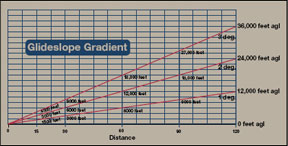
Mr. Meragers "Letting Down Easy" (September 2007) helped remind me again of that quickly needed and often used relationship in aviation: If you travel one degree on a circle and you travel one mile, the circle has a radius of 60 miles. In other words, your distance traveled and the distance from the center of the circle has the ratio of 1:60. Remember how we used this to determine the distance we are from the NDB? Flying abeam the station, we travel one degree and note the time. The time required to fly to the NDB will be 60 times the time required to fly the single degree. Knowing our airspeed, we can compute distance from the station or, knowing the distance, our airspeed. This same "magic" ratio applies in descents, too. If you are 6000 feet (one nautical mile) from the airport, and you are 100 feet agl, you will be on a one-degree glide path (1:60). A three-degree flight path would be 300 feet agl at one nautical mile.

Key Takeaways:
- The "1:60 rule" is a fundamental mathematical relationship in aviation, useful for calculating distance from navigation aids and planning descents.
- Applying IFR principles, such as maintaining consistent descent rates and airspeeds, can improve precision and safety in VFR operations, including traffic patterns.
- The article underscores the critical importance of stabilized approaches and the instructor's responsibility in guiding students toward safe decision-making and recognizing unstable conditions.
- Clarifications are provided regarding VFR weather minimums in different airspaces and the specific conditions for conducting IFR flight in uncontrolled (Class G) airspace.
Key takeaways sponsored by Aviator Pro | Start Your Training ->
See a mistake? Contact us.

