Register

Search Results for: Lear 45

Features

Deviant Behavior

Its been said that experience is what you get when you dont get what you wanted to get. Well, taking significant liberties, a pilot might then say that a deviation is where you go when you dont get to go where you planned to go. Got it? We pilots are typically a robust and determined bunch. We dont like to admit we cant travel our planned route. Once were on our way and it looks like Mother Nature doesnt want us on our planned route, the common technique is to simply go have a look before deciding on a different, longer route. To understand the fallacy in this, lets cover a little basic geometry to see that its better to deviate early for the shortest practical addition to your route while maintaining your sanity and keeping your blood pressure in check with a conservative deviation.

Read More »
Features

Unfamiliar Territory

Theres little I find more exciting than launching for a new destination across unfamiliar territory. Exploring the great unknown makes adventurers out of pilots who use their planes for, you know, actually going places. But, getting there requires a little-sometimes a lot of-extra planning. My bride enjoys the adventure of personal airplane travel as much as any pilot; she also appreciates the added risks involved when tackling new terrain, new airspace, new weather systems and new destinations. Shes such a good sport, in fact, weve enjoyed the thrill many times. Our first “real” trip took us on a 2300-mile journey starting only five days after passing my private pilot checkride. Then, there was our first time to Sun n Fun; to coastal North Carolina and the sands of the Wright Brothers; our first flight to Oshkosh and-well, you get the picture. We also made a couple of international trips that still stand out years later: Key West to Grand Cayman for one, and Cancun, by hugging the Bay of Campeche to Vera Cruz, then the West Yucatan city of Campeche and across the Yucatan. The latter one took two days each way.

Read More »
General

Two Days in the Life of Bill Settle

Since 2002 the bestselling certified single-engine airplane in the world has been the Cirrus SR22. More than 700 new Cirruses have been sold per year for the past two years, and the company hopes to sell 800 in 2008. The question is, how do they do that? How do you take on Cessna and Columbia […]

Read More »
Features

How To Fly Twin Engine Aircraft At Single Engine Performance Levels

Twin-engine airplanes certified under FAR 23 do not have the same performance guaranteed for transport category airplanes certified under FAR 25. Especially, light twins weighing less than 6000 lbs and have VS0 equal to or less than 61 KCAS are not required to have any positive single-engine performance. Twins weighing more than 6000 lbs and/or having VS0 above 61 KCAS must demonstrate, in still air at 5000 ft, with the inoperative engine feathered, a climb gradient of 1.5 percent (if certified after February 1991), or a rate of climb of 0.027 V2S0-not exactly earth-shaking performance. We often hear that losing an engine in a light twin-engine airplane is far more dangerous than losing the only engine in a single-engine airplane. Melville Byington Jr. (1989 and 1993) of Embry-Riddle Aeronautical University conducted an experimental study of the bank angles required to obtain the zero sideslip flight, and consequently, the maximum performance in light twins. Based on the NTSB accident data, Byington concluded that 30 percent of twin-engine airplane accidents occur due to the loss of directional control (VMCA rollover), while 43 percent can be traced to insufficient performance with one engine inoperative (OEI). The remaining 26 percent or so are stall/spin accidents, which also carry the highest fatality rate. Evidently, more accidents happen due to the inadequate SE performance planning or understanding, than due to the control problems.

Read More »
Airmanship

You Are The Backup To Safety Enhancing Aircraft Avionics

Theres no going back-we are in an era of high-tech avionics and cockpit automation. Even some LSAs are sporting “glass” cockpits and simple autopilots; cross-country airplanes sport panels and equipment unheard of even in high-end turbines scant years ago, and the turbines themselves are becoming more accessible to owner-pilots. Even the most capable of these airplanes, however, has its automation limitations. Proper operation and constant monitoring of automated systems remains the responsibility of well-trained and emergency-current pilots. On April 19, 2008, a Cessna Citation Mustang suffered substantial damage when its pilot ground-looped the light jet to prevent a runway overshoot at Carlsbad, Calif. According to the NTSBs preliminary report, this was an intentional act to prevent going off a cliff past the end of the runway after the pilot landed “fast” and beyond the mid-point of Carlsbads 4600-foot available landing surface. The pilots quick action may be credited with sparing injury (or worse) to the four people on board.

Read More »
News

Cirrus ‘V1’ Now Has a Flight Logbook

Last Thursday, Cirrus’ single-engine personal jet flew for the first time. The 45-minute test flight was the first of a series to establish “verification and validation” of the proof-of-concept airframe, now dubbed V1 for that reason, according to Cirrus Chairman and CEO Alan Klapmeier. But the name also references the unique jet’s V-tail configuration, which […]

Read More »
General

Low-Speed Loss of Control

From an NTSB preliminary report on an accident involving a Piper PA-46-500TP (Meridian turboprop single): “An eyewitness, a retired Navy instructor pilot, located about one half-mile northwest of the accident site, reported observing the accident airplane descending through the overcast about 1227. The airplane leveled off about 300 feet above ground level (agl) and turned […]

Read More »
Airmanship

Are Some FAA Flight Regulations Too Lax?

Theres no way the FAA can come up with a regulation covering every possible scenario, which is a good thing. If they did, wed rarely be able to roll our airplanes out of their hangars except on the clearest of days when no airliners were about. So, the FARs set certain minimum standards for pilots and once we determine were in compliance, its up to us to decide if the proposed operation is safe, morally acceptable and non-fattening. Or something like that. Frequently what we want to do complies with both the FARs letter and spirit. Sometimes its borderline; certainly legal but safe only if everything goes our way and nothing on the airplane breaks. And then, there are occasions when the proposed operation is both legal but really not smart.

Read More »
Photos

A Faster King Air

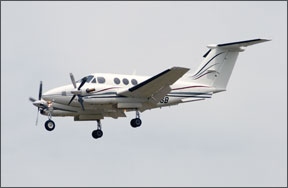
When Beech developed its big T-tailed King Air 200 in 1973 it named it the Super King Air, and using the word super has proved to be right on target 35 years later. More than 2,000 King Air 200s have been delivered, making it the most popular turbine-powered business airplane of all time. And over […]

Read More »
News

Hold on Tight

There are two kinds of people: those who find spins exhilarating, and those who find them terrifying. I found them exhilarating when my instructor, Betty Faux, first demonstrated them to me in a Cessna 150 during the course of my post-private-ticket training. I promptly invited friends to share this great thrill. We would fly out […]

Read More »
Pilot in aircraft
Sign-up for newsletters & special offers!

Get the latest stories & special offers delivered directly to your inbox.

SUBSCRIBE