Register

Search Results for: Lear 45

Accident Probes

Dark Horizon

My most recent night flight involved a relatively short hop across the Florida peninsula. It was one of those humid, heavy summer nights when remnants of the days thunderstorms were still about, forcing FLIB and airliner alike to seek alternate routes and taxing controllers who just wanted a calm evening. Still, I had a few things going for me: Training, currency, experience and the occasional cluster of ground lights denoting a small town. I filed IFR at 8000 feet for this short hop, because I didnt want to try doing it at a level low enough to stay VFR-legal (there are way too many cellphone towers out there these days), and climbing high enough to get above the buildups wasnt practical. It was yet another case where having the instrument rating to spend maybe 90 seconds punching in and out of billowing clouds during a 45-minute flight meant all the operational difference in the world.This was one of those nights where the natural horizon wasnt all that apparent, due to the moist, summer haze over south Florida extending up to my altitude, plus the number and size of the buildups. Although I could see each buildup, and navigate around or through them, the natural horizon wasnt consistently visible.

Read More »
Preliminary Reports

August 5, 2009, Napa, Calif., Cessna 182S

At 0431 Pacific time, the airplane impacted a hill shortly after departure. The solo commercial pilot was killed and the airplane was substantially damaged. Instrument conditions prevailed; an IFR flight plan had been filed and a clearance had been issued. Recorded radar data was consistent with the airplane making a shallow left bank and gradually increasing in altitude towards the east. The target was first identified at a Mode C reported altitude of 100 feet msl. During the next minute, radar returns disclosed a gradual ascent to 1000 feet msl; the last two returns show an altitude of 900 feet and a slight change of direction to the south.

Read More »
Accident Probes

Failure To Climb

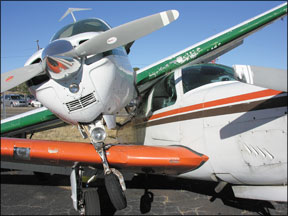
Almost 20 years ago, I rode coach from JFK to Osaka, Japan on a Northwest Airlines 747-400. Taking my time in deplaning, I managed to sneak a peek at its cockpit and chat briefly with the crew. I was astonished to learn the airplane weighed nearly 900,000 lbs at takeoff, close to or at its maximum gross, and burned almost half that weight in fuel before landing. I can presume the airplanes handling characteristics at takeoff versus landing. While transport pilots routinely operate at maximum weight, the rest of us rarely do. So, on our first gross-weight takeoff in, say, 10 years, the airplanes desire to roll farther and climb more slowly than were accustomed can be an eye-opener. Ive written previously in these pages about how my airplanes FAA-approved maximum gross weight is 250 pounds heavier than its manufacturer intended, thanks to wingtip fuel tanks installed pursuant to a supplemental type certificate (STC). That STC comes with various paperwork, but does not include revised performance charts showing expected takeoff or climb performance. From experience, I know a climb at the higher gross weight requires patience.

Read More »
Pilot Proficiency

SimCom Training Centers

Back in 1989, businessman Wally David made an interesting observation: Computer graphics technology was improving so dramatically that a whole new realm of simulator training was about to become possible. With the new graphics technology, a non-moving Flight Training Device (FTD) might be able to provide a realistic sensation of movement simply by incorporating high-quality, […]

Read More »
Unicom

Patterns Of Conflict

Well guys, if theres an aviation subject, other than lean-of-peak EGT, guaranteed to generate a multitude of conflicting opinions, traffic patterns and entries at non-towered airports certainly qualify (Unicom, July). You are to be commended for your bravery in taking it on! Unfortunately, and like so many other aspects of aviation, there is seldom a “one size fits all” situation. As Im sure you are well aware, there is that faction who believe straight-in-approaches are blatantly illegal at non-towered airports. Then there is another group who will blunder straight in regardless of how many aircraft are in the pattern. As always, good judgment must prevail and, unfortunately, there seem to be those few who are totally immune to learning or exercising same! One advantage to the 45 is that it allows you to break off the entry safely if there doesnt seem to be an adequate interval within which to fit, make a 360 away from the airport and try again.

Read More »
Airmanship

Understanding the Difference Between a Headwind and a Tailwind

I have a 100-knot airplane. Oh, sure; the airspeed indicator usually reads much higher than that. But when it comes down to what really counts-rate of movement over the ground-my shiny, expensive, 160-knot airplane is frequently relegated to speeds closer to those of an 18-wheeler on the Interstate below me. The reason? Headwinds. Eastbound, westbound-any direction-its not a matter of whether Ill have a headwind, but how strong it will be. If I plan a trip for Tuesday, on Monday the chosen route will afford a nice little nudge. On Tuesday, the fickle fates will deal a howling 40 knots on the nose. After an unplanned fuel stop, Ill drag into my destination about two hours late, landing only after being forced to shoot an ILS to near-minimums and well after the FBO has closed. The only food available will be a warm Pepsi and a package of cheese crackers. On Wednesday, that same route will once again have a nice little tailwind. Such is my life. Of course, there are good, logical reasons for headwinds. Lets explore them.

Read More »
Accident Probes

Windy Conditions in Mountainous Areas

Some of the more memorable flights Ive made over the years involve flying over or through mountainous terrain. The terrain itself, of course, is visually interesting, with vivid colors and shapes, contrasting with the overwhelming monotony other geographic areas may present. I will long remember a late afternoon, eastbound flight over New Mexico, with some of my favorite music blasting over the headphones as I watched the terrain underneath change to its nocturnal state. I was overflying the terrain, though: The airplane performed as it always does at 13,000 feet msl. The weather was utterly benign, yet Im glad I was cruising instead of taking off or landing. On another occasion, I found myself looking at decent weather but strong winds aloft for a flight over other portions of New Mexico, plus Arizona and Nevada. I scrubbed that flight due to the forecast winds at altitude, which were at or above the airplanes stall speed.

Read More »
News

Two Runway Incursions Last Month at CLE

A pair of runway incursion incidents at Cleveland Hopkins International Airport are under investigation by the National Transportation Safety Board. On June 3, a Boeing 737 was cleared into position on Runway 6L at the same time an Embraer E-145 had been cleared for takeoff from the same runway. On June 26, another Embraer 145 […]

Read More »
Photos

It’s All About Speed

The Beech Premier IA is the fastest business jet that you can fly by yourself so it’s no surprise that Jack Roush, who owns five Sprint Cup NASCAR race teams, owns a Premier to fly to and from his many business locations, and to race tracks spread across the country. Roush is like most pilots […]

Read More »
News

The Myth of Gross Weight

“The pilot’s failure to maintain airspeed while maneuvering for approach to land. Contributing to the accident was the pilot’s operation of the airplane above the design gross weight.” Such was the verdict of the National Transportation Safety Board as to the probable cause of the fatal crash of a Cessna 172 at St. Petersburg-Clearwater airport […]

Read More »
Pilot in aircraft
Sign-up for newsletters & special offers!

Get the latest stories & special offers delivered directly to your inbox.

SUBSCRIBE