Register

Search Results for: Lear 45

Technique

Wake Turbulence In IMC

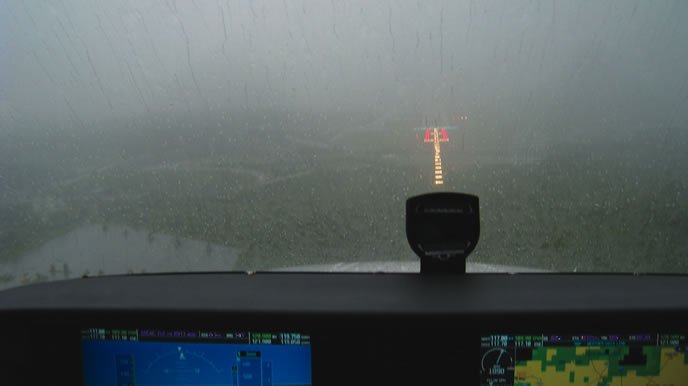
From my base in Santa Barbara, Calif., I often fly north to San Jose (KSJC). At San Jose, GA aircraft operate from Runway 29, parallel and to the west of the two main runways, 30L and 30R for jets. All the runways have straight-out IFR missed-approach procedures.One night, while I was waiting for release on 29, Southwest 376 (a 737) reported on final and asked, How close is 376 to the killer bee ahead? He was referring to a 757 and its reputation for leaving a brutal wake.
Read More »
Technique

Wind on the ILS

Youre descending on the glideslope for the ILS 29 with a 25-knot tailwind. Winds at the surface are eight knots from the southwest. Quick: What two corrective actions will you need to make over the next three minutes? With enough experience youll get it right, but ask yourself: Is this brand of analysis second nature to you? Sure, you can just follow the needles and correct, but thats accepting being behind the curve rather than mastering it. An understanding of the variables affecting an approach path give you the capacity for proactive, rather than reactive, piloting.

Read More »
Readback

Readback: May 2010

On page 14 of the February issue (Glass Panel Scans), you state that a case can be made for flying track instead of a heading assigned by ATC. This I have to hear. When a controller assigns me a heading, that is what he wants me to do, and doing something else would seem to constitute failure to follow an ATC instruction. Your thoughts?

Read More »
Accident Probes

Crossed Up

Traffic patterns arent that hard: Fly a rectangle. One side is the downwind; one side has the final approach and departure paths. Simple, right? Not really. One of the problems is all those turns we have to make align the airplane with the runway or the downwind. And some of those turns are close to the ground, at relatively low speeds and are poorly executed. Sadly, the results of steep turns to final-especially when overshooting the runways extended centerline-can be fatal.

Read More »
Readback

Readback: April 2015

I see a lot of confusion between the terms VFR and VMC (as well as IFR and IMC). VMC and VFR are often used interchangeably, in fact.To me, VFR and VMC are in fact not the same because VFR refers to a set of rules that govern flight (visual flight rules), which includes airspace and so on. There are certain weather minimums to operate VFR. However, VMC can be interpreted as conditions that allow you to keep the plane upright by looking outside. You can be VMC but in VFR weather by simply being 1500 feet away from a cloud.However, while I could find VFR and IFR defined in FAR/AIM, I couldnt find anything for VMC. Are you aware of any FAA guidance on this?

Read More »
Training & Sims

GA Takeoff Minimums

Many sharp instrument students and pilots, when asked what items must be considered for an IFR departure, go confidently to Section L of the Terminal Procedures Publication, TPP, and talk about the Obstacle Departure Procedures, ODPs. This makes me confident theyre on the right track. But many will then either gloss over or improvise their way through the section on takeoff minimums. This information looks important, with restrictive numbers and climb gradients in it. Many CFIIs, though, just teach that it doesnt matter at this stage. True enough, but knowing a little about them can help us make better departure decisions.

Read More »
Technique

Bag of Tricks

Teaching teaches the teacher. Ive got over 4000 hours total time and of that over 3000 hours teaching instruments. In that time, my students have taught me quite a bit and Ive picked up a few tricks on my own. Heres a compendium of helpful little tips and tricks.

Read More »
News

NTSB to Reopen Buddy Holly Accident Case?

More than five decades after what was termed “The Day the Music Died,” when rock and roll legends Buddy Holly (Charles Hardin), Ritchie Valens (Richard Valenzuela) and J.P. “The Big Bopper” Richardson died after the Beechcraft Bonanza Model 35 they were flying in crashed, a Petition for Reconsideration or Modification (49 CFR – § 845.41) […]

Read More »
Features

Incomplete Circles

Not all approach procedures are aligned with the runway on which we want to land. Once we have it in sight, to get from the procedures missed approach point (MAP) to the desired runway, we may need to maneuver well within 1000 feet agl in low visibility, and do it at a relatively low airspeed to remain within airspace protected from obstacles. Its called circling to land, and is one of IFRs red-headed stepchildren: a visual maneuver, with IFR constraints.Sadly, a few of us each year prang airplanes while circling to a runway after an approach. To learn more about how and why, we looked at a collection of recent accidents during circling maneuvers. They all seem to have a few things in common, like banking too steeply in turns and letting the airplane descend too early.

Read More »
Pilot in aircraft
Sign-up for newsletters & special offers!

Get the latest stories & special offers delivered directly to your inbox.

SUBSCRIBE