Register

Search Results for: Citation X

Airmanship

Smoothing The Bumpy Ride

Nothing can spoil a nice trip on a good-weather day like bumpy air. Like most other things in meteorology, its somewhat possible to predict turbulence. But unlike most other things in meteorology, as well as in life itself, there is something you can do about it. Altitude, time of day, tall-and not-so-tall-buildings and the relative flatness of the terrain over which were flying can all combine to make what should have been a smooth, relaxing flight into your (or your passengers) worst nightmare. Sometimes, those are the cards youre dealt. Most of the time, though, it doesnt have to be that way. The air that supports our aircraft is a fluid subject to the laws of physics. Ignoring the local influence of the sun and obstructions for a moment, when the wind blows, its flow is laminar-all air moves together smoothly. Even though that air might be moving rapidly it will be pretty smooth. If you upset the laminar flow of that wind, things can get interesting in a hurry. The upset can be something physical like a mountain or just a different air flow. The result on the nice days is just a slight change to the laminar flow of the wind. On bumpy days, though, the result is air in the boundary between the laminar flow and the upsetting influence is not smooth at all. In fact, there are often eddies and backflows, same as you get aft of an airfoil thats just at or past the its critical angle of attack. Depending on the strength of the wind and the opposing forces, those eddies and backflows can be slight or quite severe, with the corresponding flight through them being either a little jittery or enough to separate wing from fuselage.
Read More »
Photos

Cessna 172TD: Skyhawk With a Bang

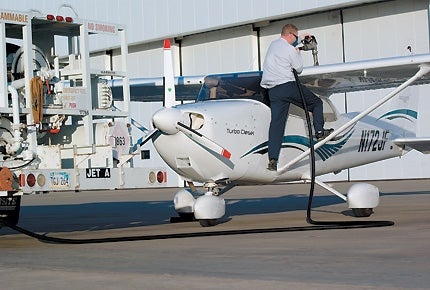
The fuel filler caps on the new Cessna Skyhawk 172TD aren’t your garden-variety flip-lid 100LL caps like I’d pried (or twisted) open countless times before. These babies are industrial, overbuilt Teutonic-looking things, placarded in bold letters to make it clear what kind of fuel to use: “Jet-A Only.” They seem emblematic of this new breed […]

Read More »
News

Cessna Unveils Its Largest Business Jet

In February Cessna announced details of its new Model 850 Citation Columbus, the first business jet in the line to have a flat-floor cabin with 6-feet 1-inch stand-up headroom. The Columbus promises 4,000 nm of IFR range flying at Mach .80 (459 knots) while carrying eight passengers. The airplane is an all-new design and will […]

Read More »
Photos

Learning to Fly the Mustang

When I earned my first jet type rating more than 25 years ago it was just assumed that I knew how to fly and could pass the course. If I couldn’t, the check ride would find my shortcomings, and I would be out the door. The training was one size fits all, sink or swim, […]

Read More »
Photos

What Happened to the Piston Twin?

The year 1979 was the last big year of aircraft shipments. Almost 18,000 were sold that year. About 3,000 of those airplanes were piston twins. Today, any single that sells 534 units a year is red hot. In 1979, that’s how many Seneca twins Piper sold. If the piston single business looks lethargic when compared […]

Read More »
Features

Aircraft Turn Dynamics

According to the AOPA Air Safety Foundations 2007 Nall Report, you have a 57.4 percent chance of dying if you lose control while maneuvering an airplane, up from 50.5 percent in the reports 2005 edition. Maneuvering describes a host of flight operations including aggressive turns from base to final, confined-area course reversals and retreats to the runway following an engine failure. In other words, turns. Why cant Johnny turn safely? One reason might be losing understanding of and appreciation for the dynamics of a turn, regardless of bank angle, airspeed or pitch. Lets take a look

Read More »
Preliminary Reports

November 4, 2007, Tuscaloosa, Ala., Piper PA-31-350

While taxiing slowly in reduced visibility, on the taxiway centerline and using the taxi and landing lights, the pilot noticed a parked airplane to his right and applied brakes. The airplane yawed to the left and its right wing collided with the left side of the fuselage of a parked Cessna Citation. The pilot stopped the airplane, notified ground control that he had collided with another airplane and shut down.

Read More »
Photos

The Real Glass Cockpit Question

There has been a great deal of discussion about the difficulty, or lack of it, of transitioning from conventional flight instruments to flat-panel primary flight displays (PFD). Many also worry that new instrument pilots who learn on a PFD will find it very difficult to fly safely with a conventional round dial set of gyros […]

Read More »
Features

On a Mission: Managing Ice

Aircraft utility can go down significantly in cold weather. Adverse weather is more common and tenacious than in warmer months, and along with the fog, low clouds and wind, there is often the threat of airframe ice. Yet we still want, and sometimes feel we need, to fly. How can we balance the possibility of airframe ice with the utility of our airplanes? How do the experts-those “on a mission” with their airplanes-predict, avoid and escape airframe ice? To answer these questions I spoke with professionals who slog through the weather every day (and night), flying high priority aeromedical, charter and air cargo in piston, turboprop and small jet aircraft.

Read More »
Photos

Cessna Cuts Pilot Training Cost In Half

The most exciting news to come out of the big Oshkosh AirVenture show last July was that Cessna committed to building a light-sport airplane, the Model 162. The new two-seater will have a standard price of $109,500 complete with an exclusive Garmin flat-panel glass cockpit, a price well below half of any other Cessna single. […]

Read More »
Pilot in aircraft
Sign-up for newsletters & special offers!

Get the latest stories & special offers delivered directly to your inbox.

SUBSCRIBE