Search Results for: Cessna 172

Aircraft

Belite’s Chipper Aircraft Continues Evolving

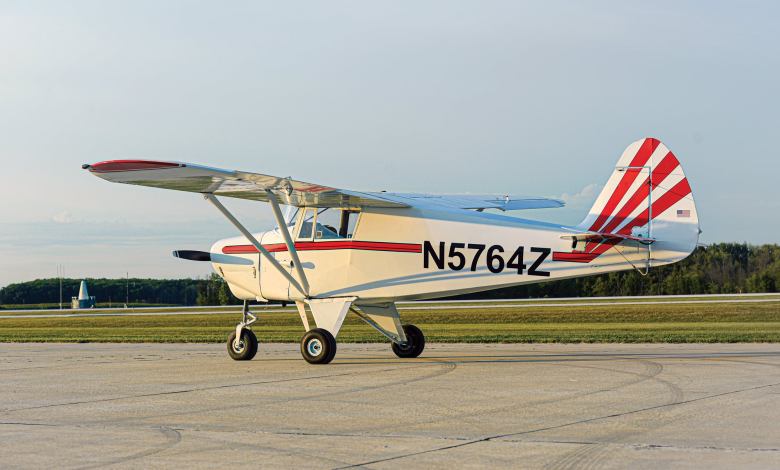
Being a tail dragger aficionado since my Citabria ownership days probably gave me a leg up on taking to Belite Aircraft‘s Chipper when I first saw it at Sun N Fun in April. Belite’s president, James Wiebe, made it clear from the start of our conversation in Lakeland that the Chipper was a work in […]

Read More »
Aircraft Analysis

Gadget Addiction

I chuckled reading Mike Hart’s comments on reverting from his in-cockpit gadgets to paper (Addicted To Gadgets? June 2017). I fly my Cirrus with a Garmin Perspective, but just attained my commercial license using a 1967 Piper Arrow II, since I needed a retractable-gear airplane. These good friends keep their planes in top shape, but it was a similar experience to Mike’s 135 challenge. The club has three retracts and I would move between each one until I decided which one to test in. Between the Arrow IV, 172RG and the Arrow II, I finally decided on the II.

Read More »
Avionics and Gear

Readback: August 2017

In April Killer Quiz, The Prof and the Pilot, I dont think that the answer to the last question is correct. With tailwind, one should reduce the airspeed below best glide speed, which in turn reduces the sink rate. Gliders pilots are very familiar with these concepts.Unfortunately, Cessna doesnt publish sink rates at various speeds to compute that accurately, so we are left to back-of-the-envelope calculations. We know that at best-glide speed (65 knots.

Read More »
Another Look

Wheels

The tailwheel could not be steered during an annual inspection. The tailwheel had been painted; its grease fitting had been completely covered. The owner stated a technician told him not to grease the tailwheel and to tighten the nut on the bottom of the steering pivot bolt as tight as possible. Disassembly revealed all parts inside the tailwheel unit were extremely worn.

Read More »
Aircraft Analysis

Smooth Transitions

At some point in your flying career, you likely graduated from your trainer to flying different aircraft. Maybe you gained access to a fleet of aircraft through a club or flight school, an FBO or a Part 135 charter company. Or you moved to light sport aircraft, a plane you built or a plane you bought. Perhaps you stepped up quickly to higher-performance aircraft, those with more horsepower that can swing gear or have two engines.

Read More »
Accident Probes

Fuel Tanks

Aircraft had been inactive and hangared for approximately six months. While trying to troubleshoot a fuel quantity indication problem, a fuel sample revealed contamination, which was sent for analysis. While awaiting results, tanks were drained and an anti-bacterial fuel additive was added before they were refilled.

Read More »
Accident Probes

Know Thy Cargo

Out flying about here in Idaho, its amazing the kind of useful cargo that gets thrown into a typical personal airplane. Personally, Ive flown white gas, propane, butane, isobutene, bear spray, flares, magnesium metal, petroleum jelly-soaked cotton, windproof matches, fire starter, resin wood, radioactive materials, guns and ammunition. And thats just my emergency kit. I also usually carry (mostly) full tanks of aviation fuel and an engine filled with oil. You probably do, also.

Read More »
Accident Probes

More Changes Coming

For almost as long as Ive been flying, the general aviation industry has been in upheaval. By the mid-1980s, product liability concerns and tax law changes helped remove what was propping up things, and the bottom fell out. Among other outcomes, Cessna stopped making piston-powered airplanes altogether while other manufacturers discontinued numerous models, preferring to concentrate on one or two.

Read More »
Pilot Proficiency

Taking Wing: Virtual Airports of My Digital Dreams

Airplanes, pilots and airports: Where you find two, you’ll find the third. In my airplane-obsessed childhood, this indisputable fact led to an early acquaintance with every airfield within a 20-mile radius. These were quiet country fields, mind you, but every so often a Cessna would drop in to do a couple of touch-and-goes, or maybe […]

Read More »
Accident Probes

NTSB Reports: April 2017

At about 0937 Mountain time, the airplane was destroyed when it collided with mountainous terrain. The private pilot and three passengers were fatally injured. Instrument conditions prevailed.Radar data show the airplane reached its cruising altitude of approximately 8000 feet msl some 12 minutes after takeoff. The airplane subsequently descended about 1300 feet in one minute before entering a momentary climb, which was followed by a shallow descent. In the remaining two and a half minutes, the airplane maintained a 300 fpm descent rate, with some intermittent climbs. The final two radar targets show the airplane climbed about 425 feet in 12 seconds. The airplane maintained a straight track from its departure airport to the last radar target, which was within 0.1 nm of the 6670 feet msl accident site.

Read More »
Pilot in aircraft
Sign-up for newsletters & special offers!

Get the latest stories & special offers delivered directly to your inbox.

SUBSCRIBE