Search Results for: Cessna 172

Aircraft Analysis

Light Retract Safety

For owners not blessed with heroic stick-and-rudder skills and cash to burn, the usual sequence of ownership starts with a fixed-gear single and progresses to a high-performance retractable. For many owners, the retract is the end game.

The attraction of a folding-gear single is undeniable. These models are plentiful in both variety and price, most offer good performance at reasonable operating costs and they usually do represent a step-up in performance and capability.

Ignoring price and performance for this analysis, were comparing these aircraft strictly on one narrow parameter: the models accident record. What kinds of accidents do they suffer and how do they compare with each ot…

Read More »
Preliminary Reports

NTSB Reports

The following briefs were selected from the 136 preliminary reports filed with the NTSB in March 2002. Statements in quotes were taken directly from the NTSB documents. The information is subject to change as the investigations are completed.


March 01, Austin, Texas
Beech Bonanza

At 1641 central time, a Beech A36 crashed during a missed approach at Austin Bergstrom International Airport, killing the pilot and passenger. The pilot was cleared for the ILS Runway 17L approach and maintained the localizer and glidepath until near the approach end of the runway. At that point, the pilot declared a missed approach and the tower issued missed approach instructions. The ai…

Read More »
Squawk Box

Locked, Not Down

The following information is derived from the FAAs Service Difficulty Reports and Aviation Maintenance Alerts.


The FAA has issued a special airworthiness information bulletin in a continuing attempt to get owners of Beech prop airplanes to use proper gust lock procedures.

Numerous incidents and accidents have resulted from the failure of a pilot to remove the flight control gust lock prior to attempting to take off. Many involved the use of a makeshift gust lock, including such things as a common bolt or nail inserted through the holes in the control column provided by the manufacturer.

Obviously, this tactic did not provide the pilot with any kind of reminder that a gust…

Read More »
Features

New Breed of Sims

The next generation of training devices look and feel more like real simulators. Thats a big improvement, but theyre still not perfect.

Read More »
Preliminary Reports

NTSB Reports

The following briefs were selected from the 99 preliminary reports filed with the NTSB in February 2002. Statements in quotes were taken directly from the NTSB documents. The information is subject to change as the investigations are completed.


Feb. 03, Joshua Tree, Calif.
Beech Baron

At 0953 Pacific time, a Beech 95-B55 was damaged in an off-airport landing following a loss of power while on approach to Joshua Tree Airport. The pilot and passenger were not injured. The pilot, with about 600 hours in the airplane, said the airplane had come out of its annual inspection just over four flight hours earlier. The engines lost power in the traffic pattern. Both auxiliar…

Read More »
Accident Probes

Expectations

You often see what you expect to see rather than whats really there, a deadly combination on a Sarasota runway.

Read More »
Squawk Box

Shoot, No Chute

The following information is derived from the FAAs Service Difficulty Reports and Aviation Maintenance Alerts.


Three days after the FAA issued an airworthiness directive on the Cirrus Design emergency parachute, the first parachute deployed in actual emergency conditions failed to fire and the SR-20 crashed. The pilot and passenger were not injured.

The FAA published AD 2002-05-05 on March 13, with an effective date of March 19. The AD requires the owners of some SR-20s and SR-26s to avoid flying at night or in IMC until installing a clamp on the cable that activates the parachutes rocket – with the installation due within 10 flight hours.

The accident airplane belonged…

Read More »
Airmanship

Unwanted Push

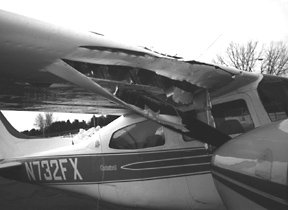
[IMGCAP(1)]One of the most basic tenets in aviation is that an airplane ought to take off and land into the wind. Yet each year the accident statistics show that some pilots refuse to follow this basic rule. And each year the tailwind factor results in bent aluminum, injured passengers, or worse.

Right off well acknowledge that there are occasions when a downwind departure is necessary. For example it is quite common due to ATC traffic flow and airport congestion at large terminals such as JFK, LaGuardia, Teterboro or Washingtons Reagan National. Then there are airports such as Aspen, Colo., with a mandatory downhill departure on runway 33 – often with tailwinds – due to surrounding t…

Read More »
Features

Gimme Gyros

Partial panel isnt a death sentence, but backups – from simple manifold suction to complete panel redesign – turn it into a nonevent.

Read More »
Pilot in aircraft
Sign-up for newsletters & special offers!

Get the latest stories & special offers delivered directly to your inbox.

SUBSCRIBE