














Compared to general aviation, the airlines enjoy an enviable safety record. Part of that record can be attributed to the aircraft they operate – all-weather, high-performance machines with robust and redundant systems. Plus they operate mostly into big airports sporting long, obstruction-free runways equipped with the latest safety enhancements.
But perhaps the most significant factor in that safety record is the high-quality simulator training airline flight crewmembers receive from the very first days of their employment that continues regularly throughout their career. These simulators are aircraft type-specific and mimic the aircraft flight and systems characteristics so completely that most airline flight crewmembers qualifying on a new type dont operate the real thing until theyve taken their checkrides and theyre flying the line on revenue trips under the guidance of what is called an initial operating experience instructor.
The advanced simulators the airlines use have six-axis motion bases, wrap-around visual systems and cockpits that are identical to the real thing, right down to the upholstery on the seats.
When you push the thrust levers up for takeoff, youre shoved back into the seat. When you land and deploy the thrust reversers and brakes, youre thrown against the straps of your shoulder harness. When a system fails, all the appropriate lights and aural alerts operate. The airport environment, complete with cars moving down adjacent highways, appears out the windows.
This sophistication comes with a price – about $10 million when you count the delivery, set-up, and building infrastructure. Plus, it takes a cadre of technicians to keep all that hardware working.
The high cost of entry is what has kept high-quality simulator training from being a routine part of general aviation. Two companies – Environmental Tectonics and Fidelity Flight Simulation – have recently introduced flight training devices that include visual systems and motion bases that may start to change that. These devices are targeted toward flight schools and can be purchased for less than the outlay for a new four-seat training aircraft.
Flight training devices are sometimes called sims in the GA world, even though they have little in common with the full-motion, high fidelity versions employed by the airlines. An FTD is a replica of an airplanes instruments, equipment, panels and controls in an open flight deck or an enclosed airplane cockpit.
Unlike a simulator, flight training devices do not have to completely re-create the actual aircraft cockpit. Typically they sit on a desktop or in the corner of the room with the worst lighting. We visited one flight school that had its old FTD wedged into a closet under a set of stairs, which made it even more claustrophobic than a 152 with a 300-pound instructor.
We recently flew the two new FTDs and they both had hybrid cockpits – the flight instrument panel looked like that installed in current GA aircraft but sub-panels containing switches, engine controls, and flight controls were generic. Our main question: Are these bona fide training tools in an FBO environment or high-tech tricks to keep flight instructors working during periods of foul weather?
The Value of Simulators
The use of simulators produces economies of time and money, both of which are valuable commodities in the cash-intensive world of aviation. They provide a better environment for learning, there are no problems with weather or other air traffic, and they dont burn expensive fuel.
Over the past eight years as a Boeing 757 simulator instructor, Ive seen these benefits time and again. Through the power of simulation, I can have a pilot with virtually no large turbojet time ready for a checkride in seven four-hour sessions. This is possible because the pilot brings good airmanship skills and extensive aviation experience to the simulator, where theyre augmented by an intense, time-tested syllabus.
Airlines use simulators for all phases of training, not just cranking out junior flight crew. Through annual recurrent training called Line Oriented Flight Training scenarios, pilots can see and experience the abnormal flying qualities induced by system failures and emergencies that would be far too dangerous to practice in real airplanes. They can also learn first-hand how inadequate manuals and poorly written checklists can lead them astray and recognize the pitfalls of bad habits they have developed along the way.
Even as an instructor, I rarely come out of a simulator without learning something.
Though the operators like the economies involved with simulator training, the most compelling benefit of simulators is the safe environment in which training is conducted. Until the advent of simulators, airlines had a sickening record of accidents during training flights, with several notable fatal accidents. System and power plant failures can be introduced in a way simply not possible when training in the aircraft. The instruction can also reinforce the lessons by pausing the scenario and examining particularly good or bad reactions.
Some regional and commuter airlines still train in the airplane. Shortly after Continental Express introduced the Embraer EMB-145 jet in the late 1990s, that airline lost one of their new multi-million dollar aircraft in a takeoff training accident. There were serious injuries, but fortunately no fatalities.
The Flight Training Devices
For general aviation training, Environmental Tectonics Corp. has developed the GAT-II flight training device. ETC, based in Southhampton, Pa., near Philadelphia, is an established global company with an extensive background of producing motion devices.
Fidelity Flight Simulation, headquartered near Pittsburgh, is a brand-new firm of pilots that saw a niche and is filling it with the Motus 6-Series FTD.
Both FTDs are FAA-certified Level 2 machines that use large computer monitors to display the flight instrument panels. The advantage of this arrangement is the ability to configure the panel to look like the one installed in just about any aircraft. It also reduces maintenance because there are no delicate mechanical instruments.
Computer monitors also serve as the visual systems. The GAT-II actually uses the same monitor for both the instrument panel and the view outside. The Motus uses four separate monitors for a wider field of view and a separate monitor for the flight instrument panel.
Both use generic hardware for the throttle, prop, and mixture controls and for switches that operate radios, aircraft systems and lights.
The GAT-II features a fully enclosed, single-seat cockpit. The enclosed cockpit is a required characteristic of an important ancillary use of this FTD – spatial disorientation training. More about that later.
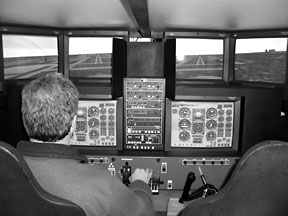
The Motus has a cockpit that is open at the rear for crew entry and instructor observation. It can be configured for one or two seats and dual controls for training crews of multi-pilot aircraft.
Both FTDs have motion bases with electrical actuators instead of the hydraulic ones found on most simulators. The Motus system has six axes of motion while the GAT-II has three, but the GAT-II has unlimited 360 yaw motion that facilitates its spatial disorientation training function.
Neither FTD has control loading, which is a fairly complex system that creates the stick-force-per-G of an actual aircraft flying at the same speed and altitude.
Aerodynamic modeling for several aircraft are available for both FTDs and the GAT-II has a helicopter version.
Flying the Motus
Ill get right to the point. These FTDs do not fly just like the airplanes they represent. Without control loading and type-specific cockpits, its simply not possible. However, I think they can make effective training devices, which is exactly what they are. What pilots using these devices will have to do for effective training is to learn to fly these specific training devices and transfer that experience to the aircraft.
I flew the Motus 622P at Corporate Flight Management in Smyrna, Tenn. Corporate Flight chief pilot Leon Custers says his company uses the dual-control simulator for a full range of tasks – initial and recurrent pilot training – in a number of aircraft from a single-engine trainer to twin turboprops.
The Motus 622 looks like a scaled-down boxy version of the airline simulator I teach in. Entry is made from the rear across a small bridge that is raised when the simulator motion is activated, again just like the airline simulator.
Custers had configured the simulator as a Beech Model 58 Baron, an aircraft type in which I have lots of hours. Sure enough, the familiar sight of a late model Baron panel greeted me when I took my seat. But the sub-panel where switches for fuel pumps, starters, lights and other systems was generic and nothing was where I expected it.
We were positioned on the runway with engines running (one of the economies possible with a simulator) and I was soon on takeoff roll. As Custers had warned, the rudder pedal steering was especially sensitive and I weaved down the runway until I reached flying speed. Once airborne, I was in more familiar territory.
The visual system is four large computer monitors mounted above the flight instrument panel and the upward angle at which you have to crane your neck to see outside is a little unnatural, but you can see outside, unlike the Level 6 767 FTD in which I occasionally instruct.
As I expected, the controls of the Motus were like most simulators – quite sensitive. As Custers vectored me for an ILS approach, I made some changes of heading, altitude and airspeed. The pitch attitudes and power settings were close to what I remember them being from my days as a Baron charter pilot.

