













Salt Lake CQ, and Skiing Too: Learning to Love Recurrent Training

As an airline captain over 40, passing a two-day bout of continuing qualification simulator practice is required every six months.

Gemini Sparkle

Key Takeaways:

  • Professional airline pilots are required to undergo a range of periodic qualifications, including medical exams, online ground school, line checks, and recurrent simulator training (CQ), to maintain their operational status.
  • Airline training philosophy has significantly evolved from extensive systems knowledge and challenging scenarios to a more pragmatic approach emphasizing quick reference handbooks (QRH) and resource management, influenced by the FAA's Advanced Qualification Program (AQP), which also made training less stressful and more cost-effective.
  • The author, initially anxious about check rides, has adapted to the current, less daunting training regime, appreciating its reduced stress and enjoying the learning opportunities, particularly when new training facilities offer perks like combining simulator sessions with leisure activities such as skiing.
See a mistake? Contact us.

As a professional pilot operating under Part 121, there are a couple of easy but important hoops I am required to periodically jump through in order to retain my usually cushy, admittedly well-paid sinecure. 

Being a captain over the age of 40, I must procure a fresh Class I medical every six calendar months. Once a quarter, I slog through several hours of online ground school. Every 24 months, a line check airman sits on my jumpseat for a few legs and confirms that I can go at least one whole day without terrorizing my first officers or endangering the general public.

This Article First Appeared in FLYING Magazine

If you're not already a subscriber, what are you waiting for? Subscribe today to get the issue as soon as it is released in either Print or Digital formats.

Subscribe Now

Finally, once every nine months I am compelled to pass a two-day bout of recurrent simulator training, which at my airline is called continuing qualification, or CQ for short. This consists of one four-hour session of pure training, and then a check ride that alternates between a maneuvers validation (MV) or line-oriented evaluation (LOE). I sardonically refer to this as my “how-bad-do-I-want-to-keep-my-job quiz.”

Now in reality, once you’re established at an airline and beyond probationary year, no single check ride is a truly must-pass event. Most airlines are unionized and have contracts that specify the process to be followed in case of a busted ride, the object of which is the successful retraining and restoration of the errant pilot to line operations.

But failing a check ride definitely puts one on management’s radar, something I’ve always tried to fly well beneath. It would undoubtedly add stress to my life, not to mention wasting free time on retraining. Worst of all, it would be a crushing blow to my ego. Thankfully, thus far in my career I have passed every ride on the first attempt. 

Which isn’t to say that check rides never bothered me. I had nightmares for months before my private pilot ride and still lost sleep to check ride jitters as late as my first few years at the airlines. But over time I came to realize that I do my best flying during training—and particularly during check rides.

At this point, between seven employers, six type ratings, and 31 years of flying I reckon I’ve taken something like 54 check rides and an additional 20-25 line checks. They’ve just ceased to be a big deal, and I’ve lost all fear of them, to the extent that I’ve become a bit cavalier in my preparation, at least by my earlier standards. A bit of stress actually ups my performance. 

Admittedly, my career has coincided with a pretty major change in philosophy around training and checking in the airline industry. Airline check rides today are not what they were 25 years ago.

My first airline, Horizon Air, was pretty gung-ho about training. It made sense given the rugged environment we operated in and the quirky, demanding nature of the Bombardier Q400. We spent two weeks in an actual classroom learning the systems. The initial simulator course was five weeks long. My oral exam alone lasted four hours and basically required that I know how to build the airplane.

By 2007, Horizon Air was shrinking, and I jumped ship to a brand-new regional carrier, Compass Airlines. The transition brought several culture shocks, the first of which was the brevity of the training.

Systems ground school was initially one week and was soon eliminated altogether in favor of online training. The type rating course was half the length of Horizon’s. My oral exam was a short 30 minutes, and most answers consisted of “twelve o’clock and dark per system logic.” I got to the airplane and couldn’t believe how little I knew about it.

My assumption at the time was that Compass was simply a crummy regional—the bastard child of the Northwest Airlines bankruptcy—started on a shoestring budget to provide cheap feed. All that was true, but the training was actually a reflection of industry trends that had already left Horizon behind.

The new paradigm holds that too much systems knowledge tempts pilots to troubleshoot from the hip rather than follow the quick reference handbook (QRH) and call the experts at maintenance control. It suggests that implausible, mettle-testing scenarios with multiple systems failures don’t really happen in the real world, and line pilots actually get themselves into trouble in mundane situations like unexpected go-arounds. There’s much more emphasis on using resources and working together to problem-solve, and much less stress on flying maneuvers. 

The change in philosophy coincided with the widespread adoption of the FAA’s Advanced Qualification Program (AQP). It replaced the traditional six-month recurrent training cycle with a nine-month cycle with alternating MVs and LOEs. Before AQP, the practical test standards were ironclad, and violating one even momentarily would theoretically result in a bust. Now there is a grading scale of 1 to 5, and only a 1 (e.g. red-screening the sim) results in immediate failure. A score of 2 (exceeding ACS consistently without self-correcting) merely requires on-the-spot retraining.

I’m sure it’s pure coincidence, but the kinder, gentler training is also much cheaper and came into vogue right as all the airlines went through their post-9/11 bankruptcies. When I got to my current major airline in 2014, the training was strikingly similar to Compass. 

Not that I’m complaining. With the stress of recurrent training removed, I casually crack the books on my last line trip before CQ and then cram for 90 minutes of study and 10 minutes of chair-flying before each event—and the instructors are overjoyed that I show up overprepared.

I actually look forward to the training itself, as I always learn something interesting. However, my airline’s main training center is in Atlanta, and traveling 2,000 miles and three time zones away just to do two simulator sessions is a pain. “Virginia Avenue,” like many urban areas surrounding noisy airports, is a bit of an impoverished, high-crime district, and not an altogether pleasant place to hang out. The training center itself is immediately adjacent to our operations center and corporate headquarters, and you feel very much in the fishbowl as various suits drop in and out.

When I upgraded to B737 captain, it was my third initial qualification course in six years, and the month spent on Virginia Avenue turned into a seemingly endless grind. That memory has helped keep me on the fleet for five years.

Thus I was happy when my airline started sending West Coast 737 crews to do CQ at CAE in Phoenix several years ago, and downright overjoyed when we broke ground on our own auxiliary training center in Salt Lake City. It just opened this spring, and I was lucky enough to be one of the first to do recurrent training there. It’s a beautiful facility, and you can’t get much further out of the fishbowl.

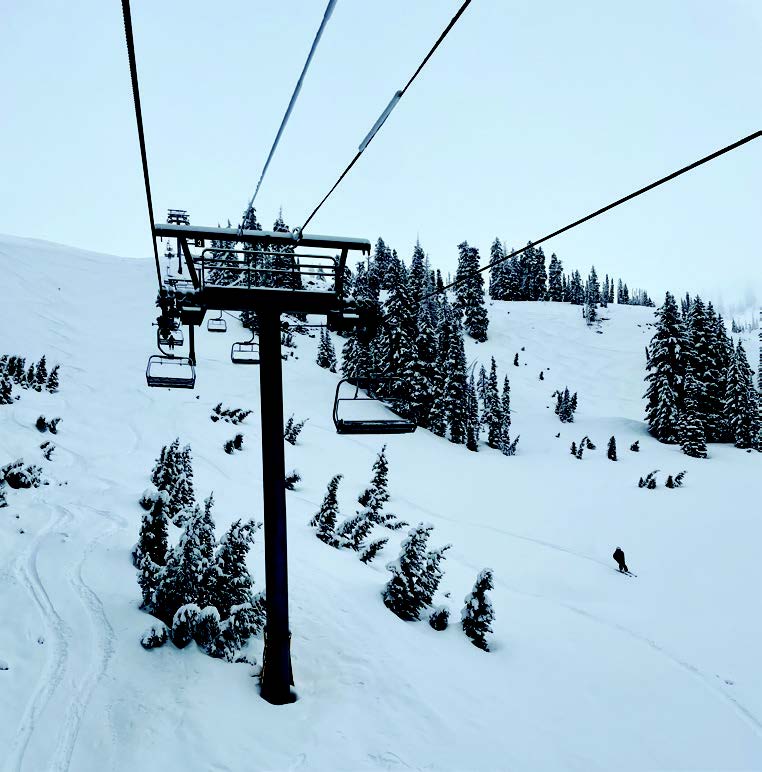
I intentionally bid “D-periods” (evening training slots), brought my skis, and shredded the steeps at Snowbird Ski Resort all three mornings—including one fantastic, unforecast 12-inch powder day. There are seven ski resorts within 50 minutes of the Salt Lake City training hotel, and my next two CQ cycles will be in March and December. 

There are also rumors that the Salt Lake training center may soon receive a second A320 simulator and an initial qualification program. Thus far the trips and seniority within the SEA A320 category haven’t tempted me to make the leap, seeing as how it would entail another month grinding away on Virginia Avenue.

That said, if there’s anything that would motivate me to “learn French” and finally make the jump to Airbus, it’s a wintertime training slot in Salt Lake City. A monthlong type rating course would be a small price to pay for 30 glorious days of Wasatch Range powder skiing.


This column first appeared in the July Issue 960 of the FLYING print edition.

Sam Weigel

Sam Weigel has been an airplane nut since an early age, and when he's not flying the Boeing 737 for work, he enjoys going low and slow in vintage taildraggers. He and his wife live west of Seattle, where they are building an aviation homestead on a private 2,400-foot grass airstrip.

Ready to Sell Your Aircraft?

List your airplane on AircraftForSale.com and reach qualified buyers.

List Your Aircraft
AircraftForSale Logo | FLYING Logo
Pilot in aircraft
Sign-up for newsletters & special offers!

Get the latest stories & special offers delivered directly to your inbox.

SUBSCRIBE
