



Robinson Helicopter has produced conventional rotorcraft for more than half a century. But the company is making autonomous and remotely piloted aircraft a key part of its future.
Robinson this month formally combined its uncrewed aircraft system (UAS) activities and Ascent AeroSystems subsidiary, acquired in 2024, to form Robinson Unmanned—a developer of small drones as well as self-flying helicopters built around its flagship R44 and R66.
The new business unit will offer two uncrewed variants of the R44, one each for heavy-lift cargo and agricultural operations, such as crop spraying. Its R66 “Turbinetruck” will be equipped with Sikorsky’s Matrix autonomy system, primarily handling defense logistics.
Robinson Unmanned will also offer three coaxial small UAS developed by Ascent.
The company in a news release said the move marks a “significant structural shift” from a “traditional rotorcraft manufacturer to a provider of scalable, autonomous vertical flight systems.” Speaking at Verticon in Atlanta this month, David Smith, president and CEO of Robinson Helicopter, said the new unit “could easily be bigger than all of our heritage businesses combined.”
Paul Fermo, president of Ascent, will lead the company.
“We are creating a versatile ecosystem of certified, proven airframes capable of tackling any mission profile,” Smith said in a statement. “Our goal isn’t just to build better helicopters. It’s to build smarter, safer [vertical takeoff and landing] solutions. By fusing human expertise with autonomous reliability, we are massively amplifying mission capability while significantly reducing operational risk.”
Robinson Unmanned said it is building aircraft with a technology-agnostic open architecture, meaning the vehicles will be able to accommodate a wide variety of equipment and systems and be enhanced with new capabilities as they become available. Smith at Verticon said he envisions an “era of both manned and unmanned [aircraft] in collaboration.”
“By focusing our engineering expertise on modular, open systems, and autonomy-agnostic platforms, we ensure our fleet evolves at the speed of the mission, not the speed of a traditional procurement cycle,” said Fermo. “Our competitive edge lies in Robinson’s vertically integrated manufacturing and scalability, which allows us to deliver aircraft-grade performance at a cost structure built for high-volume operations.”
Robinson’s Uncrewed Additions
The uncrewed helicopters will be built on existing airframes with common engine, drivetrain, and rotor systems. They will be designed to meet the Pentagon’s Group 3 and 4 UAS requirements. All three lack seats and flight controls and will not be certified to carry people.
R44 Airtruck and Sprayhawk
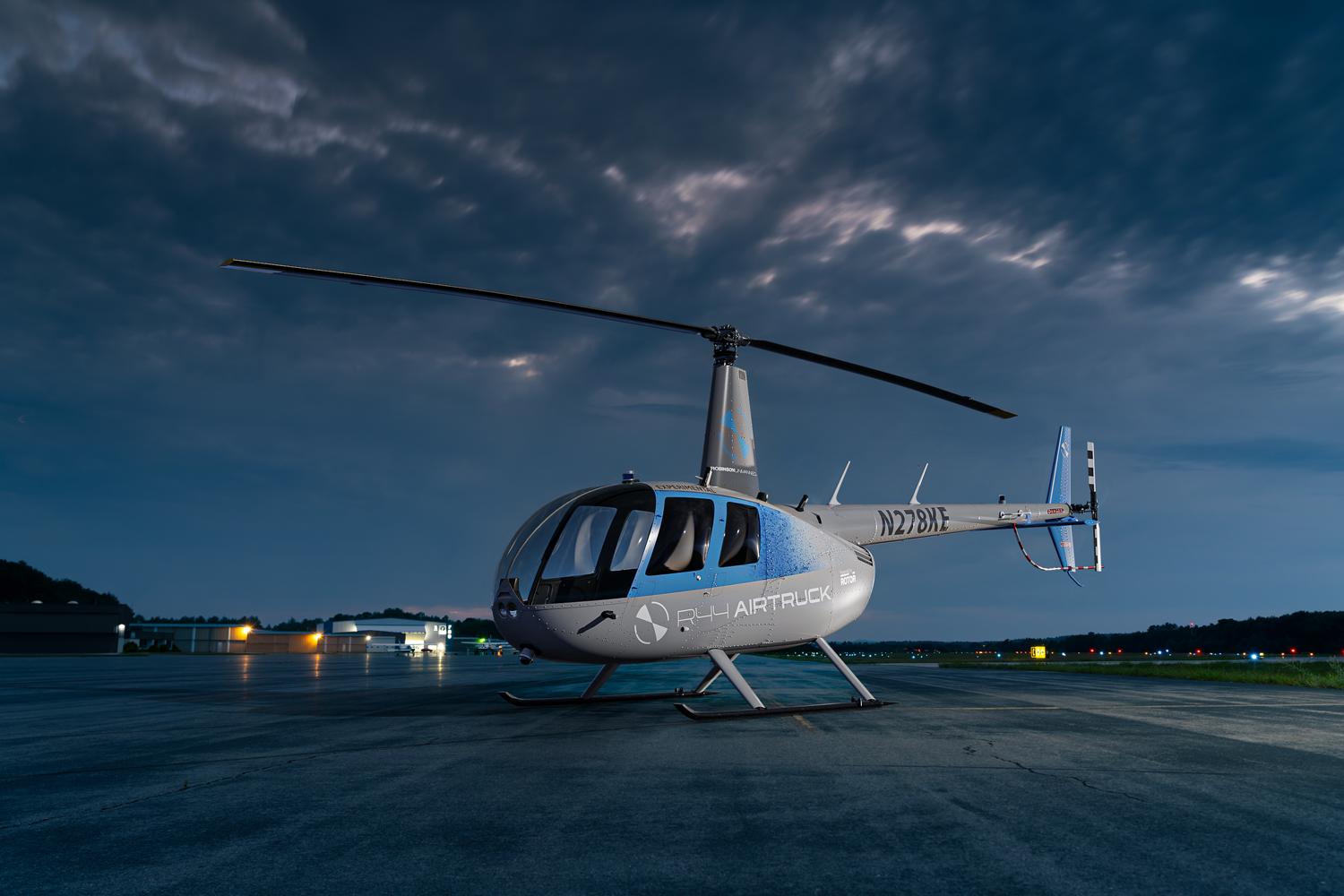
The R44 Airtruck is a heavy-lift platform for cargo transport, resupply, and surveillance missions. It can accommodate about 1,100 pounds within its 63-cubic-foot cargo hold. A sling for external cargo could carry gimbals, cameras, cargo buckets, winches, hoists, firefighting tanks, and most products with a supplemental type certification for the R44.
Piloted remotely from a ground station, the Airtruck will use cameras, radar, and lidar to enable autonomous flight controls, precision auto-hover, terrain avoidance, and emergency return to home functions. It has an expected cruise speed of 109 knots, powered by a 6-cylinder Lycoming engine. Communications systems include SpaceX’s Starlink and 4G/LTE connectivity.
The other uncrewed R44 model, the Sprayhawk, is intended for agricultural and rural operations. It can carry up to 110 gallons of liquid spray with a flow control system enabling 60-foot-wide swaths. Per Robinson, it could cover up to 200 acres of farmland per hour, using an automated system to follow preprogrammed routes cruising at 109 knots.
Onboard cameras and sensors help the Sprayhawk follow terrain and maintain appropriate altitude and coverage. Mission planning, navigation, and post-flight reporting will be powered by Ag-Nav’s GUIA Platinum and Ag-Mission software.
At least for now, the Sprayhawk will be limited to visual line of sight operations, requiring human observers to keep an eye on it. But Robinson Unmanned is pursuing the FAA’s 44807 exemption, which would permit operations where a pilot can’t see them.
Per an FAQ on Robinson Unmanned’s website, R44 customers will be able to retrofit their conventional models with autonomy at Rotor International’s facilities in New Hampshire. Rotor’s RPX system will power both autonomous variants. The partners also plan to offer conversions at select Robinson centers worldwide.
Robinson Unmanned said both R44 variants can be flown with a commercial helicopter license and Rotor training course. But it is working with regulators to authorize operations with only a Part 107 remote pilot certification, required for commercial activities with small drones.
R66 Turbinetruck
The R66 Turbinetruck will feature Sikorsky’s Matrix system, which uses cameras, sensors, and algorithms to generate flight plans and navigate the aircraft.
Sikorsky has installed Matrix on its UH-60 Black Hawk—and about 20 other aircraft, from small drones to airlift platforms—for applications such as aerial firefighting and reduced crew defense operations. Earlier this year it unveiled the S-70UAS U-Hawk, a production-intent uncrewed Black Hawk that it hopes to fly later this year.
“We view the U-Hawk and R66 Turbinetruck as complementary bookends that meet emerging customer needs across defense and commercial segments, delivering seamless capability wherever the mission demands,” said Rich Benton, vice president and general manager of Sikorsky.
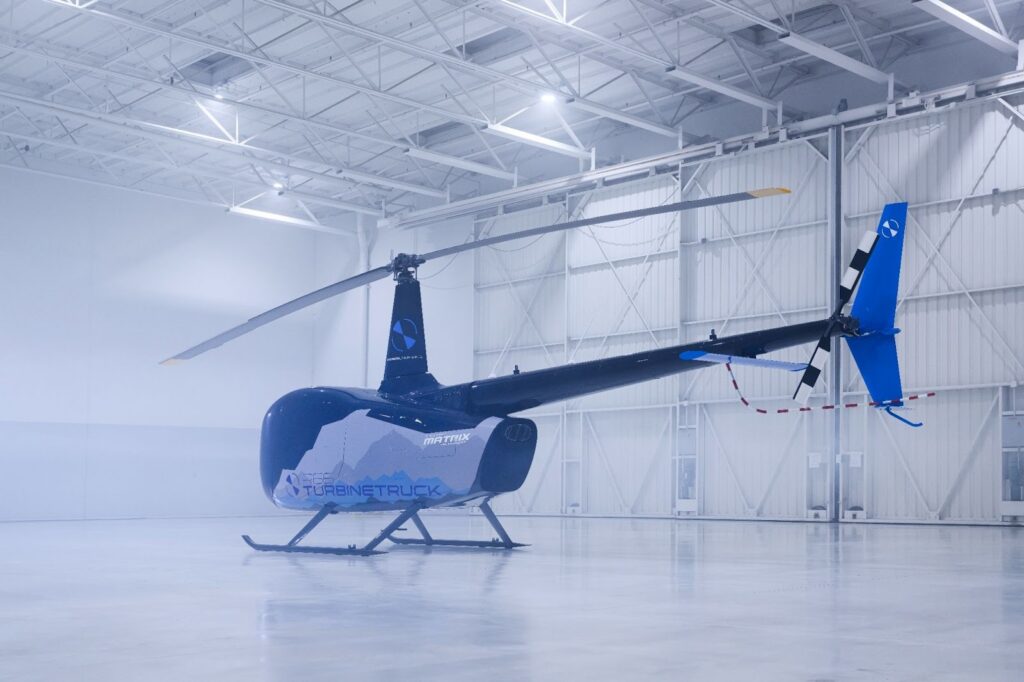
The Turbinetruck will be a heavy-lift cargo platform for defense logistics in risky or contested environments. It is designed to be affordable and attritable, with easily replaceable parts. The uncrewed helicopter will have an internal payload of 1,300 pounds, with a cargo hook for external loads.
Robinson removed the R66 cockpit and crew stations to make way for a larger fuselage, reconfigurable cargo floor, and nose-mounted clamshell door. A secondary side baggage door accommodates smaller loads.
The R66 is also the core of Skyryse’s Skyryse One automated helicopter.
Though Rotor and Sikorsky are handling the initial autonomy integrations, Robinson Unmanned said there will be “others to come.”
Small UAS
In addition to the uncrewed rotorcraft additions, Robinson Unmanned will offer three Group 1 and 2 small UAS. All are capable of operations in heavy rain, snow, or dust, extreme temperatures, and winds up to 50 mph.
Helius is a pocket-sized drone for high-risk environments, weighing less than 250 grams and deployable by hand.
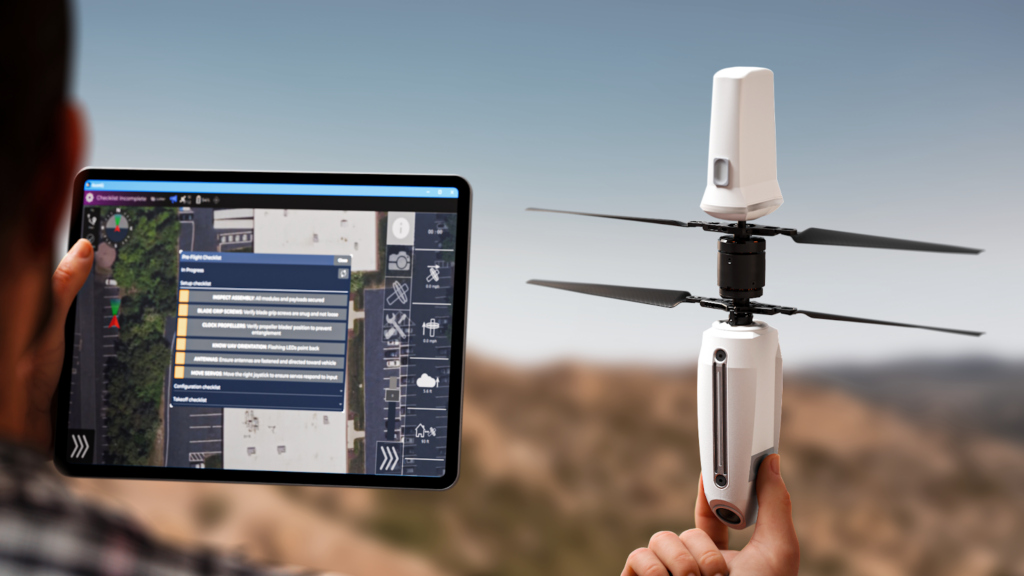
Spirit is a more rugged UAS for inspection, mapping, and surveillance missions spanning the defense, public safety, and commercial sectors. It can remain airborne for about 53 minutes with a payload of 6.1 pounds. Spirit is also a Blue UAS that has been cleared by the Pentagon for military use.
Rounding out the trio is Spartan, designed for extended endurance, multi-sensor integration, and scalable enterprise and defense operations. It has a flight endurance of about 70 minutes with a 15.3-pound payload.
According to Robinson, customers will have “total continuity of all existing product support, technical roadmaps, and program commitments remain in place.” Spirit will maintain its Blue UAS status.