











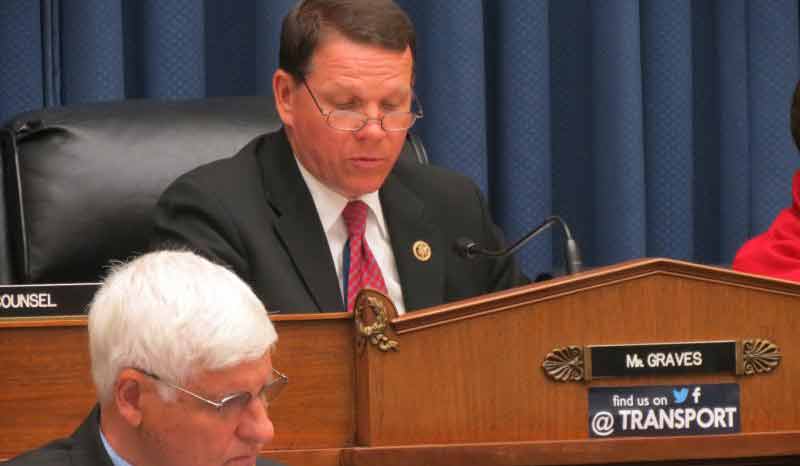


When Rep. Bill Shuster (R-PA) tried to pass his FAA reauthorization bill in 2016, he found resistance in Rep. Sam Graves (R-MO), who is a general aviation pilot. However, after making some changes, including the elimination of GA user fees, Shuster’s 2017 effort made a believer out of Graves, who heralded the 21st Century AIRR Act as it was passed by the House Transportation and Infrastructure Committee by a vote of 32-25.
Graves’ reason for supporting this bill now is that Shuster addressed his concerns and together they worked through Graves’ “issues” with the bill, and they ultimately shaped “a bill that’s in the best interest of aviation and our country as a whole.” Those were his words in his closing statement on FAA reauthorization during the T&I markup, and he drove his point home by stating that the “federal government should not be managing our ATC system,” because “the private sector has always been better positioned to oversee a project that’s completed on time and under budget.”
Graves echoed this sentiment almost verbatim on Wednesday when he delivered a letter to his colleagues in the GA caucus, urging them to add their support to the AIRR Act. The letter is almost identical to his closing statement from the late June markup, as he once again highlighted his efforts in reaching a compromise with Shuster.
“I worked to guarantee that no user fees were levied on any segment of general aviation; to maintain parity on the governing board; protect access to airspace, air traffic services and airports; and ensure the long term sustainability of the Airport Improvement Program (AlP), which is the main source of funds for our small airports,” Graves wrote.
The problem with his letter, as many aviation groups probably agree, is that Graves claims his decision to support the AIRR Act and ATC privatization is what is best for GA. It’s clearly not.
“When we talk about FAA reauthorization, I think about protecting the skies so all of aviation can continue flying safely, securely and freely,” he claimed. “That is why I support this bill, because I believe it is in the best interest of everyone in the aviation industry.”
Upon the committee passing the AIRR Act, 46 aviation groups issued a joint statement of opposition to ATC privatization, as many of them had already done leading up to the vote. Today, that number has almost tripled, according to AOPA. It seems that Graves and at least 120 aviation groups have differing definitions of the phrase “best interest.”

