Proficient Currency

Fly this exercise twice in an FAA-approved sim, with variations, and you’ll be current. Fly it to checkride standards on any sim, and you’re definitely proficient, too.

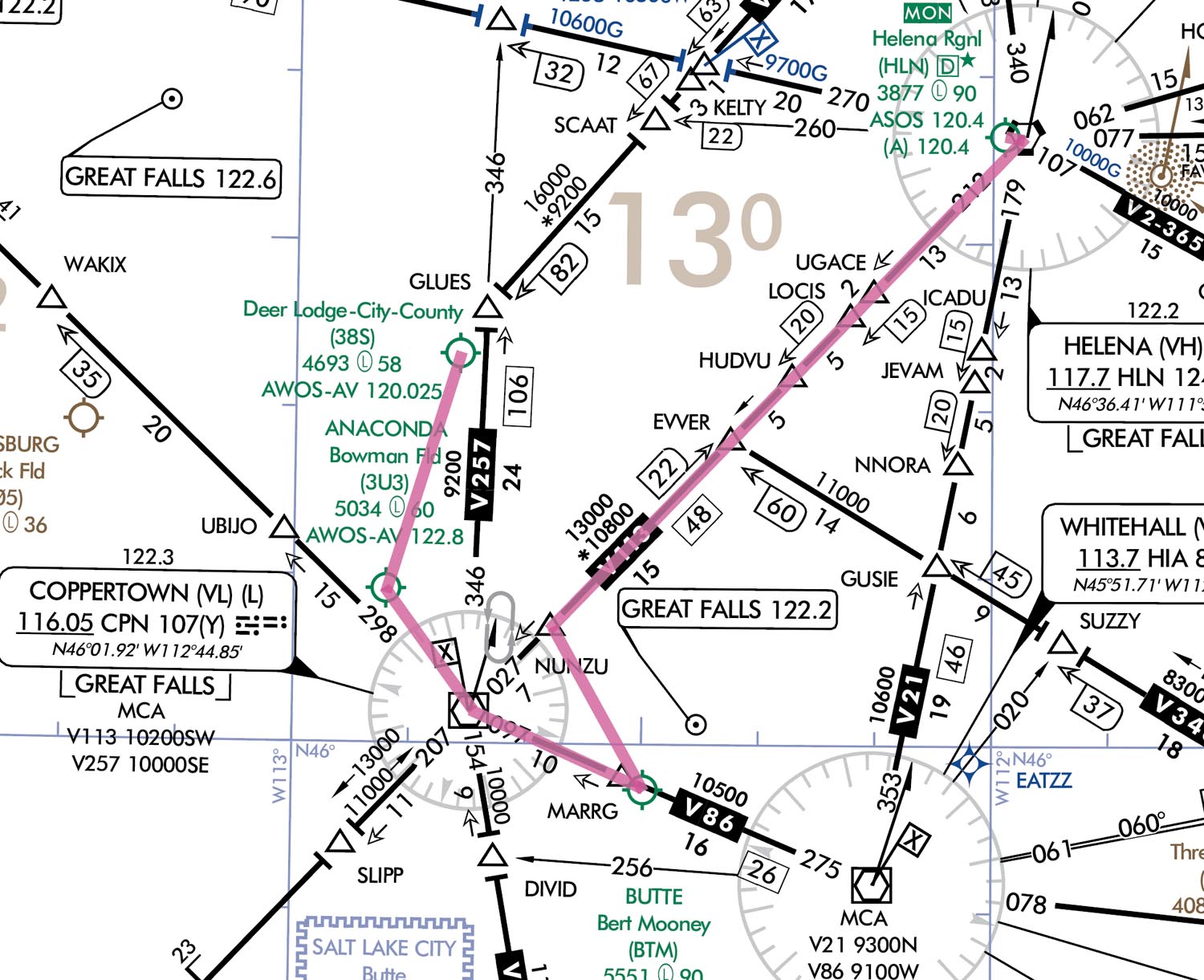
This chart shows the routing for this challenge but doesn’t show the procedures.
Gemini Sparkle

Key Takeaways:

  • The article details a comprehensive flight simulator challenge designed to enhance instrument flight proficiency and satisfy currency requirements.
  • Pilots navigate a series of complex procedures including multiple VOR and ILS approaches, missed approaches, holding patterns, and challenging departures in mountainous terrain.
  • The challenge incorporates strong, variable winds and requires precise instrument flying, careful GPS management, and a simulated dead-stick landing.
  • The entire sequence is flown twice, with reversed wind conditions on the second attempt, to provide diverse operational challenges and reinforce learning.
See a mistake? Contact us.

By Ryan Koch and Jeff Van West

Load up at Helena, Montana, (KHLN) in whatever plane you like. We’re in mountain territory, but even a lightly loaded 172 can do the job on this challenge that’s designed to improve your proficiency and even get you current.

This chart shows the routing for this challenge but doesn’t show the procedures.

For Legal Currency…

To meet instrument currency, approaches done in an approved sim must be flown all the way to mins. Of course, you could set weather to minimums. Set your sim weather for ceilings below 5778 MSL, or 255 AGL, and you’ll never break out … currency accomplished.

However, there’s value in seeing where you are at mins, and whether you’d be able to land successfully. There’s value in actually landing, too. You could pause the sim between approaches and set new weather conditions for minimums at each new airport and approach, but that’s not realistic.

Or, you could go under the hood. No, seriously. On a home sim you can accomplish this with a preset view that only shows instruments. Fly with the instrument-only view, and change views to “look up” when you reach minimums. On an FAA-approved sim you might not be able to change views like this. As odd as it sounds, consider wearing an actual hood or foggles and looking up at minimums.

Either way, make it windy. Set surface winds from 090 at 15 knots, increasing to 130 at 40 knots by 8000 MSL. You’re in for a workout.

Go Fly

The first leg of the challenge is from Helena (KHLN) to Butte (KBTM) via DIVD2.HLN V113 NUNZU. Climb to whatever cruise altitude is appropriate. You’ll have a bit of time on the airway to prep and set up for what’s next.

NUNZU is an IAF for the VOR-A at Butte. Fly that approach. You’re going to fly the published missed but be sure to brief the circle-to-land. After all, landing would be the goal in real life.

The published missed approach leaves you holding at the Coppertown VOR (CPN). That hold checks a currency box. Fly as many laps as you need to prep for the next approach attempt at Butte: the ILS 15. Conveniently, CPN has a feeder route to that approach.

Go missed on the ILS, and you’ll end up holding at CPN again. CPN is an IAF for the VOR-A at Bowman Field (3U3). Fly it, again to a missed, but consider how you’d actually plan to land. This one’s an odd, tricky approach, so brief it thoroughly.

This missed approach goes to GLUES intersection. When you get there, pull the mixture and deadstick into the airport right below you. Don’t look up until you’re below 500 AGL.

If you aced this flight, congratulations—you’re halfway to IFR currency. Do it again. You needn’t relocate to Helena. Instead, take off from 38S where you just landed. The ODP will take you to the by-now infamous CPN VOR, where you can have another go at each approach. This time, reverse the wind: 270 at 15 at the surface, and 310 at 40 by 8000 MSL. Despite flying the same approaches, this wind will make for an entirely different experience.

Come back and debrief:

Departure Procedures

How’d it go at Helena?

The DIVIDE TWO looks like a complex procedure on paper, but it’s not too bad. However, there are some gotchas. It’s possible that given the strong east wind, departing from Runway 9, you might never cross the 322-degree radial before making your initial left turn. If you then turn to the published 274-degree heading, you’ll never intercept. Then, be sure you understand the variety of leg types in your GPS and how to sequence them. After intercepting the 322-radial outbound, you might need to manually unsuspend when reaching 8100. A GPS-equipped aircraft wouldn’t need to climb to the 13,000 MEA. You could use 12,000 westbound and be above the 10,800 MOCA. In a pinch, you could even ask to cruise at 10,800.

On take two departing from 38S, did you have to hold at CPN?

The ODP includes a climb in holding to the MEA. Again, the 10,800 MOCA is sufficient for GPS aircraft on the short leg to NUNZU. That means about 6100 feet to gain in 21 miles, or 290 feet/NM.

Departing west helps, but then the tailwind hurts the gradient. The ODP itself requires a 370 feet/NM climb to 7000 from Runway 31, and then the IFR-standard 200 feet/NM thereafter. If you’re only barely meeting that gradient, you might only barely have to hold. It wouldn’t hurt to plan a lap anyway for more time and as a procedure turn of sorts. Otherwise, the GPS turn anticipation would sequence early to the next leg and could complicate transitioning onto the tight DME arc that follows. Tell ATC if you’ll hold.

KBTM VOR-A

What made this approach difficult?

The seven-mile DME arc is as tight as TERPS allows. The strong tailwind component on the first attempt makes it a continuous steep turn by IFR standards. Slowing down helps, but you also need to descend: from no lower than 10,800 on the airway to 9000 on the arc and 8200 inbound. Some good prep, however, will reveal you don’t need to descend that fast.

After the arc, there’s a full 17 miles to the airport, into the headwind. The second time, with the west wind, will feel different: a slower DME arc and then a fast final approach segment. Don’t forget the turn at the FAF.

How did you plan the circle-to-land?

With the east wind, you could land straight-in on Runway 12 if you see the runway in time. Otherwise you must comply with the prohibition against circling northeast of 15-33. (You saw that, right?) Basically, you can’t cross Runway 15-33. Oh, and did you notice the prescribed right traffic pattern for 15? So, if you get close to the airport before spotting it—say, the 1¼ SM minimum visibility—entering a legal pattern for both 12 and 15 would be tricky and would require advance planning from a thorough briefing.

KBTM ILS RWY 15

Was this simply a routine ILS?

Of all the approaches in this challenge, this one’s the most normal. But as ILS approaches go, it has some quirks. The strong crosswind component will challenge stick-and-rudder skills, especially as it decreases and changes throughout the long descent from 10,000.

A good scan that incorporates track information makes the job easier. An electronic HSI with a track indicator makes that easier. Try it again with an old-school CDI and no GPS for a real challenge. When landing, be ready to look for the approach lights and runway slightly off to the side in a crosswind like this. For a greater challenge, try this one as a LOC-only approach with the stepdowns inside the FAF.

What minimums did you use?

The “#” symbol on the first line of minimums refers to the missed approach procedure’s requirement for 365 feet/NM to 8700. With the east wind increasing to 40 knots in the climb and becoming a direct tailwind, groundspeed will be high.

Suppose you’re cruise climbing at 120 knots IAS. At 8000 feet, that’s around 138 knots TAS, or as much as 178 knots GS. That means you’ll need almost 1100 FPM. If you can’t do that, you need to use the other line of minimums and go missed more than 400 feet earlier.

3U3 VOR-A

How did you transition from the missed-approach hold to the new approach?

In many older GPS systems, like the Garmin GNS series, loading a procedure deletes the existing one. That means if you’re flying the missed approach hold for the previous ILS and attempt to load and brief the GPS-A, your current hold goes away. That could be a problem.

One trick is to load the next approach into a separate catalog flight plan, and activate that when ready. The GTN series and other modern Garmin touchscreen units retain the missed-approach hold when you load (but don’t activate) a new approach. Avidyne’s IFD systems allow multiple approaches to be loaded at once.

Did you get down in time to see the airport?

If you start this approach at the 11,000 feet from the last one, you’ve gotta descend a lot. As always, slowing down helps, but you have a big tailwind inbound. The procedure turn must be completed within 10 NM of CPN—you want to use as much of that as practical. Next time, with a west wind, you might need to start the course reversal almost immediately to keep within 10 NM. At least when you get turned inbound things slow down and get easier.

Any trouble on the missed?

The east wind on attempt #1 sets a sneaky trap here. The first step is a 030 heading to intercept CPN R-346 to GLUES. But GLUES itself is on an approximate 010-degree bearing from the airport, and the strong east wind could turn the 030 heading into something less than 010 degrees. That means you wouldn’t intercept the radial before GLUES. Depending on your GPS, it might offer a heading leg here (correct but not helpful), or a track leg (helpful). Or, it might simply draw the 346-degree radial and let your figure out the intercept. Either way, an awareness of your position, the wind, and your GPS behavior is what makes this work smoothly … or not.

Engine Out

Did you make it?

A dead-stick landing in IMC is challenging, obviously. It’s also a great test of your stick and rudder, instrument scan, and ability to divide attention. You can’t really join an instrument approach, so you have to improvise. A workable method is to zoom in your EFB or GPS map and attempt to enter a key position on downwind, just as you would in VMC. Synthetic vision can help once you’re on final.

This challenge no doubt kept you busy, but there’s one workload element missing: ATC. Dealing with frequency management, approach clearances, and dynamic changes to the plan add another layer to the challenge. So next time, you can amp it up and fly this trip on the PilotEdge ATC network.


Ryan Koch and Jeff Van West put extra effort into this one to make sure everything worked (or challenged) as planned. But at least they’re both proficient now, even though their home sims don’t let them be legally current.

Ready to Sell Your Aircraft?

List your airplane on AircraftForSale.com and reach qualified buyers.

List Your Aircraft
AircraftForSale Logo | FLYING Logo
Pilot in aircraft
Sign-up for newsletters & special offers!

Get the latest stories & special offers delivered directly to your inbox.

SUBSCRIBE