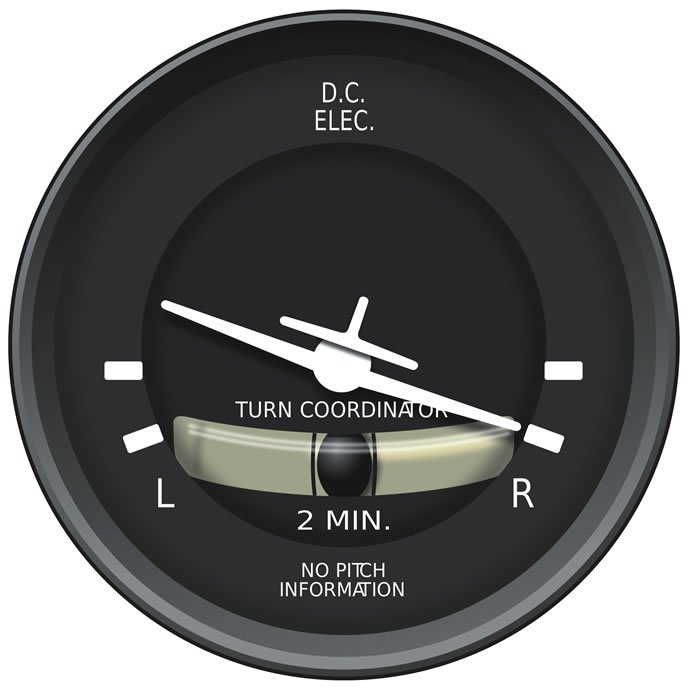
Uh oh! Halfway through an IFR cross country flight, it appears your instrument panel has suffered a couple deaths in the family: the attitude indicator, and the heading indicator. A glance at the suction gauge shows none. To top it off, you left your handheld GPS back in the car. Youre in VMC right now, but theres instrument weather down the road to your destination. A look at your charts shows a decent-sized airport about twenty miles off your right wing that probably has an A&P mechanic. Better to put it down now than get into some clouds without knowing which ways up. Unfortunately, a scattered cloud deck below is making it hard to pick out any landmarks. Not a good day.
No-gyro vectors are an essential ATC service designed to guide pilots who have lost their attitude and heading indicators, especially when unable to navigate visually or with GPS.
The procedure involves ATC issuing "turn left/right" and "stop turn" commands, while the pilot executes standard rate turns using the turn coordinator to maintain directional control.
This vital technique enables safe navigation and diversion to an alternate airport under instrument flight conditions when primary navigation instruments have failed, and pilots are encouraged to practice it.
Uh oh! Halfway through an IFR cross country flight, it appears your instrument panel has suffered a couple deaths in the family: the attitude indicator, and the heading indicator. A glance at the suction gauge shows none. To top it off, you left your handheld GPS back in the car.
CREATE A FREE ACCOUNT
Sign up to keep reading
Create a free account to continue. Already a member? Sign in below.