New Expedition and Old Theories Keep Amelia Earhart’s Legend Alive

One thing cannot be denied about the famous aviator: She sure had guts.

In this photo taken in 1935, Amelia Earhart stands in front of a Boeing P-12 at March Field in California. [Credit: National Archives]
Gemini Sparkle

Key Takeaways:

  • Amelia Earhart's celebrity and aviation career were heavily managed by publicist George Putnam, who funded her increasingly risky flights and cultivated her iconic image despite her acknowledged limitations as a pilot.
  • Her final, fateful attempt to circumnavigate the globe was marred by an initial aircraft mishap, the omission of critical survival and communication equipment, and disregarded advice from experienced peers about her capabilities.
  • The enduring mystery of her disappearance near Howland Island has spawned numerous, often fantastical, theories, from a crash at sea to capture by the Japanese, with new expeditions still hoping to find definitive answers.
See a mistake? Contact us.

A recent Sunday edition of the Cincinnati Enquirer featured a full-page photo of Amelia Earhart and the headline: “What Happened to Amelia Earhart? New Expedition May Finally Find Out.”

Another expedition? C’mon. You gotta be kidding!

On a Sunday morning in 1962, I was sitting in a downtown Kansas City, Missouri, hotel lobby while attending TWA’s stewardess training. Upon reading the July 24 edition of the Kansas City Star, I was amused to see a photo and article celebrating Earhart’s birthday…which also happens to be mine. 

This Article First Appeared in FLYING Magazine

If you're not already a subscriber, what are you waiting for? Subscribe today to get the issue as soon as it is released in either Print or Digital formats.

Subscribe Now

Since I started flying in 1961, there have been comparisons. OK, I vaguely resemble her. I’m built like her, dress like her, have the same hairstyle, flown the same kinds of airplanes, and even share that birthday. From all reports, I’m probably a better pilot…with lots of help from Garmin, ForeFlight, etc.

But one thing’s for certain: I sure don’t have her guts.

Fascinated with airplanes since youth, it took her a year to solo a Kinner, but she bent it several times afterward, mostly during landings. Her instructor, Neta Southern, and other women pilots like Louise Thaden agreed she “needed practice.”

But she persevered and in June 1928 enjoyed international celebrity status as the first woman to fly across the Atlantic. Actually, she was only a passenger, crammed in the rear of the Fokker F.VII Trimotor named Friendship between two gas tanks. The actual flying from Newfoundland to Burry Port, Wales, was done by Wilmer “Bill” Stultz and Louis “Slim” Gordon. 

These pilots were ignored by the press and public, while Earhart became an object of adulation across the world. She was feted, invited to speak, wrote a book and soon came to the attention of publisher-publicist George Putnam. 

When Putnam was eased out of a position at his family’s prestigious publishing company, he formed his own and was intent on exploiting the enormous publicity potential of a woman who would be first to fly the Atlantic solo. When she did it, he published her books (mostly ghost written) and arranged an exhaustive schedule of promotional lecture tours.

Putnam secured lucrative endorsements with the Beech-Nut chewing gum company and had her name attached to clothing, stationery, and a luggage line. He also leveraged a connection to Purdue University, where she was generously paid for lecturing and gained financial backing for flying projects.

In 1931, Putnam and Earhart (she kept her name) were married, but most friends and biographers suggest he divorced his previous wife and pushed the famous aviator into the marriage. Putnam, the consummate publicist, promoted Amelia profitably and bought airplanes that enabled her to take on increasingly risky flights and stunts to generate publicity and financial gain.

Despite all that, as mentioned, she did have guts.

She flew solo across the United States and the Atlantic alone and founded an organization of pioneer women pilots—the still-active Ninety-Nines. But her contemporaries, among them Jackie Cochran, Ruth Elder, friend and instructor Paul Mantz, and Gill Robb Wilson, former editor of FLYING Magazine, were aware of her limitations and strongly advised against some of those planned flights. Earhart wasn’t a “natural” pilot and during the 1930s continued to bend metal (or fabric)—probably even more than I even have.

Putnam finally raised enough money to finance her ultimate round-the-world flight, which would begin in Hawaii, flying a Lockheed Model 10 Electra. I am intimately familiar with this airplane because my husband, Ebby Lunken, had purchased four for his fledgling little airline in the 1960s. His friend and competitor in the Bendix Trophy races, Mantz, talked about having instructed Earhart but telling her and Putnam she wasn’t up to taking that airplane around the world with only a navigator.

Mantz flew it to Honolulu for the epic journey, but on her takeoff for an east-to-west flight, it got away from her. Despite Mantz’s instructions, she tried keeping the twin-engine Lockheed straight by jockeying the throttles instead of using rudder and aileron in the crosswind. The damage was extensive, and the airplane was shipped back to Los Angeles.

The original navigator “bailed out,” but Putnam and Earhart weren’t about to give up. Repairs were made, Fred Noonan, a former Pan Am navigator, was hired, and Earhart decided to take off from Florida and go around the other way.

Maybe significantly, this would put the early morning sun in their eyes on overwater legs.

More importantly, she left behind survival gear (life rafts, etc.) and got rid of some essential radio equipment. She had ignored Mantz’s suggestion to learn Morse code so, critically, their communication and navigation capabilities were far below par.

As you know, they made it all the way around to Lae, New Guinea. Noonan wasn’t in the best shape physically and Earhart had lost weight, looked tired, and was suffering from severe bouts of dysentery. 

You can read about what happened from there in an excellent new book, The Aviator and the Showman: George Putnam, and the Marriage that Made an American Icon, by Laurie Gwen Shapiro. At least eight different theories attempt to explain why they missed Howland Island in the Pacific:

» She got off course, ran out of gas, and crashed into 16,000-plus feet of shark-infested waters.

» She landed on an uninhabited, coral atoll, Gardner Island, where a jar of freckle cream and piece of plexiglass were found.

» The flight was an elaborate scheme to spy on the Japanese, who captured and killed her.

» She crashed on Saipan and was captured by the Japanese. A controversial photo and two metal fragments were found.

» She crashed in the ocean, was picked up by a Japanese ship, repatriated by the U.S. Navy, and secretly returned to New Jersey, taking the name of Irene Balam. 

» She survived the crash and became a nurse in World War II on Guadalcanal, attributed to patients suffering from malarial hallucinations. 

» She crashed on New Britain Island or maybe Emirau Island—both far out of range.

» She was captured by the Japanese, and she (along with other women) broadcast throughout WWII as Tokyo Rose.

That last one may well be my all-time favorite. But what I really believe (and hope) happened is that she and Noonan survived a crash landing on or near some uninhabited isle. They dressed in palm fronds, fished and ate coconuts, and lived happily ever after.

Putnam would marry twice again, dying in a resort he owned in 1950. In November 2025, researchers from Purdue and the Archaeological Legacy Institute are financing another search of uninhabited Nikumaroro Island to investigate bones, artifacts, and maybe even a piece of airplane called the “Taraia Object.”

Who knows? But I like my theory better. 


This column first appeared in the November Issue 964 of the FLYING print edition.

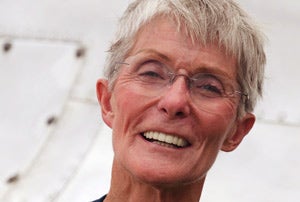
Martha Lunken

Martha Lunken is a lifelong pilot, former FAA inspector and defrocked pilot examiner. She flies a Cessna 180 and anything with a tailwheel, from Cubs to DC-3s.
Pilot in aircraft
Sign-up for newsletters & special offers!

Get the latest stories & special offers delivered directly to your inbox.

SUBSCRIBE