















Register

NASA’s X-59 May Be Days Away From Supersonic Flight

Agency says the experimental, quiet aircraft is expected to break the sound barrier in early June.

NASA X-59 supersonic research aircraft
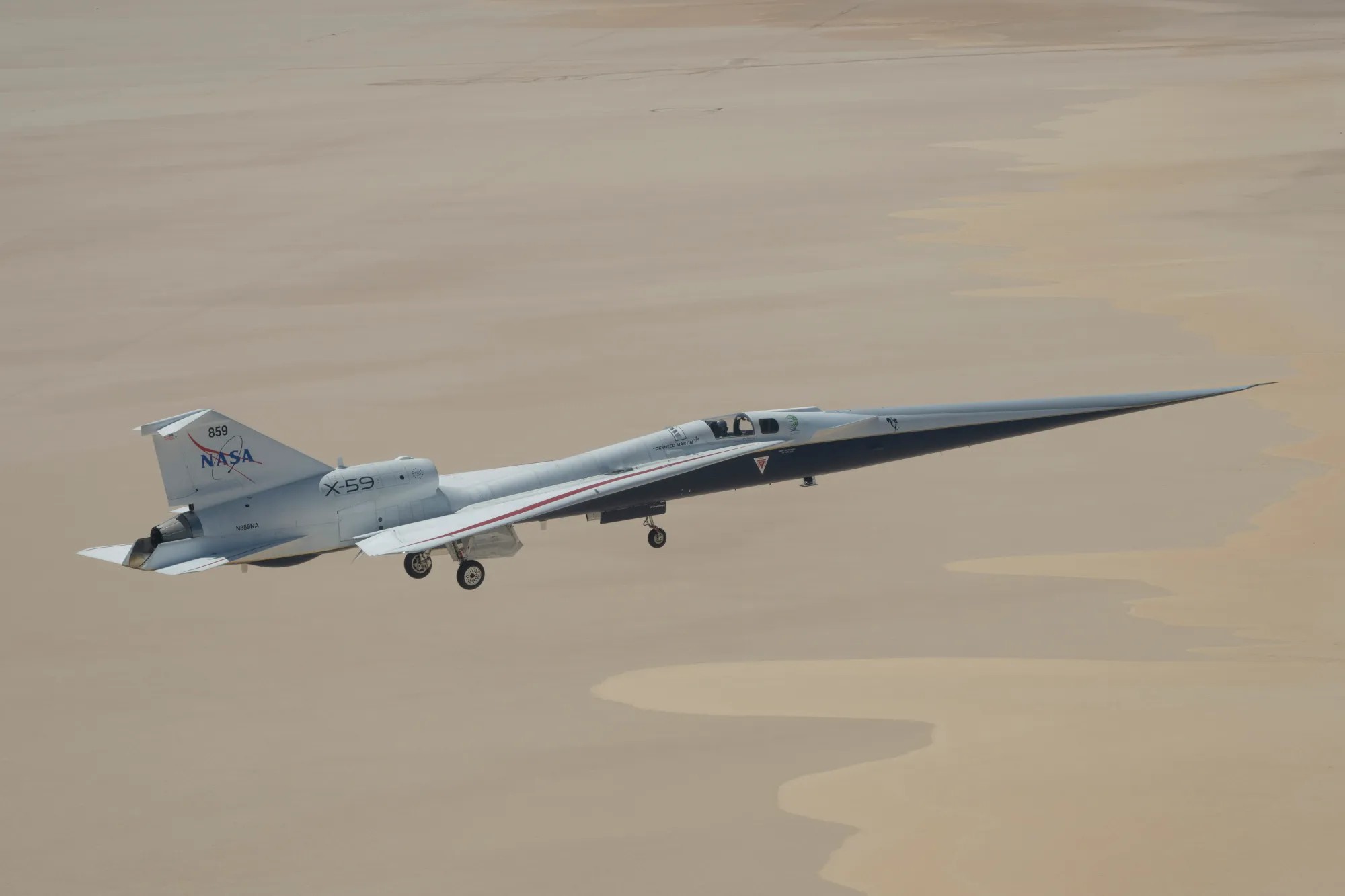
NASA’s X-59 quiet supersonic research aircraft flies over Rogers Dry Lake near Armstrong Flight Research Center in Edwards, California, on May 12, 2026. [NASA/Jim Ross]
Gemini Sparkle

Key Takeaways:

NASA and Lockheed Martin’s quiet supersonic X-59 could break the sound barrier for the first time in the coming days, the space agency said Thursday

NASA said it is targeting early June for the X-59’s first supersonic sortie, about seven months after its debut flight in October. The experimental aircraft’s long, slender nose and other unique features are designed to reduce the volume of sonic booms to a quieter sonic “thump,” akin to a car door shutting in the distance.


After an initial series of test flights that began in March, the X-59 has been undergoing scheduled maintenance in a hangar at NASA’s Armstrong Flight Research Center in California. It last flew May 12, per FlightAware, where it can be tracked under the tail number N859NA.

According to NASA, though, X-59 teams believe the aircraft is almost ready to meet the conditions required for a planned community noise survey—the culmination of the space agency’s Quiet SuperSonic Technology (Quesst) project. It plans to fly the aircraft at Mach 1.4 and 55,000 feet to gauge the responses of people below its path.

The results of the community survey will be shared with lawmakers and regulators to inform their development of rules for commercial supersonic flight over land, which the FAA has banned since 1973. A reversal of the ban could clear the way for a successor to Concorde that would be capable of transcontinental service—not just flight over open ocean.

What’s Next for the X-59?

Teams have made significant progress since the X-59’s debut in October and return to the skies in March following an earlier scheduled maintenance period.

Since then, NASA has completed 14 more flights, including the first with retracted landing gear. Researchers collected data and assessed the performance of fuel, hydraulics, environmental controls, structures, and behaviors during takeoff, landing, and flight.

They also gauged the aircraft’s eXternal Vision System, which replaces a traditional windshield with a digital monitor fed by external cameras. The X-59’s nearly 100-foot nose—designed to break apart shock waves—would otherwise block the pilot’s view. Another noise-cancelling feature is the model’s top-mounted F-18 Super Hornet engine, which gives it a smooth underside to prevent the merging of shock waves in its wake.

During the initial testing, the X-59 achieved a top speed of Mach 0.95 (about 625 mph) and altitude of 43,000 feet. Teams also conducted low-and-slow testing to study an array of different maneuvers, further expanding the envelope by putting it through different operational conditions. The aircraft had its first two-flight day on April 30, marking an important milestone for flight cadence.

NASA said Thursday that the X-59’s inaugural supersonic flight next month will reach 630 mph and 43,000 feet. After that will come a “mission conditions” flight that aims to meet the Quesst performance targets. The plane will ultimately achieve top marks of Mach 1.6 and 60,000 feet during this phase, but teams will continue to mix in subsonic and low-altitude demonstrations.

“Every step of envelope expansion brings us closer to demonstrating the quiet supersonic capability that is at the heart of the Quesst mission,” said Cathy Baum, project manager for NASA’s Low Boom Flight Demonstrator program. “Completing the first mission-conditions flight is especially meaningful—it’s the moment where we begin validating the aircraft in the environment it was designed for.”

All of the aforementioned activities fall under the first phase of the Quesst campaign and will not test the X-59’s noise-cancelling capability. In fact, the experimental aircraft will be accompanied by supersonic chase planes that generate their own booms, drowning out any sonic thumps it produces.

NASA will modify a pair of F-15 Eagles with life support systems that allow pilots to fly them as high as 60,000 feet. Engineers will equip them with a special probe designed to measure shock waves. NASA also chases with F/A-18s that are preferred for collecting imagery.

“Every flight has pushed the boundaries of what’s possible, steadily expanding the envelope and strengthening our confidence in the aircraft,” said Baum. “As we look ahead to the upcoming flights, we’re poised to open the envelope even further—moving boldly toward the mission test point this aircraft was built to achieve.”

Noise-cancelling capabilities are expected to be fully validated during Phase 2 of Quesst, which NASA said will come later this year. The X-59 will head to the supersonic test range at Edwards Air Force Base (KEDW) in California for conclusive measurements of its flight signature.

When—or if—NASA validates the aircraft’s quieter sonic thumps, its final task will be the community noise survey.

Per a notice published in the Federal Register this month, NASA plans to conduct up to five 30-day surveys in different areas of the contiguous U.S., each covering 1,000 respondents. The objective would be to collect 350,000 annual responses across a maximum of two surveys per year. The notice notes that responses may be collected up to six times daily, implying the X-59 would complete as many daily flights.

Jack Daleo

Jack is a staff writer covering advanced air mobility, including everything from drones to unmanned aircraft systems to space travel—and a whole lot more. He spent close to two years reporting on drone delivery for FreightWaves, covering the biggest news and developments in the space and connecting with industry executives and experts. Jack is also a basketball aficionado, a frequent traveler and a lover of all things logistics.

Ready to Sell Your Aircraft?

List your airplane on AircraftForSale.com and reach qualified buyers.

List Your Aircraft
AircraftForSale Logo | FLYING Logo
Pilot in aircraft
Sign-up for newsletters & special offers!

Get the latest stories & special offers delivered directly to your inbox.

SUBSCRIBE
