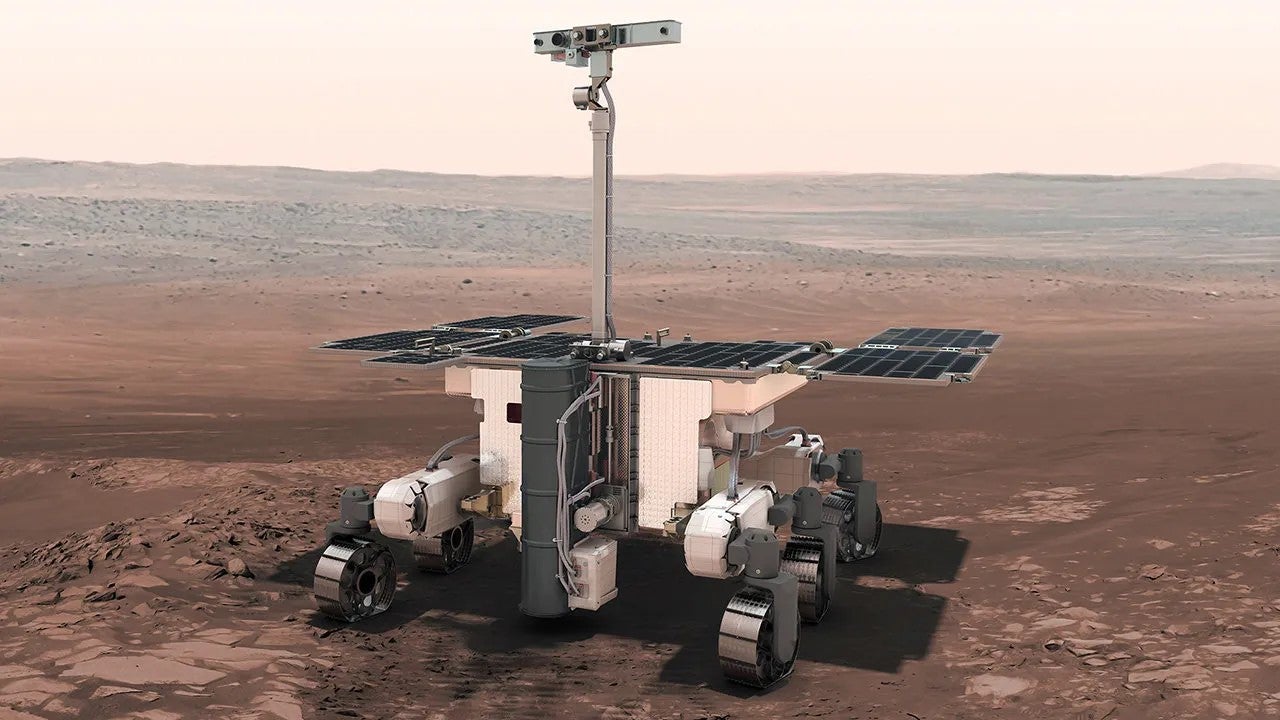
An artist’s concept depicts the Rosalind Franklin rover on Mars. [Courtesy: NASA]
Key Takeaways:
NASA and the European Space Agency (ESA) have formalized a new partnership for the ExoMars mission, aiming to land ESA's Rosalind Franklin rover on Mars by 2030 to search for signs of past and present life.
NASA's expanded contributions to the mission, following ESA's severed ties with Russia, include providing launch services, propulsion elements, a mass spectrometer component, and radioisotope heater units.
The Rosalind Franklin rover features unique capabilities, such as a drill that can bore 6.5 feet deep to collect samples and an onboard laboratory for autonomous analysis, furthering the agencies' collaborative Mars exploration efforts.
NASA and the European Space Agency (ESA) are joining forces to land an ESA rover on Mars as early as 2030.
NASA and ESA on Thursday signed a fresh memorandum of understanding (MOU) to launch the latter’s Rosalind Franklin rover to the Red Planet as early as 2028, bolstered by expanded U.S. contributions to the mission.
CREATE A FREE ACCOUNT
Sign up to keep reading
Create a free account to continue. Already a member? Sign in below.
Jack is a staff writer covering advanced air mobility, including everything from drones to unmanned aircraft systems to space travel—and a whole lot more. He spent close to two years reporting on drone delivery for FreightWaves, covering the biggest news and developments in the space and connecting with industry executives and experts. Jack is also a basketball aficionado, a frequent traveler and a lover of all things logistics.