











In a prederegulation court hearing with the Civil Aeronautics Board, Frank Borman, the CEO of Eastern Airlines and former Apollo 8 commander on the first lunar orbit mission, was taking Delta Air Lines to task in the early 1970s in an effort to sway the judge from awarding the airline nonstop authority from Boston to Atlanta. Eastern was claiming that Delta was siphoning customers away from its established nonstop route.
As part of its argument, Borman’s legal team claimed that passengers weren’t being given the option of Eastern’s direct flight when calling Delta reservations. An experienced reservation sales agent testifying suggested the judge simply call the reservation number. Without prompting, the reservations agent that answered the judge’s call offered Eastern Airlines’ option of a nonstop flight first and then Delta’s connection option. Borman wiped the egg off his face.
If you're not already a subscriber, what are you waiting for? Subscribe today to get the issue as soon as it is released in either Print or Digital formats.
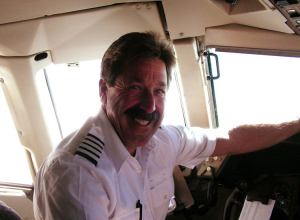
Subscribe NowThe experienced reservations sales agent supervisor that testified was Rob Moser. In 1972, fate had brought him through the proverbial side door of the airline at age 25. Despite being discouraged by management in attempting to fulfill his dream of being hired into the cockpit from within the company, he persevered. It ranks as one of the most unorthodox airline pilot career stories I’ve ever heard.
My introduction to Moser was also unorthodox. In the May 2025 Issue 958 of Jumpseat, I had mistakenly repeated an accepted 40-year-old rumor that the psychologist who was industry-infamous for conducting a phase of the Delta pilot interview process that involved a rocking chair had committed suicide. In a phone call made for the purpose of correcting me, Moser adamantly disagreed, conveying that Dr. Sidney Q. Janus died of heart failure on February 10, 1986. I located the obituary online verifying that fact. My apologies to the family and friends of Janus.
- READ MORE: Eco-Friendly Aviation: Look Mom, Engine-Free Airplane Taxi
- READ MORE: Checklist Challenge: Flight Crew’s Successful Mistake Really Wasn’t
Aside from occasional trips to Idlewild Airport (now KJFK) at age 3 that peaked his fascination, Moser’s addiction to aviation began at 17 when he was attending night school at Rutgers University. A professor offered him a ride in his single-engine Comanche.
Thereafter he was hooked and began flight instruction in a J-3 Cub at the now extinct Hadley Airport in New Jersey—the first transcontinental airmail launch site in the New York area. His instructor didn’t quite live up to professional expectations, so Moser continued his training at the now-defunct airport in North Brunswick, New Jersey, flying an Aeronca Champ.
After a brief stint of flight instruction at nearby Solberg Airport (N51) in New Jersey, it was recommended to Moser that he continue his training in Panama City, Florida. Through the assistance of his flight instructor, he proved to reluctant parents his seriousness in pursuing an aviation career path. Both his parents and a benevolent uncle agreed to help finance the endeavor.
Meanwhile, with the possibility of being drafted for the Vietnam War, he joined the Army Reserve and was fortunate that his fluency in German was enough of a military asset to keep him out of the jungle.
An opportunity to gain additional flight time experience as an instructor paid for Moser’s continuing education at Auburn University in Alabama. His other miscellaneous endeavors, in no particular order, were flying for an aircraft leasing company in California, working briefly as a line boy at the Dekalb-Peachtree Airport (KPDK) in Georgia, and then flying an occasional multiengine trip as a copilot. Moser also had a brief stint at World Airways, working for the senior vice president of ground ops and passenger service as an administrator assistant.
In 1967, Moser interviewed and was hired by Southern Airways for a pilot position at the carrier’s associated commuter airline, but unfortunately fate dealt another hand. The aftereffects of an accident involving one of its Beech 99s at Hartsfield-Jackson Atlanta International Airport (KATL) canceled his employment opportunity.
When Delta announced openings for part-time reservation sales agents in 1972 because of increased demand for north-south flights after the Northeast Airlines merger, Moser saw an opportunity to get his foot in the door. He quickly advanced past agent status into a supervisory role within the marketing department. He said he received accolades from company leaders and customers alike, which later worked to his advantage in his pilot pursuit.
Because of Moser’s understanding of airline reservation systems, he was recruited as a cofounder for Southeastern Commuter Airlines in 1973. More importantly, he exploited the opportunity to maintain his flight-time currency, flying as a copilot in a Britten-Norman BN-2 Islander.
In January 1977, after four years of no hiring at Delta, Moser was finally interviewed for a pilot position. Approximately 100-130 employees from other departments participated. Up to that point, less than 2 percent had nonmilitary backgrounds. Moser was one of three in-house employees who made it through a highly scrutinized interview process.
After becoming an airline pilot, out of respect for his fellow Delta agents, Moser would often leave ops at least 30 minutes early to talk with his former colleagues, knowing they were envious of his success. The B-727, B-737, B-767, B-757, B-777, DC-9, MD-80, MD-11, and L-1011 were all part of Moser’s repertoire. In addition to being captain on most of these airplanes, he was also a check airman.
Nearing the mandatory retirement age of 60, in September 2005 a company attorney friend hinted that Delta was on the precipice of declaring bankruptcy. At 58 he decided it was best to retire ASAP in order to retain his pension. It didn’t matter. He suffered the same consequences as his colleagues, wiping out almost all of his retirement funds.
Because Delta was losing qualified pilots on the B-777, a backdoor provision allowed Moser and others to return as contract captains. He remained on the payroll through December 2005 until the Air Line Pilots Association’s protests got louder.
In retirement, Moser has worked for an Orlando, Florida, training facility as a B-757, B-767, and B-777 simulator instructor, also taking on the role of DPE. Within the same time period, he was recruited by Jet Airways as a “senior commander,” employed for 3.5 years, and he flew for the airline in India. As part of a wet lease agreement, he also flew for Turkish Airlines in Turkey and Gulf Air in Bahrain.
Boeing recruited Moser as an instructor and examiner for Korean Air. He spent six years in Incheon, South Korea, commuting three weeks on and three weeks off. For two years, his last employer had him flying a B-777 Business Jet for a billionaire.
At some point, Moser connected with Kit Darby, the guru of airline pilot hiring. He has been interview-prepping aspiring professional pilots for 20 years, claiming a 95 percent success rate for about 600 candidates.
Moser’s parents escaped the advancing tyranny of Nazi Germany in 1937. It seems he inherited their courage, perseverance, and tenacity. He demonstrated his own courage in having successfully battled cancer. No doubt the story won’t end there.
In an age where many aspiring pilots have their career path predetermined from the very first flight lesson, it’s important to remember this wasn’t always the case. Like Moser, some of us had to walk uphill to the airport in a snowstorm both ways before we were hired.
This column first appeared in the October Issue 963 of the FLYING print edition.



